
Faculty of Social and Cultural Sciences

Europa-Universität Viadrina Frankfurt (Oder) / Heide Fest
Study in the field of cultural studies
Studying cultural and social sicences at the Viadrina means interdisciplinary research and teaching in the heart of Europe. The aim of all Bachelor's and Master's programmes is to enable students to discover new perspectives. In the interplay between various academic disciplines in the cultural and social sciences, you will search for answers to fundamental questions about the nature of identity, culture and society as well as how to deal with the multiple transformation processes of our time.
Internationality and multilingualism are key features of all degree programmes at the Faculty of Social and Cultural Sciences. Therefore, learning foreign languages and a stay abroad at one of our numerous partner universities in Europe or non-European countries are not only possible, but even a mandatory element in some of our degree programmes.
We also attach particular importance to a good learning atmosphere in small classes and to linking research and teaching.
Qualifications and career opportunities
Thanks to the interdisciplinary, international and practice-oriented focus of the programmes, our graduates are well prepared for work in various professional fields in Germany, Europe and the world. In addition to specialist knowledge, they acquire the ability to think in a networked way, quickly analyse new topics, take different perspectives and develop solutions for complex issues.
This profile qualifies our graduates for various professional fields, such as:
- Academia
- Cultural and project management
- Educational work (e.g. political and cultural education)
- Journalism, press and public relations
- Marketing
- NGOs
- Political, economic and HR consulting, coaching
- Politics and administration
Bachelor programmes
An interdisciplinary bachelor's degree programme in English and German that provides knowledge in the fundamentals of social and cultural sciences and in two of three individually chosen subject areas (EUROPE/S - MEDIA - DIFFERENCE).
If knowledge of the German language is not available at the beginning of the programme, it will be acquired in the course of the programme.
- Main course language: German
- Open admission
- Application for the 1st semester in the summer semester
- Application for the 1st semester in the winter semester
- Duration of study: 6 semesters
Understanding and shaping society
Societies across Europe and the globe are increasingly defined by persistent conflict, rapid change, and complex challenges. To achieve successful coexistence, we must develop solutions that draw on diverse perspectives and account for varying cultural and social contexts.
The Culture and Society programme provides you with the in-depth knowledge and practical skills needed to understand the histories, structures, and ideas shaping today’s world. You will develop sharp critical thinking skills and learn to make informed judgements regarding complex cultural and social processes.
By cultivating a deep understanding of these cultural foundations and critically examining established modes of thought, you will be empowered to devise innovative solutions that transcend conventional boundaries. In doing so, you will be uniquely prepared to tackle the most pressing societal challenges of our time.
Career prospects
The Culture and Society programme equips you for both an immediate professional career and continued academic progression, such as a Master’s degree. Your undergraduate studies provide a strong foundation for postgraduate specialisation in the following disciplines:
- History
- Literary studies
- Social sciences
- Linguistics
- Media studies
Furthermore, the programme prepares you for a wide range of professional roles within national and international sectors, including:
- Cultural institutions and projects, museum curation and exhibition management
- Educational institutions, including lifelong learning, cultural and civic education
- European and international organisations
- Foundations and NGOs
- Public relations, media and journalism
- Politics and public administration
- Research and academia
- Tourism
An interdisciplinary course of study in law, political science, and cultural studies that examines the foundations of the legal and political order of modern states and societies and their international interconnections.
Read more...Roman Boichuk
Daniel Rudolph
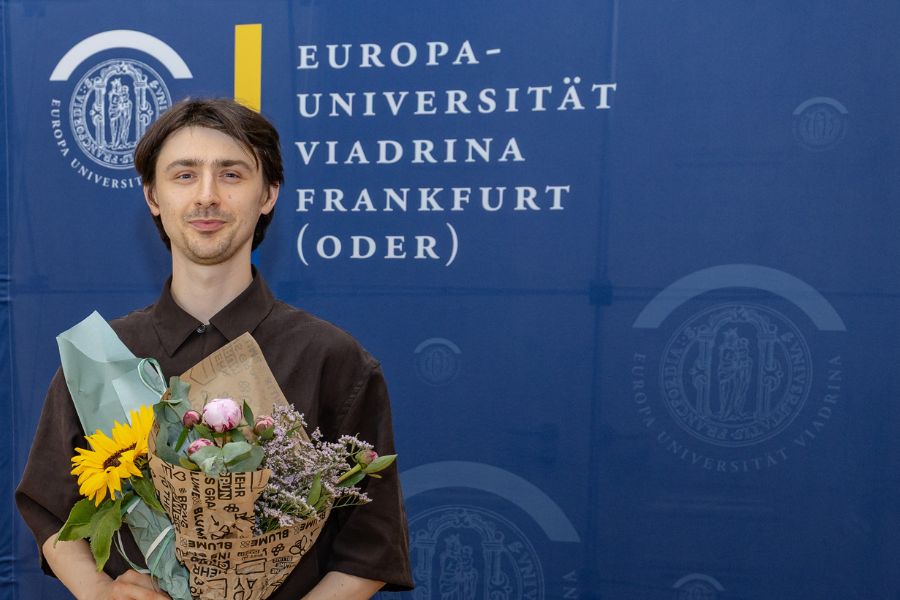
My time as a student at the Faculty of Social and Cultural Sciences has taught me three things in particular: 1) the courage to follow my own path, 2) to remain curious and ask questions, 3) to think critically and be open to new perspectives and people.
Roman Boichuk, works in the Collections, Access and Digitisation Department at the Frankfurt (Oder) Municipal Archives
Master programmes
- Main course language: English, German
- Open admission
- Application for the 1st semester in the summer semester
- Application for the 1st semester in the winter semester
- Duration of study: 4 semesters
International, transregional, and interdisciplinary: studying Central and Eastern Europe in the heart of Europe
Are you fascinated by the history and culture of Central and Eastern Europe? Would you like to explore the social and cultural characteristics, connections, and interdependencies within this diverse and dynamic region from different perspectives?
The Master’s programme in Central and East European Studies at European University Viadrina offers in-depth knowledge of the diverse cultures, societies, history and literature of Central and Eastern Europe. In a unique way it pairs the regional focus on Central and Eastern Europe with a cultural studies perspective.
Additionally, you have the option to earn one of two double degrees: The Polish-German double degree in “German Literature in a European Context” in partnership with Uniwersytet Jagielloński in Kraków or the Romanian-German double degree in “German Literature in a European Context” with Babeș-Bolyai University in Cluj-Napoca.
Career prospects
The Central and East European Studies programme trains you for both starting your professional career or pursuing further academic studies. It prepares you for the following professional fields in a national or international context:
- Cross-border cultural work
- Extracurricular education
- Foreign Office
- Heritage education
- Media, journalism, and public relations
- Museums and archives
- Non-governmental organisations
- Publishing houses
- Research and academia
- Specialised regional departments in parliaments, ministries and interest groups
- Main course language: English
- Open admission
- Application for the 1st semester in the winter semester
- Duration of study: 4 semesters
Designing change: Working through conflicts to shape democratic futures
The interdisciplinary Master’s programme Conflict and Democracy combines political science and legal studies with practical conflict research. As a student, you will gain comprehensive theoretical, and hands-on expertise in conflict resolution, dialogue facilitation, negotiation, mediation and decision-making. This programme trains you to adeptly analyse and navigate conflicts within democracies and between democratic and authoritarian entities. This enables you to actively influence and shape societal negotiation processes, preparing you for a dynamic career in today’s complex political landscape.
Career prospects
The Conflict and Democracy programme trains you for both starting your professional career or pursuing further academic studies. It prepares you for the following professional fields in a national or international context:
- Academia and science communication
- Civic education
- Conflict mediation, conflict management, and municipal (conflict) consulting
- Diplomacy and international cooperation
- Media, publishing, communication and public relations
- Non-governmental organisations, foundations, trade unions and advocacy groups
- Political and organisational consulting
- Politics and administration
- Main course language: English
- Restricted admission
- Application only for the winter semester
- Duration of study: 4 semesters
Master of Digital Studies: Interdisciplinary Perspectives on Digital Technologies, Media and Society
Platforms structure public debates, algorithms influence political processes, AI systems intervene in work and everyday life - digital technologies are fundamentally changing societies. They are changing the way we live together in Europe and around the world - at a time characterised by armed conflicts, the climate crisis, geopolitical power shifts and polarised debates. Understanding and shaping these interrelationships requires critical, theoretically informed thinking across disciplinary boundaries.
The Master's degree programme in Digital Studies enables you to analyse and critically question the interactions between digital technologies, media, culture and politics. You will acquire theoretical knowledge and methodological skills from Science & Technology Studies (STS), Media Studies and Communication Studies, supplemented by perspectives from Cultural Studies, Law and Economics.
The interdisciplinary approach of the fully English-language programme prepares you for research in academia as well as for knowledge-based activities in politics, civil society, media and technology companies.
Career prospects
As a graduate of the Master of Digital Studies, you will have knowledge and skills that qualify you for an academic career. This includes doctoral studies and research-oriented work at universities, research institutions, cultural organisations, civil society organisations, think tanks and other knowledge-based organisations.
In addition to academic training, the Master of Digital Studies qualifies you for responsible activities in digital transformation processes that involve changes in social, media, economic and political areas. You will acquire knowledge and methods that will enable you to understand, critically categorise and actively shape complex interrelationships and interactions between digital technologies and media, culture and politics. The degree programme also qualifies you for activities in national and international fields of work, including science and technology communication, digital and technology policy, knowledge and technology transfer in companies.
Learn moreThe Master of Digital Entrepreneurship (MoDE) is an interdisciplinary, project-based degree program offered by the European New School of Digital Studies (ENS). The English-language program deals with digitalization from the perspective of law, economics, social sciences and computer science and offers the possibility of a German-Polish double degree. In six module groups, students are taught theoretical and practical methods to develop and reflect on their own entrepreneurial solutions to the challenges of digital transformation in Europe.
Read more...From four central areas - culture, politics, law and economics - courses are offered in English, French, Polish and German by the various faculties.
Read more...- Main course language: English
- Open admission
- Application for the 1st semester in the summer semester
- Application for the 1st semester in the winter semester
- Duration of study: 4 semesters
Understanding and shaping the connections between language, media and society
The Master’s degree programme in Language and Media Studies combines critical media studies with culturally oriented research on language use. It imparts methods, theories, and practical approaches from linguistics as well as film and media studies. During your studies, you will develop the skills needed to analyse and critically engage with audiovisual, digital, and linguistic phenomena – from AI and social media to film and video games. This will enable you to deal with the complex media landscape of our time.
You will have the option to pursue the international double degree in “Multimodality – Discourse – Media” in collaboration with Université Sorbonne Nouvelle – Paris 3 as part of this programme.
Career prospects
The Language and Media Studies programme trains you for both starting your professional career or pursuing further academic studies. It prepares you for the following professional fields in a national or international context:
- Coaching, especially in intercultural environments
- Communication and writing consultancy
- Communication in public institutions and companies
- Higher education management
- Information design
- Marketing
- Project management
- Public relations and journalism
- Publishing houses
- Research and academia
- Social media management
Continuing education (4 semesters, qualified practical professional activity of at least one year, fee required).
The course of studies "European Cultural Heritage" presents an overall profile of the knowledge, skills and competences relevant in the protection of cultural property / preservation of historical monuments and in the management of cultural property.
Read more...- Main course language: English, German
- Open admission
- Application for the 1st semester in the summer semester
- Application for the 1st semester in the winter semester
- Duration of study: 4 semesters
Understanding, criticising and changing society
The Master’s programme in "Social Studies: Crises, Culture, Critique" combines social science theories and empirical social research methods with perspectives from social and cultural philosophy, as well as critical studies in art, media and history. You will acquire the theoretical foundations, comprehensive specialist knowledge, and practical skills needed to explore, understand, and critically analyse the social and cultural challenges confronting our societies. Consequently, you will be prepared to develop solutions for coexisting in communities based on critique of power, democracy, human rights, social justice and ecological responsibility.
You will have the option to pursue the international double degree in “Sciences sociales et culturelles” through a partnership with the Université Paris 8 Vincennes – Saint-Denis as part of the programme.
Career prospects
The "Social Studies: Crises, Culture, Critique" programme trains you for both starting your professional career or pursuing further academic studies. It prepares you for the following professional fields in a national or international context:
- Cultural institutions and publishing houses
- Development cooperation
- Equality and anti-discrimination work
- Extracurricular and continuing education
- Media and journalism
- Non-governmental organisations, foundations, associations, political parties, and trade unions
- Research and academia
- Political consulting
- Public relations
- Social services and public administration
- Main course language: German, French, English
- Open admission
- Application for the 1st semester in the winter semester
- Duration of study: 4 semesters
The programme
As a student of the Franco-German double degree “Philosophie et études culturelles / Philosophie und Kulturwissenschaften” (Philosophy and Cultural Studies), you will obtain a Master’s degree in literature (European University Viadrina) and philosophy (Université Paris 1 Panthéon-Sorbonne) in four semesters. You will start your studies at Viadrina in Frankfurt (Oder) and continue in Paris 1 in your second year.
The programme analyses the complex interplay of rhetorical, aesthetic, medial, and material practices. You will investigate European literatures and philosophies within their specific contexts of reception and interaction. The goal is to explore aesthetics, literature, and philosophy in a cultural theory perspective.
Career prospects
The programme is research-oriented and provides the foundation for doctoral studies or other highly skilled academic professional practice (publishing, media, cultural institutions).
Read more...Annemarie Kelpe
René Matschkowiak
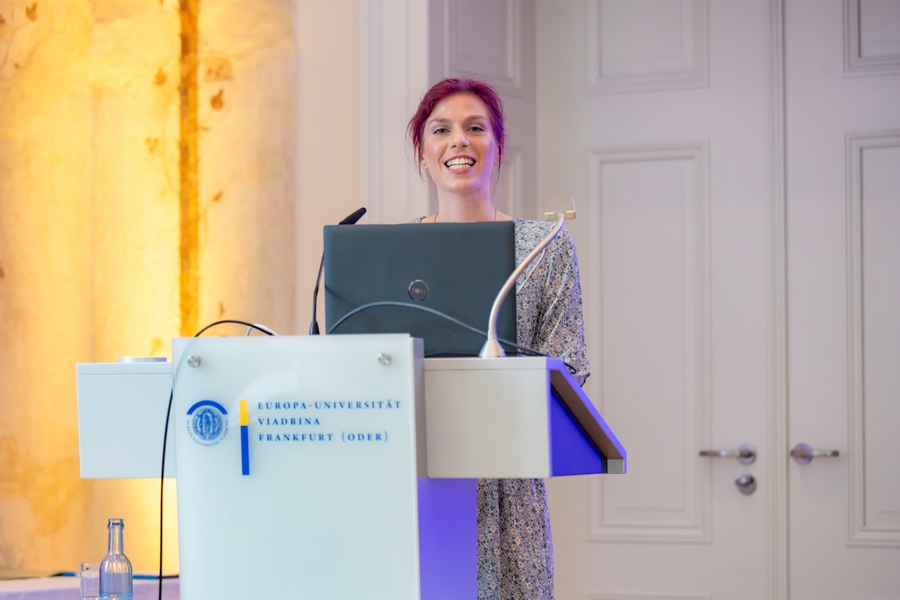
Kultur und Geschichte Mittel- und Osteuropas (Culture and History of Central and Eastern Europe) was the perfect choice for me. After completing my bachelor’s degree in Intercultural Communication in Chemnitz, I wanted to delve deeper into history and Eastern Europe – subjects that had completely fascinated me during my semester abroad in Poland. This programme allowed me to focus entirely on these areas, which was a real highlight for me.
Annemarie Kelpe, project assistant at “DenkMal! The Mülsen–Eibenstock Death March 1945” (Alter Gasometer e.V., Zwickau)
Doctoral studies
At the Faculty of Social and Cultural Sciences, you have two options to obtain the academic degree "Doctor of Philosophy" (Dr phil): The classical individual doctorate and the International Doctoral Programme in Cultural and Social Sciences.
Learn more
Links & Contacts

Heide Fest