
Researchers
Erasmus+ STA Teaching (EU+)
During an Erasmus+ teaching mobility (STA) in programme countries (EU+) you can take part in one of our partner universities and discuss teaching content and methods that can benefit your teaching at Viadrina. Furthermore, you will strengthen the European dimension of the partner university, enrich its academic programme and share your expertise with students who do not wish to or are unable to study abroad.


Who is eligible for funding?
- Professors and lecturers with a contractual relationship with Viadrina
- PhD students involved in teaching
- Teaching staff without compensation
- Contract lecturers at Viadrina
- Research assistants
- Professors emeritus and retired lecturers
What is funded?
- Funding is available for visiting lectureships at Viadrina’s partner universities under the Erasmus+ programme countries.
- Teaching placements at non-partner universities are also possible, provided that a cooperation agreement has been concluded beforehand – please contact us well in advance regarding this.
- The host country must not be the country of your own main residence.
We share current opportunities in the Moodle course.
Even if you are generally interested in an Erasmus+ mobility programme but cannot find a suitable opportunity on your own, please feel free to contact us!
Duration of funding & teaching activities
- Stays of at least 2 to a maximum of 14 days (excluding travel days) are eligible for funding. In justified exceptional cases – subject to available funds – funding may be granted for up to 60 days (excluding travel days).
- The teaching load is at least 8 hours per week (5 days) or for shorter stays. For stays of more than one week, the minimum number of hours for additional days is calculated as follows: 8 hours divided by 5 days, multiplied by the number of additional days.
In the case of combined staff mobility (STA teaching and STT continuing education), the teaching load may be reduced to 4 hours per week.
You can only apply for funding under the Erasmus+ Mobility Programme via Viadrina. It is not possible to apply directly to the European Commission or the DAAD.
Application deadline
- There is no fixed application deadline; applications may be submitted at any time. Funding is provided on an ongoing basis and depends on available funds as well as the number of applications.
- We recommend contacting us at an early stage, ideally around 2 months before the start of your mobility period. Later applications may also be considered, provided that funds are still available.
- Once your application has been approved, you will receive all Erasmus+ documents and will be guided step-by-step through the application process.
Erasmus+ documents
We will send you the necessary documents once your funding has been approved. The following list of documents is provided for reference only:
- Mobility Agreement for Teaching or Teaching and Training (completed and signed by you, the host institution and us)
- Cost breakdown for accommodation and travel expenses
- Business travel authorisation
- A1 certificate (for your records only)
- Grant Agreement (signed by you and by us)
- If applicable Declaration of Honour on green travel (signed by you)
- Letter of Confirmation (signed by the host institution)
- EU Survey (You will receive the link by email directly from the EU Beneficiary Module).
Please note: Only digital documents (PDFs sent by email) will be accepted. Paper documents will not be accepted.
Information on funding
Erasmus+ funding for Staff Mobility for Teaching (STA) consists of several components:
(1) Daily Rate (depending on country group and duration of stay)
(2) Travel Grant (depending on distance and mode of travel: ‘Green’ or Standard)
(3) If Applicable: Additional Funding for Travel Days
(4) If Applicable: Special Grants (for participants with a disability, a chronic illness or when travelling with a child)
As university staff funded by Erasmus+ grants should not be better off than staff funded from the university budget, we base our calculations not only on your cost plan (accommodation and travel costs) but also on the Federal Travel Expenses Act. When calculating the funding rates, therefore, zero-grant days (days without funding/daily rate) may be taken into account. Any excess funding must be declared for tax purposes.
(1) Daily Rate
- The daily rates are divided into three country groups and are valid up to the 14th day of the stay. From the 15th to the 60th day, funding amounts to 70% of the daily rate.
- Funding is available for stays of at least 2 and up to 14 days (excluding travel days).
In justified cases and subject to the availability of funds, funding for up to 60 days (excluding travel days) is possible.
Projects 2025 and 2026
Country Group 1 – €180 per day (up to day 14; from day 15–60: €126 per day)
Belgium, Denmark, Germany, Finland, France, Ireland, Iceland, Italy, Liechtenstein, Luxembourg, the Netherlands, Norway, Austria, Sweden
Country Group 2 – €160 per day (up to day 14; from day 15–60: €112 per day)
Estonia, Greece, Latvia, Malta, Portugal, Slovakia, Slovenia, Spain, the Czech Republic, Cyprus
Country Group 3 – €140 per day (up to day 14; from day 15–60: €98 per day)
Bulgaria, Croatia, Lithuania, North Macedonia, Poland, Romania, Serbia, Turkey, Hungary
(2) Travel Grant
- The calculation is based on the European Commission’s distance calculator based on the distance between the point of departure and the destination.
- The amounts specified apply as a one-time total for the outward and return journey.
Projects in 2025 and 2026
- 10–99 km: €28 (Green Travel: €56)
- 100–499 km: €211 (Green Travel: €285)
- 500–1,999 km: €309 (Green Travel: €417)
- 2,000–2,999 km: €395 (Green Travel: €535)
- 3,000–3,999 km: €530 (Green Travel: €785)
- 4,000–7,999 km: €1,188 (Green Travel: €1,188)
- from 8,000 km: €1,735 (Green Travel: €1,188)
Sustainable travel – “Green Travel”
- "Green Travel" applies if you use for at least half of your journey (50% or more) low-emission means of transport (e.g. train, bus, bicycle or carpooling; travel by ship is only green, if combined with green means of transport or if no green alternatives are available).
- With Green Travel, you receive higher travel grants and additional travel days.
We would like to encourage you to choose sustainable travel options for your journey. Of course, journey times by train and bus are sometimes significantly longer than when travelling by air. On the other hand, you won’t need a luggage scale and you’ll have the opportunity to break your journey into stages, allowing you to get to know the places between our university and your host institution.
Further information:
Exceptional Costs for Expensive Travel
- Exceptional travel costs may be funded if it can be demonstrated that the standard travel grant covers less than 70% of the actual costs.
- In this case, up to 80% of the actual travel costs may be covered.
- If approved, the standard travel grant does not apply.
(3) If Applicable: Additional Funding for Travel Days
- For standard trips, up to 2 travel days may be funded.
- For Green Travel, up to 4 additional travel days (a maximum of 6 in total) are possible, and you will also receive a higher travel grant.
(4) If Applicable: Special Grants
- Additional funding is available for participants with a disability, a chronic illness or for stays abroad with a child.
- The application for actual costs will be submitted on your behalf via Viadrina.
- The maximum funding amounts to up to €15,000 per mobility period.
Further information can be found on the DAAD website.
Before Your Stay Abroad
- Check the requirements and find a host institution
- Request confirmation of funding from the Division of International Affairs
- Complete the Mobility Agreement, have it signed by the host institution and submit it by email (PDF)
- Prepare a cost breakdown for travel and accommodation costs and submit it by email
- Submit a business travel request, download a PDF of the approval from the portal (via ‘print’) and submit it by email
- You will receive a pre-filled Grant Agreement from us; please check and sign it, then return it by email
- If applicable, apply for an A1 certificate for your own records (for business trips only)
- Book your travel and accommodation; sustainable modes of transport are recommended and are supported with a higher travel grant and, if applicable, additional travel days
- If applicable, take out any additional insurance, e.g. international health or third-party liability insurance (Note: The Erasmus+ mobility grant does not include any insurance cover. If the Erasmus+ mobility takes place as part of a confirmed business trip, only the statutory accident insurance for full-time Viadrina staff applies, even abroad)
Once all documents have been received, 70% of the grant will be paid out.
During Your Stay Abroad
- Get the Letter of Confirmation signed by the host institution
- If necessary, collect receipts (invoices, tickets, etc.) for your own records for your tax return or as evidence for the voluntary declaration on sustainable travel
After Your Stay Abroad
- Submit the Letter of Confirmation as a PDF via email
- Complete the EU Survey (online participant report); you will receive the link via email directly from the EU Beneficiary Tool
- If applicable, keep any supporting documents for sustainable travel for 5 years yourself
- If applicable, declare any surplus mobility grant as income on your tax return, or conversely, declare any additional costs incurred
Once all documents have been received, 30% – the remaining grant – will be paid out.
Note on Online Language Support (OLS)
Online Language Support (OLS) is available via the EU Academy platform to all university members undertaking a period of study abroad as part of the Erasmus+ programme. You can voluntarily take language tests and online language courses before, during and after your stay. The service currently covers 24 languages.
- Go directly to the EU Academy.
- A guide and the Help Centre of the European Commission are available to assist you with any queries.
Erasmus+ STT Training (EU+)
Staff mobility under Erasmus+ for further training and professional development (STT) in programme countries (EU+) offers a range of benefits: You can exchange ideas at a professional level and gain new perspectives on your work. It allows you to experience the diversity of the European higher education landscape and gain fresh insights into your field from different perspectives. In this way, you strengthen and expand your skills and can deepen your professional networks. Last but not least, you will gain valuable international experience and practical skills that are essential for your professional development.
Erasmus+ with partner countries (outside the EU)
The Erasmus+ KA107/171 programme enables the expansion of existing student and staff mobility to countries outside the European Union (so-called partner countries). The expansion of regular Erasmus+ mobility to these countries serves to deepen academic cooperation between Viadrina and its partner universities in Ukraine, Georgia, Kosovo and Guinea.
Who can be funded?
University staff from all sectors can be funded under the Erasmus+ programme. This activity promotes the professional development of university teachers and other university staff through training activities abroad (other than conferences*) and work shadowing at a partner university or relevant institution abroad.
Examples of areas with eligible university staff:
- General & technical administration
- Library
- Faculties
- Faculties
- Finance
- International Office
- Public Relations
- Student Counselling
- Technology & Transfer
Examples of the continuing education formats:
- Further education
- Hospitation
- Job shadowing
- Study visits
- Participation in workshops and seminars
- Participation in language courses
There are various training programmes that you can find out about online.
*Additional information on funding for conferences: If it can be proven that new and innovative learning and teaching practices are acquired during the mobility, the activity of the participant during the event plays a subordinate role in terms of eligibility for funding. The type of event is more important: participation is not eligible if it is only dedicated to a specific discipline.
Possible places of stay
The stay must take place at one of the partner universities in Ukraine, Georgia, Russia or Kosovo.
Duration of stay
Stays abroad last at least 5 days and a maximum of 2 months.
There is no application deadline for participation in the Mobility with Partner Countries programme (KA107/171). Whether funding can be granted depends on the budget available and the number of applicants. If you are interested, please contact us directly, preferably with a 3-month lead time. As soon as you have our approval, you can submit the funding documents.
During the mobility
On the basis of the grant agreement, up to 100% of the allocated mobility grant is paid out.
The stay abroad must be confirmed by the host university on site. For this purpose, the Confirmation of Stay must be completed and signed by the host university.
After your return
After your return, you have 30 days to submit both the Confirmation of Stay to Viadrina International Affairs and to complete the report required by the EU (Online Participant Report). The link will be sent to you automatically from the EU database. If you do not complete the report within 30 days, the EU reserves the right to reclaim the amount already paid to you.
Mobility grant for further education and training
- A grant is paid out for training and further education stays to cover additional costs incurred during the stay.
- Employees with disabilities can apply for special funding.
- Weekends and holidays can only be subsidised if it can be proven that work or travel took place on these days (e.g. through confirmation from the host university).
- As travellers who are financed via a third-party funded project should not be in a better position than travellers who are financed from budget funds, any losses incurred must be claimed for tax purposes.
Amount of the mobility allowance
The amount of the mobility allowance is based on the following fixed rates:
- Amount up to and including the 14th day of the stay: 180 euros / day
- Amount from the 15th day of funding of the stay abroad: 126 euros / day
In addition to these daily rates, there is a flat-rate travel allowance depending on the actual distance between the place of departure and destination of the stay abroad, which is determined using a standardised calculation tool worldwide. The following amounts are reimbursed depending on the stay and the distance:
- 10 km - 99 km: 20 EUR
- 100 km – 499 km: 180 EUR
- 500 km – 1,999 km: 275 EUR
- 2,000 km – 2,999 km: 360 EUR
- 3,000 km – 3,999 km: 530 EUR
- 4,000 km – 7,999 km: 820 EUR
- 8,000 km and more: 1,500 EUR
- Mobility Agreement for Training
- Grant Agreement
- Letter of Confirmation for Training
Erasmus+ Blended Intensive Programmes (BIP)
“Blended Intensive Programs (BIPs) offer teachers and learners new and creative opportunities for international educational cooperation and participation in jointly designed courses” (DAAD).
In the new generation of the Erasmus+ program (2021-2027), the opportunities for studies abroad have been greatly expanded once again and supplemented with digital and hybrid elements, among other things. The development of transnational and interdisciplinary curricula and innovative learning and teaching methods is to be promoted, including online collaboration (e.g., COIL – Collaborative Online International Learning), research-based learning, and challenge-oriented approaches with the aim of tackling social problems.
In this context, there are so-called “Blended Intensive Programs” (BIPs), which enable universities and their departments to develop and implement international mobility formats and learning activities for students as well as for academic and administrative staff in collaboration with partner universities.
What are Blended Intensive Programmes (BIP)?
BIPs are short physical learning, teaching and training programmes for students (5-30 days) combined with a compulsory virtual phase (collaborative online learning exchange) of undefined duration. The physical activity should preferably take place at a foreign partner university or be subject-specific with an institution affiliated with the university.
What is the aim of a Blended Intensive Programme (BIP)?
To organise short, intensive mobility periods and activities with international partner universities, using innovative learning and teaching methods, including online collaboration (Collaborative Online International Learning). The intensive programme should have added value compared to existing courses or training, e.g. by BIPs aiming to build transnational and transdisciplinary teams, facilitate joint work on global challenges (e.g. related to UN SDGs) or enable flexible mobility opportunities for students with different backgrounds and fields of study and in all study cycles.
Framework conditions of the Blended Intensive Programmes (BIPs)
- Collaboration/project between European University Viadrina and at least two other universities from different program countries.
- At least 10 mobile participating students; excluding teachers.
- Workload of the project/seminar/course of at least 3 ECTS.
- Physical stay of all BIP participants at the same time at the same physical location for 5-30 days.
- Mandatory virtual component before, during, or after physical mobility (no specified duration)
- Added value of the BIP compared to existing programs or courses
- Optional: Cooperation with other universities and/or organizations from program or partner countries (third countries)
- Optional: Additional participation of self-paying students possible
New call for proposals for the funding of 2 BIPs!
The call for proposals is currently open. It is aimed at all teachers/researchers at the European University Viadrina.
The deadline for submitting the proposal outline was January 31, 2026. There is currently no deadline; BIP applications may be submitted starting now. Please send your application, including the project outline, to short-term@europa-uni.de.
Click here to download the project outline.
Click here to download the information sheet “How do I plan a BIP?”
BIP applications can now be submitted.
If you have any questions, please contact Sarah Krebs at short-term@europa-uni.de, krebs@europa-uni.de, or by phone at +49 335 5534 2800.
What financial support do participants receive?
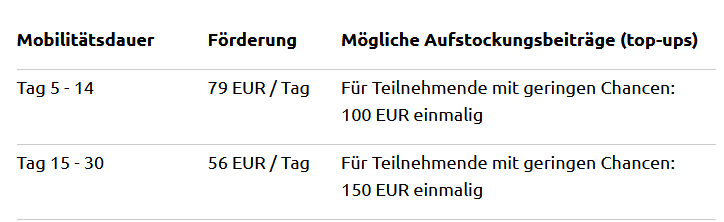
For physical short-term mobility within the Blended Mobility Program (BIP), the Erasmus+ program offers financial support calculated on the basis of a daily allowance and travel allowance. These may vary depending on the mobility period. Once you have been selected, we will advise you on this immediately.
The daily allowance for all (Blended) Short-Term mobility is as follows:
Source: DAAD
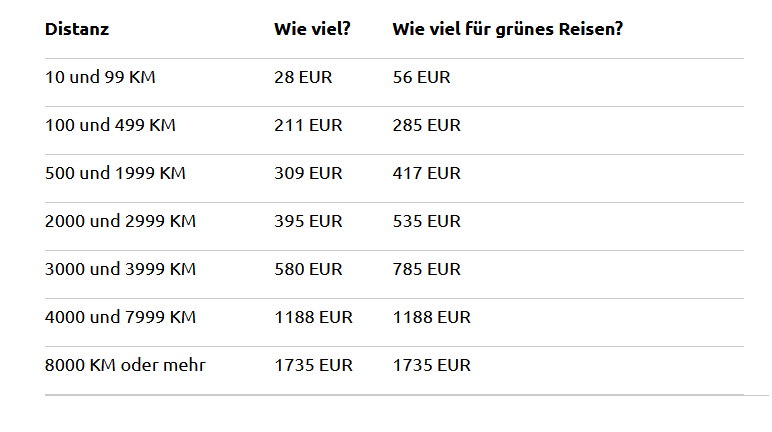
The one-time travel allowance is based on distance and mode of travel. There are standard trips (by plane, ship - not “green”) and green trips (train, bus, carpooling, etc.), and the allowances are as follows:
Source: DAAD
Source: DAAD
- Additional funding for Travel:
Additional travel days may be covered at the daily rate of €79.
Standard travel means that the majority of the journey (more than 50% of the journey to and from the destination) is made by plane or car (without carpooling), for example.
Green travel days are trips where low-emission means of transport are used for the majority of the journey (over 50% of the journey to and from the destination), e.g. train, carpool, bus or bicycle. (Travelling by plane does not count as a sustainable means of transport, even if CO2 emissions are offset.)
- Additional support for students with fewer opportunities:
Participants with fewer opportunities (those eligible for the Social Top-Up) will also receive a one-time payment of 100 EUR for stays of 1–14 days, and 150 EUR for stays of 15–30 days. This includes:
- Students with a disability or chronic illness: From GdB 20%, a proven disability or a chronic illness (this can be physical as well as chronic mental illness) both with additional financial needs abroad.
- Students with child(ren): At least one child is taken along during the entire stay abroad. Top Up amount does not depend on the number of children.
- First-time graduates: Both parents or caregivers do not have an academic degree from a university or university of applied sciences (this also includes comparable degrees from vocational academies and foreign degrees that are not recognised in Germany, see the Internet portal Hochschulkompass and the website of the Accreditation Council Foundation).
- Financial support for staff mobility:
If you are participating in a BIP or teaching and need to travel abroad under the Erasmus+ program, your mobility may also be eligible for funding. Please inquire for more information on this webpage for STA and STT.
These BIP seminars have already taken place:
- Prof. Dr Benjamin Lahusen: "Luhmann in Lecce: Law and Business / Business and Law in Systems Theory" (26.03.-01.04.2023 in Lecce, Italy + div. online-VA).
- Prof. Dr Eva Kocher: "Employment and Self-Employment in Platform Work" (EWL Student Seminar 08.-12.05.2023 in Frankfurt (Oder) + div. online-VA)
- PD Dr Carolin Leutloff-Grandits: "GlocalEast - Developing a new curriculum in Global Migration, Diaspora and Border Studies in East-Central Europe" (2023 in Bologna, Italy + div. online-VA)
- Dr. Lothar Quinkenstein & Christoph Maisch: "Transregionality and Transculturality and Historical Galicia and Ukraine" (5-11 June 2023)
- Prof. Dr Bartosz Makowicz: "Compliance & Management in Enterprises" (for students of the dual degree programme Wirtschaftsprüfung; planned for spring/summer 2024)
ERUA
The European Reform University Alliance European Reform University Alliance (ERUA) offers researchers various opportunities to undertake teaching and research placements at partner universities. Further information is available from the ERUA team.
Erasmus+ STA2 Company Staff (EU+)
Through teaching mobility for invited company staff (STA2) from Erasmus+ programme countries to Viadrina, the invited professionals from companies, research institutions, public authorities, NGOs, and other organisations can contribute international perspectives and practical experience to our teaching. Their involvement enriches our academic programme and strengthen the exchange between the university and the professional world. We encourage you to invite company staff to Viadrina, with funding available through Erasmus+.
Who is eligible for funding?
Staff from host organisations in Erasmus+ programme countries who work in a public or private organisation (without an Erasmus+ Charter for Higher Education) active in the labour market or in the fields of education and training, youth, research and innovation, and who have been invited by you to teach at Viadrina.
For example, staff (including employed PhD students) from:
- research institutions
- public authorities
- NGOs
- other organisations
What is funded?
Teaching visits at Viadrina.
Duration of funding & teaching activities
Funding is available for stays of at least 1 day and up to 14 days (excluding travel days). In justified cases and subject to the availability of funds, funding for stays up to 60 days (excluding travel days) may be granted. For invited company staff, there is no minimum teaching load and no minimum duration of the teaching activity.
You can only apply for funding under the Erasmus+ Mobility Programme via Viadrina. It is not possible to apply directly to the European Commission or the DAAD.
Application deadline
There is no fixed application deadline. Funding is provided on an ongoing basis and depends on available funds as well as the number of applications. We recommend contacting us at an early stage, ideally around 2 months before the planned start of the mobility period for the visiting company staff member. Once funding has been approved, we will contact your guest directly and guide them step-by-step through the application process.
Erasmus+ documents
We will send your guest the required documents once funding has been approved. The following list of documents is provided for reference only:
- Mobility Agreement for Teaching (completed and signed by the guest, the company and us)
- Cost breakdown for the guest’s accommodation and travel expenses
- Grant Agreement (signed by the guest and by us)
- Letter of Confirmation (issued by us and signed by the guest and you as the host)
- EU Survey (the guest will receive the link via email directly from the EU Beneficiary Module).
Please note: Only digital documents (PDFs via email) will be accepted. Paper documents will not be accepted.
Information on funding
Erasmus+ funding for STA2 consists of several components:
(1) Daily rate for Germany, i.e. Country Group 1 (depending on country group and duration of stay)
(2) Travel grant (depending on distance and mode of travel: ‘Green’ or Standard)
(3) If applicable: Additional funding for travel days
(4) If applicable: Special grants (for participants with a disability, chronic illness or when travelling with a child)
As invited company staff funded by Erasmus+ grants should not be better off than staff funded from the university budget, we base our calculations not only on your cost plan (accommodation and travel costs) but also on the Federal Travel Expenses Act. To calculate the funding rates, zero-grant days (days without funding/daily rate) may be taken into account. Any excess funding must be declared for tax purposes by the inviting staff.
(1) Daily rate
- The daily rate is valid up to the 14th day of the stay. From the 15th to the 60th day, the funding amounts to 70% of the daily rate.
- Funding is available for stays of at least 1 to a maximum of 14 days (excluding travel days).
In justified cases and subject to the availability of funds, funding for up to 60 days (excluding travel days) is possible.
Project 2025 and 2026
Country Group 1 - €180 / day (up to day 14; from day 15–60: €126 per day)
Belgium, Denmark, Germany, Finland, France, Ireland, Iceland, Italy, Liechtenstein, Luxembourg, Netherlands, Norway, Austria, Sweden
(2) Travel grant
- The calculation is based on the EU Commission’s distance calculator based on the distance between the point of departure and the destination.
- The amounts specified apply as a one-time total for the outward and return journey.
Project 2025 and 2026
10–99 km: €28 (Green Travel: €56)
100–499 km: €211 (Green Travel: €285)
500–1,999 km: €309 (Green Travel: €417)
2,000–2,999 km: €395 (Green Travel: €535)
3,000–3,999 km: €530 (Green Travel: €785)
4,000–7,999 km: €1,188 (Green Travel: €1,188)
from 8,000 km: €1,735 (Green Travel: €1,188)
Sustainable travel – "Green Travel"
- "Green Travel" applies if you use for at least half of your journey (50% or more) low-emission means of transport (e.g. train, bus, bicycle or carpooling; travel by ship is only green, if combined with green means of transport or if no green alternatives are available).
- With Green Travel, you receive higher travel grants and additional travel days.
We would like to encourage you to choose sustainable travel options for your journey. Of course, journey times by train and bus are sometimes significantly longer than when travelling by air. On the other hand, you won’t need a luggage scale and you’ll have the opportunity to break your journey into stages, allowing you to get to know the places between our university and your host institution.
Further information:
Exceptional costs for expensive travel
- Exceptional travel costs may be funded if it can be demonstrated that the standard travel grant covers less than 70% of the actual costs.
- In this case, up to 80% of the actual travel costs may be covered.
- If approved, the standard travel grant does not apply.
(3) If applicable: Additional funding for travel days
- For standard travel, up to 2 travel days may be funded.
- For Green Travel, up to 4 additional travel days (i.e. a maximum of 6 in total) are possible, and you will also receive a higher travel grant.
(4) If applicable: Special grants
- Additional funding is available for participants with a disability, chronic illness or for stays abroad with a child.
- The application for actual costs will be submitted on your behalf via Viadrina.
- The maximum funding amounts to up to €15,000 per mobility period.
Further information can be found at DAAD website.
Before the stay abroad
- Check the requirements and contact company staff
- Request confirmation of funding from the Division of International Affairs
We will then guide your guest through the application process, which is as follows:
- Complete the Mobility Agreement, have it signed by the sending organisation and submit it by email (PDF)
- Prepare a cost breakdown for travel and accommodation costs and submit it by email
- The guest will receive the Grant Agreement pre-filled by us; they must check it, sign it and return it to us by email
- Book travel and accommodation; sustainable modes of transport are recommended and are supported with a higher travel grant and, if applicable, additional travel days
- If applicable, take out any additional insurance, e.g. international health or third-party liability insurance, as the Erasmus+ mobility grant does not include any insurance cover.
Once all documents have been received, 70% of the grant will be paid out.
During the stay abroad
- Letter of Confirmation signed by the guest and you as the host
- If necessary, collect receipts (invoices, tickets, etc.) for the guests' own records for tax return or as evidence for the voluntary declaration on sustainable travel
After the stay abroad
- Complete the EU Survey (online participant report); you will receive the link via email directly from the EU Beneficiary Tool
- If applicable, the guest should keep any supporting documents for sustainable travel for 5 years yourself
- If applicable, the guest should declare any surplus mobility grant as income on the tax return, or conversely, declare any additional costs incurred, depending on the regulations in your country of origin.
Once all documents have been received, 30% – the remaining grant – will be paid out.
Note on Online Language Support (OLS)
Online Language Support (OLS) is available via the EU Academy platform to all university members undertaking a period of study abroad as part of the Erasmus+ programme. You can voluntarily take language tests and online language courses before, during and after your stay. The service currently covers 24 languages.
- Go directly to the EU Academy
- A guide and the Help Centre of the European Commission are available to assist you with any queries.
Contact
Erasmus+ Staff Mobility Outgoing (EU+)
Aleksandra Klecha
- Logenstraße 4 | 15230 Frankfurt (Oder)
- AM 214
- 0335 5534 2600
- klecha@europa-uni.de
Erasmus+ with partner countries (outside the EU)
Ana Retsch
- Logenstraße 4 | 15230 Frankfurt (Oder)
- AM 246
- +49 335 5534 2614
- erasmus-world@europa-uni.de
Erasmus+ BIP
Sarah Krebs
- Logenstraße 4 | 15230 Frankfurt (Oder)
- AM 210
- +49 (0)335 5534 - 2800
- krebs@europa-uni.de