
“Don’t be afraid to try” - Interview with Sahra Damus
Sahra Damus is currently the Sustainability Officer at Viadrina and also works with the European Reform Universities Alliance (ERUA), where sustainability is a key focus. Her career has taken her from research and equality work at Viadrina to five years as a member of the Brandenburger Landtag (Brandenburg State Parliament), before returning to the university. In this interview she talks about her way into politics, how a Viadrina inititiave paved her way to the UN in Vienna and why it is interesting to step out of the Viadrina bubble from time to time.
What made you choose Viadrina?
I initially considered studying in Leipzig, but after visiting both universities, Viadrina felt like the right choice. Leipzig seemed very large and somewhat anonymous, while Viadrina felt welcoming, well organized, and personal.
I first visited during the summer festival, which gave me a chance to experience both the university and Frankfurt (Oder). I also remember Janine Nuyken, now Vice President of Viadrina, visiting my school and giving me a very positive impression of the university. That first impression stayed with me. Viadrina felt like a place where it was easy to meet people, find support, and have a good study experience.
What was your experience as a student?
I studied Social and Cultural Sciences from 2002 to 2008, with linguistics and social sciences as my main areas. I was particularly interested in German and Polish language contact and the situation in the border region. I also became involved in university politics and student initiatives. I served on the Faculty Council, participated in the General Students’ Comittee (AStA) and Students’ Parliament (StuPa), and joined projects such as Viadrina Model United Nations (ViaMUN). These experiences opened unexpected doors. For example, my involvement in ViaMUN eventually led to an internship with the United Nations in Vienna.
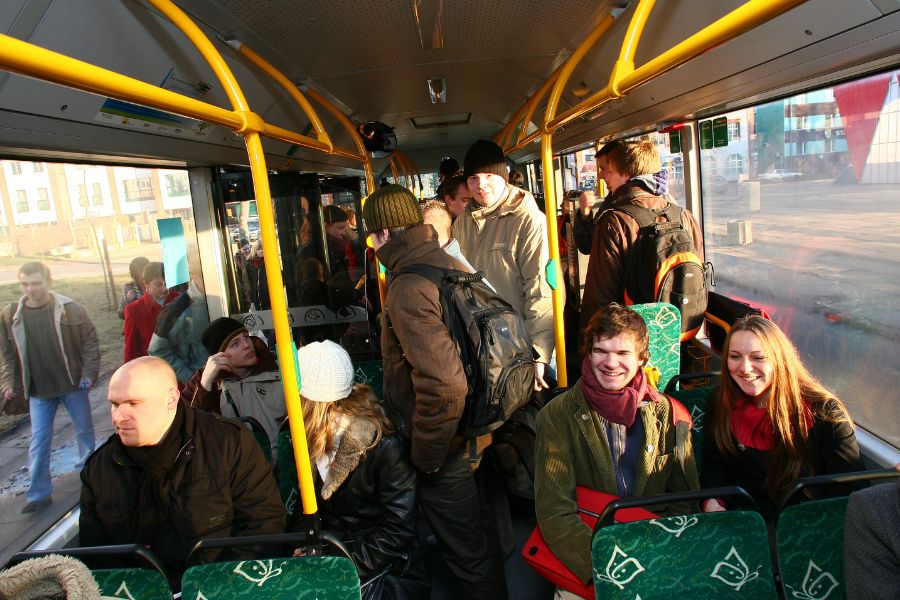
One of our biggest projects during my time in the Students´ Comittee was working to improve public transport between Frankfurt (Oder) and Słubice. Although the tram connection we hoped for has not yet returned, as students we launched the first bus connection ever across the Oder in 2008 and received the sponsorship award of the Viadrina Prize for our work.It took a lot of effort, but it was also a very empowering experience. It showed me that with commitment, you really can make things move – quite literally.
galerie-sahra-damus
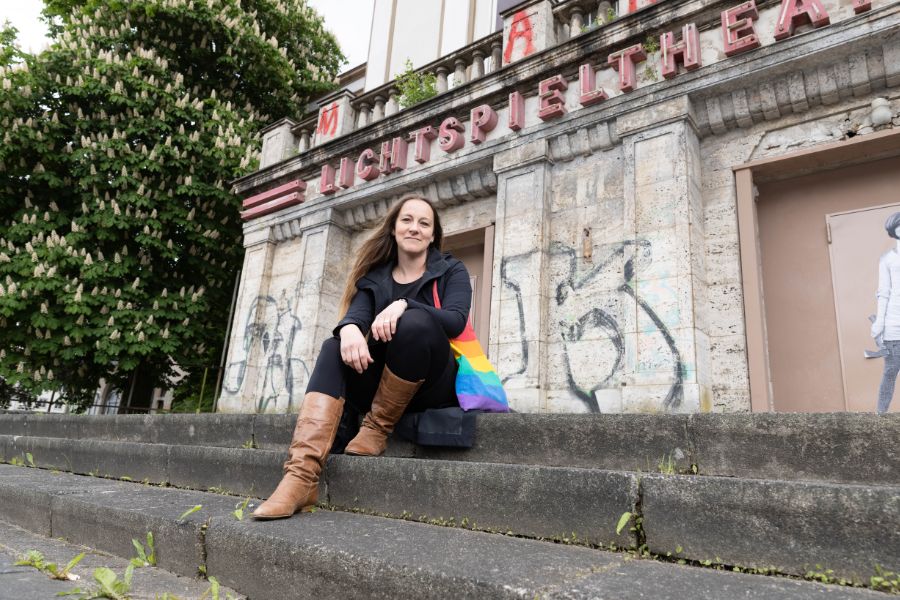
Commitment not only for the university: Sahra Damus in front of the old cinema of Frankfurt (Oder)
Back in 2008 Sahra Damus (right) and her fellow students are riding on the new border crossing student bus that they fought for.
How did your student engagement influence your career?
My career developed gradually rather than according to a fixed plan. After graduating, I joined a research project with Dr. Peter Rosenberg, a professor I had previously worked with. I enjoyed the experience and received positive feedback, but I eventually realized that academia was not the path I wanted to follow. I was more interested in shaping institutions and actively contributing to change. This led me first toward equality work and later toward sustainability, which is also closely connected to social sustainability.
At the same time, I became increasingly involved in local politics - first as part of ProTram, a citizens’ initiative made up of students and local residents campaigning for a cross-border tram, and then, from 2014 onwards, as a city councillor – a role I still hold today. I wanted to improve things at different levels — at the university, in Frankfurt (Oder), and eventually across Brandenburg.
How did politics fit alongside your professional life?
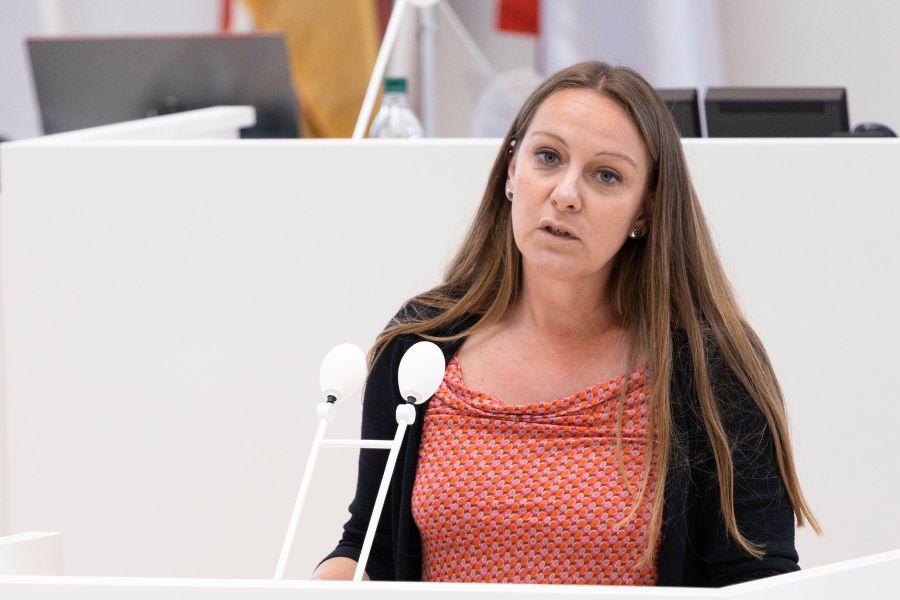
For most of the time, my political engagement was voluntary and happened alongside my work at Viadrina. That changed when I was elected to the Brandenburg State Parliament in 2019. For five years, politics became my full-time profession, and I paused my work at the university.
I brought many issues concerning Viadrina and Frankfurt into parliament and gave them a voice there: the German-Polish border region, the RE1 train service, the Oder River, gender equality and family-friendliness, and working conditions at universities. I know the difference I made in parliament: I secured funding for the restoration of Lake Helenesee, pushed for a multilingualism strategy for Brandenburg, and made sure that the Higher Education Act now requires universities to have student vice-presidents.
Being able to return to Viadrina afterwards was a major advantage. Unlike many people who leave their profession for politics and have to start all over afterwards, I was able to make a relatively smooth transition back.
What would you recommend to students?
I would encourage students to get involved wherever they can—whether in a Faculty Council, Student Council, university initiative, or local project. You learn much more than the specific task itself. You learn how decisions are made, how to convince people, how to organize participation, and how to work with different perspectives. Internships are equally valuable because they help you discover what you might want to do professionally—and sometimes what you definitely do not want to do.
The important thing is to find something that matters to you, something that you want to change, ask questions, meet people, and learn by doing.
How important is it to engage beyond Viadrina?
I have built much of my personal and professional network in Frankfurt (Oder) through Viadrina. But I would also encourage students to look beyond the university. Sometimes we can become part of a “Viadrina bubble” and miss what is happening in the city. Getting involved with local initiatives and institutions can help you to understand the community and discover new opportunities. You never know where a small project or new connection might lead.
What advice would you give to students facing new challenges?
Don't be afraid to try. New contacts, unfamiliar tasks, and challenges can feel intimidating, but they are also opportunities to learn. If you don't know where to start, ask people. You will usually find someone who can help, advise you, or introduce you to others. Even if something does not become part of your career, the experience is valuable because it helps you to understand what you want.
How has Viadrina changed since you were a student?
Digitalization has become much more important. While it offers many advantages, it can sometimes make personal connections and a lively university community more difficult. Viadrina has also become even more international. English is now a much more common part of everyday university life, which I think is positive. At the same time, I believe we should continue finding ways to connect Viadrina's international character with the local community and the languages of the German-Polish border region. Multilingualism is one of Viadrina's special strengths.
What are you final reflections looking at your journey so far?
Looking back, my journey has not followed one fixed plan. I moved from studying and student engagement to research, equality work, politics, and eventually sustainability. What connects all these experiences is the desire to participate and make a difference.
Something I haven’t mentioned yet, but which is very important to me: I have a young son who was born while I was in parliament, so I know from my own experience what it’s like to combine family, work and engagement. Especially in politics, academia or other demanding jobs, having both a family and a career can sometimes seem almost impossible. But I think we shouldn’t let that stop us from trying to make both work – and we need more people who show that it can be done. It’s not always easy, but there is support out there, and for me it has definitely been worth it.
The interview with Sahra Damus ist part of a series initiated by the ERUA Student Engagement Coaches. The work package "Student Engagement" within the European Reform University Alliance (ERUA) plays a central role in promoting an active and participatory university culture. Viadrina leads this work package within the alliance.
The Student Engagement Coaches at Viadrina are funded by the "European University Networks (EUN) - National Initiative" programme of the DAAD.
The following articles have already been published in this series:
- "Change comes from the willingness to show up for others" - Interview with Mohammad Arafat Intisher
- "The most valuable experiences at university don't come from having a master plan" – Interview with Philip Panek
- "Viadrina has never been just a university, it has been a home" – Interview with Julia Szuleta
- “We created a community across borders” – Interview with Prof. Dagmara Jajeśniak-Quast
- "Having a student perspective changes the conversation" – Interview with Ira Helten
Saliqa Parveen
Back to the news portal
Share article: