
“We created a community across borders” – Interview with Prof. Dagmara Jajeśniak-Quast
Since 2014, Dagmara Jajeśniak-Quast has been Professor of Interdisciplinary Polish Studies at the European University Viadrina’s Faculty of Business Administration and Economics. She also serves as Chair of the Viadrina Center of Polish and Ukrainian Studies (VCPU). But her connection to Viadrina goes back to its very beginnings: she was among the first students to enroll when the university was re-founded in 1992. In this interview, she talks about those pioneering years, her personal journey across borders, and the future of Viadrina as one of Germany’s most international universities.
Dagmara, you’ve been connected to the Viadrina for more than 30 years – first as a student, now as a professor. What does this university mean to you personally?
Viadrina is a part of my life story. I came here as one of the very first students in 1992, and in many ways we were building the university together with our professors. We didn’t just receive an education – we created a community across borders. That spirit has never left me.
How did you first end up studying here?
It happened almost by accident. I had passed the law entrance exam at the Jagiellonian University in Kraków and even started studying there. At the same time, I was working in England during the summer to save money. My mother saw on Polish television that a new university had just opened in Frankfurt (Oder) and that it was still looking for students with German skills. She did all the paperwork while I was abroad, and in the end I passed the entrance exam for economics at Viadrina. I had to decide quickly: stay with law in Kraków or take a completely new path at this unknown university on the German-Polish border. I chose Viadrina.
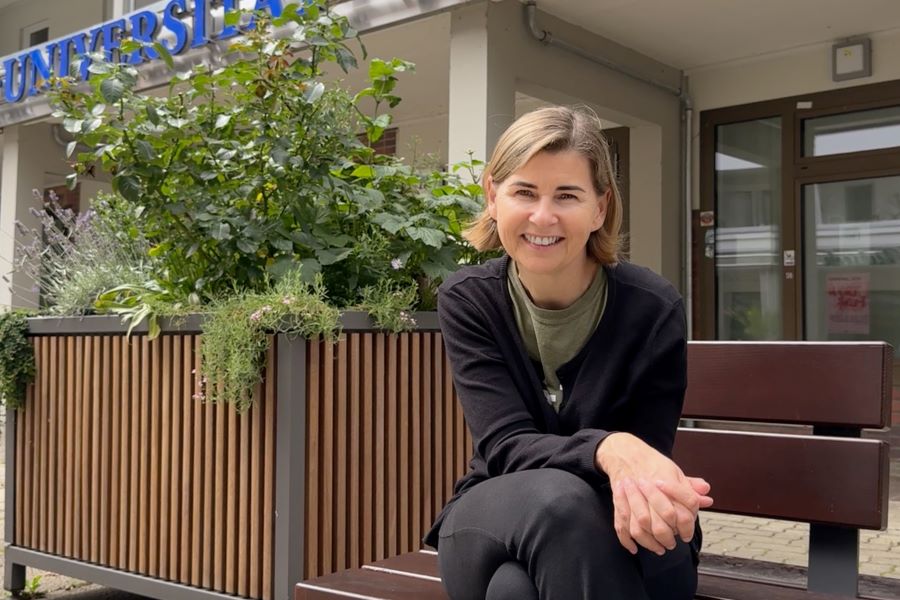
Screenshot: Valeria Lazareva
What were those first semesters like?
We were only about 300 students. The main building was still under construction, so some lectures were held in cinemas or local schools. We had to walk or cycle across the border every day, even in winter because there was no proper bus connection. It wasn’t always easy, but it created a special atmosphere. We knew all our professors personally, seminars were small, and there was this feeling that we were part of something new, something we were shaping together.
How did Polish and German students come together back then?
At first, Polish students lived mostly in Słubice, Germans in Frankfurt. The financial differences made it difficult. But very quickly we realized we had to mix. Together with some friends, I founded the Kraków Kreis, a student circle named after my hometown. We organized debates, excursions, and cultural events. Thanks to support from German foundations, we traveled across Poland and Germany, met politicians, visited parliaments, and learnt from each other. Those experiences gave us networks and friendships that are still alive today.
You mentioned before that student life outside lectures was very important. What exactly do you mean by that?
Absolutely. I always tell my students today: half of your education happens in the classroom, but the other half happens outside – in initiatives, projects, and the things you create yourselves. Back then, we had to invent everything: student parties, the parliament, organizations. It was a school of responsibility and creativity.
Languages also played a big role in your story.
Yes. I came with Russian and some German from school, but no English. At first, I survived economics lectures because numbers don’t need many words. Later, I realized I needed English for marketing and management courses. Poland wasn’t yet in the EU, so I couldn’t go abroad with Erasmus. Instead, I went on my own to Chicago, worked as a babysitter, and studied English in the evenings. It was hard but it opened a whole new world for me and for my later academic work.
You have also witnessed major European milestones right here at the border. Which moments stand out?
Poland joined the EU in 2004, then Schengen in 2007, and finally the opening of the labour market in 2011. On each of those events I went to the bridge at midnight to celebrate, sometimes even with my little daughter in my arms. Those were moments of joy, of hope, of believing in Europe. That is why it hurts so much to see border controls return today.
What do you see as Viadrina’s role for the future?
Internationality is in Viadrina’s DNA. We are still the only university in Europe with a campus on both sides of a national border – in Germany and Poland. That is unique and worth protecting. Especially today, with wars and rising nationalism, we need to be an island of openness, where students from all over the world meet, learn, and build a future together. That is the mission we started in the 1990s – and it is just as important today.
The interview with Dagmara Jajeśniak-Quast ist part of a series initiated by the ERUA Student Engagement Coaches. The work package "Student Engagement" within the European Reform University Alliance (ERUA) plays a central role in promoting an active and participatory university culture. Viadrina leads this work package within the alliance.
The Student Engagement Coaches at Viadrina are funded by the "European University Networks (EUN) - National Initiative" programme of the DAAD.
Saliqa Parveen
Back to the news portal
Share article: