
Viadrina celebrates one million Erasmus students together with the DAAD
One million students from Germany have gone abroad for a study or work placement with funding from Erasmus+. As part of the #OneInOneMillion campaign initiated by the German Academic Exchange Service (DAAD), the European University Viadrina has named its student Mareike Nesselhauf as the “millionth Erasmus student”. She is currently spending her second semester at the SGH School of Economics in Warsaw.
“My Erasmus+ placement at the Warsaw School of Economics was a very special experience. It gave me the opportunity to study in an international environment, meet lots of new people and grow both academically and personally. I am very grateful for this time and for everything I am taking away from Warsaw,” says Mareike Nesselhauf shortly before the end of her Erasmus semester.
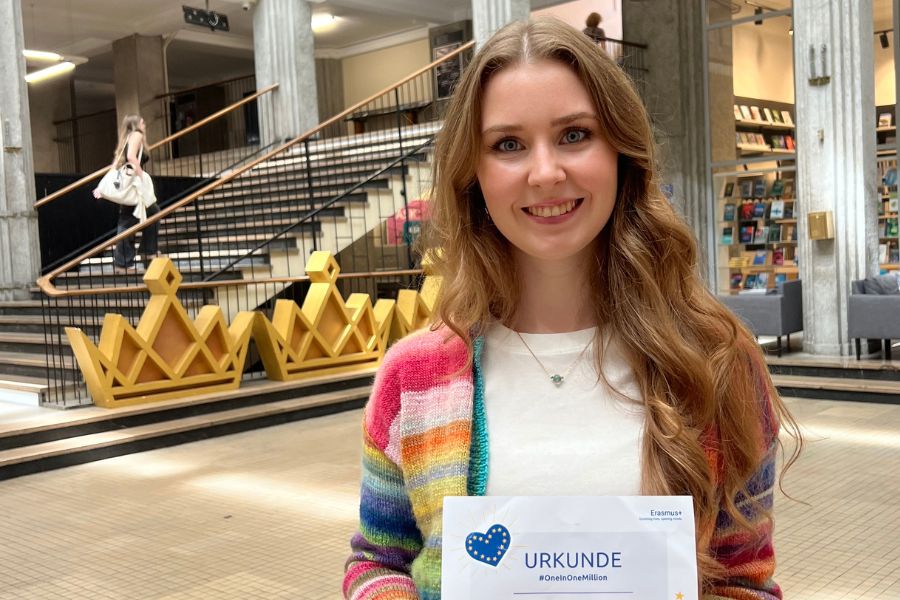
Mareike Nesselhauf
Mareike Nesselhauf is studying on the international dual Master’s programme in International Business Administration at Viadrina and International Business at the Warsaw School of Economics (SGH). It is the longest-running dual Master’s programme at the European University Viadrina. Founded in 1991, Viadrina has been accredited under the Erasmus+ programme since 1992 and has since supported more than 8,000 students during their stays abroad through Erasmus+. Most of them go to universities in France, Spain, Turkey and Poland, where Viadrina has a particularly large number of partner institutions. However, an Erasmus stay in Italy is also becoming increasingly popular among Viadrina students due to the growing number of English-taught programmes on offer. In total, more than half of all Viadrina students take up the opportunity to study abroad through Erasmus+.
DAAD President Prof. Dr Joybrato Mukherjee: “One million students from Germany who have spent time abroad through Erasmus are a powerful testament to the programme’s strength. Behind this figure lie a million educational pathways, formative experiences abroad, personal development and, in many cases, partnerships. Erasmus+ makes Europe a tangible reality.”
“This success story was made possible by the tremendous commitment of the universities and their International Offices, Erasmus coordinators, and many partner universities in Europe and worldwide,” emphasises Dr Stephan Geifes, Director of the National Agency for Erasmus+ University Cooperation (NA DAAD).
Background on Erasmus+
The Erasmus programme began in the winter semester of 1987/88. The exchange programme for study periods, launched 39 years ago, has evolved into a wide-ranging European education programme: Today, Erasmus+ at German universities supports not only study periods abroad, but also internships, short-term and blended mobility formats, teaching and further training stays for university staff, as well as international university cooperation.
Translated by DeepL and edited
Back to the news portal
Share article: