
Between town twinning and high politics – German-Polish research project examines ‘paradiplomacy’ in times of war
Town twinning is about much more than choir meetings, fundraising campaigns for relief supplies and youth exchanges. Dr Susann Worschech from the European University Viadrina and Prof. Dr Jarosław Jańczak from Adam Mickiewicz University in Poznań are investigating the role they play in international diplomacy as part of their project ‘Paradiplomacy: Soft power in heavy shelling’. The focus is on partnerships between German, Polish and Ukrainian towns and cities, and on how these relationships have changed in the face of Russia’s ongoing war against Ukraine.
“We want to ask more specific questions: How has the perception of the East changed? What impact has the full-scale invasion had on cooperation between local actors?”, says social scientist Susann Worschech, outlining one of the research questions. She observes a shift in perception within town twinning partnerships, away from the original desire to help on the German side towards an interest in what German stakeholders can learn from their Ukrainian counterparts.
Furthermore, the research team is interested in the interplay between local connections and state foreign policy. Political scientist Jarosław Jańczak refers here to the principle of multi-level governance, i.e. the distribution of decision-making power in governmental processes across regional, national and international levels, amongst others. “Given the complex problems and dysfunctional structures in international politics, it is difficult to govern centrally these days. Tasks must be delegated, and paradiplomacy is part of this process,” says Jańczak. However, the objectives of national foreign policy and local partnerships are by no means always aligned. The extent to which national guidelines influence regional partnerships, or whether town twinning also shapes high-level diplomacy, is another area of research interest for the project.
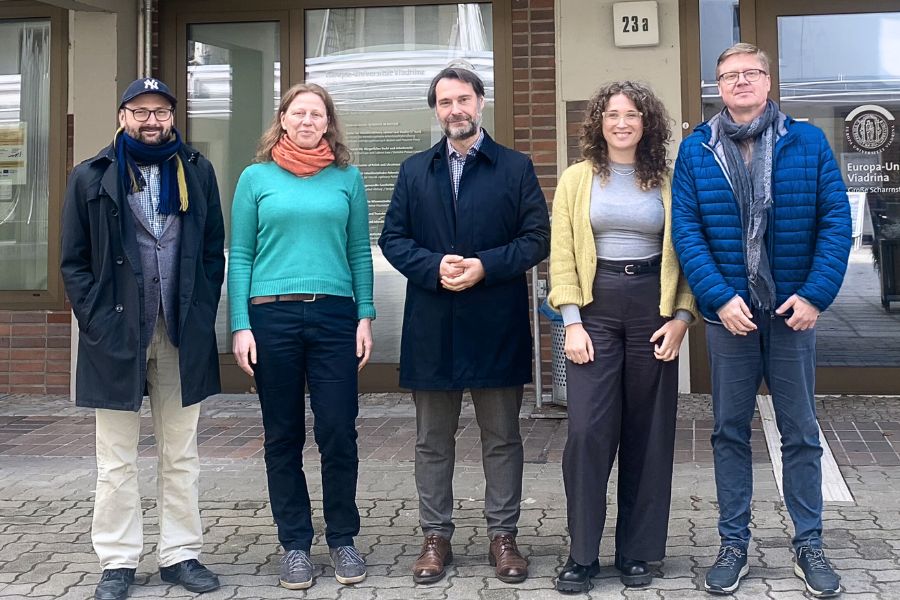
The Paradiplomacy research team at a meeting at Viadrina in Frankfurt (Oder) (left to right): Igor Ksenicz, Susann Worschech, Tomasz Branka, Mona Richter, Jarosław Jańczak
Projekt Paradiplomacy
As a first step, the teams are documenting existing partnerships. Susann Worschech provides an initial insight into this extensive documentation, noting that there are just under 250 partnerships between German and Ukrainian towns, eight of which are trilateral arrangements involving additional Polish partners. For the research project, the team is focusing on 200 partnerships between German and Ukrainian cities with a population of at least 50,000. Numerous partnerships have been newly established or revived, particularly since Russia’s full-scale invasion of Ukraine. The large number of German-Polish partnerships has been narrowed down, and the team is also concentrating on around 200 such collaborations here, adds Jarosław Jańczak.
At the same time, the researchers are currently analysing official guidelines and documents that describe the objectives of these partnerships. Here, Susann Worschech observes a shift, particularly on the Ukrainian side: “In Ukraine, aspects of soft power were not taken seriously for a long time; there was no real concept of cultural diplomacy there. But with the war, it became clear that paradiplomacy is also necessary to secure support and ensure Ukraine’s survival.” This targeted use of partnerships at local level for national purposes is an aspect she has not observed in Germany or Poland.
The project “Paradiplomacy: Soft power in heavy shelling” has been funded by the German-Polish Science Foundation for two years since early 2026. The project was selected as one of three projects under the programme ‘“A Turning Point in History”? Russia’s War of Aggression against Ukraine and its Impact on Poland and Germany’. More than 30 German-Polish research projects had applied for funding.
Translated by DeepL and edited
Back to the news portal
Share article: