
“Statistics is booming” – Prof. Dr Wolfgang Schmid on his time at Viadrina and the future of his discipline
Around 30 years ago, Prof. Dr Wolfgang Schmid, a native Schwabe, joined Viadrina University and established his Professorship in Quantitative Methods, with a particular focus on statistics. As he bids farewell, he talks about young international researchers, a flash of inspiration on a train and the importance of statistics for artificial intelligence. He does not intend to withdraw completely from research when he retires.
Mr Schmid, what is the first thing that comes to mind when you look back on your time at Viadrina?
The first thing that comes to mind is the early days. I came to Brandenburg from Schwaben and switched from a maths faculty to the Faculty of Business Administration and Economics – that was two big changes at once. What I liked about Viadrina was how international it already was back then: we had lots of Polish students, and I really enjoyed that mix of languages in the cafeteria. I was the first person to hold my chair, so I had to build everything up from scratch. My first task was to hire a secretary. That was something I had never done before either. At the same time, we were able to shape a great deal ourselves.
A photographic retrospective
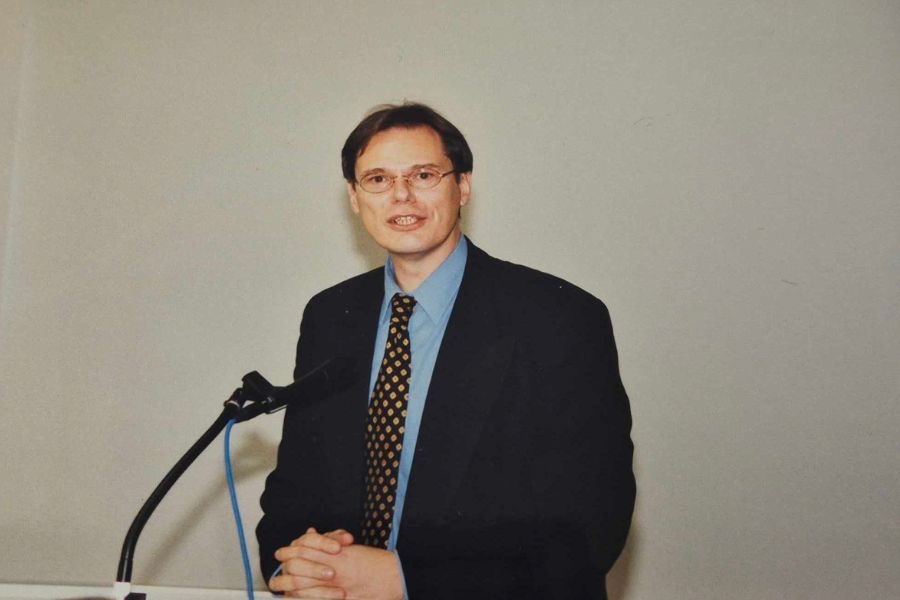
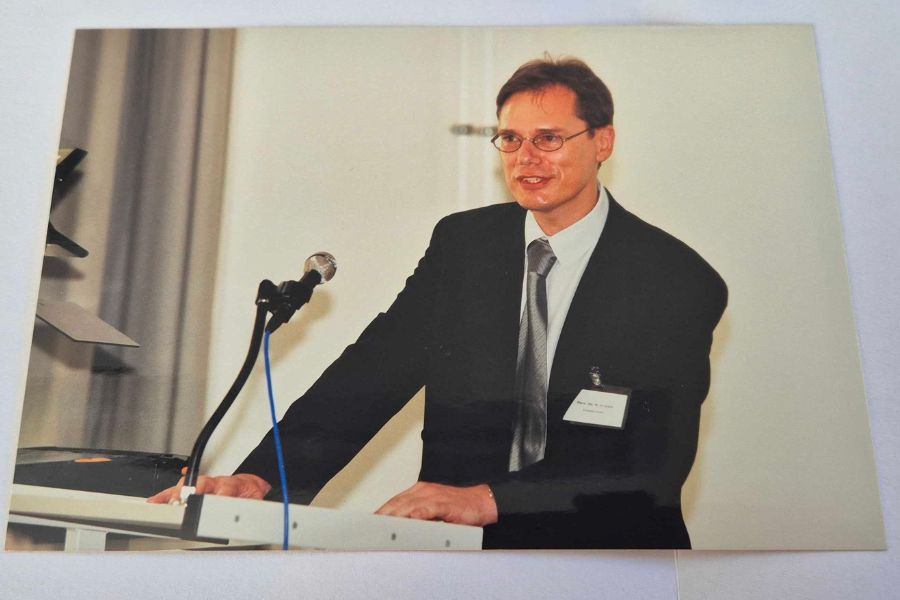
Wolfgang Schmid in 1999 at the opening of the Research Training Group ‘Capital Markets and Finance in an Enlarged Europe’
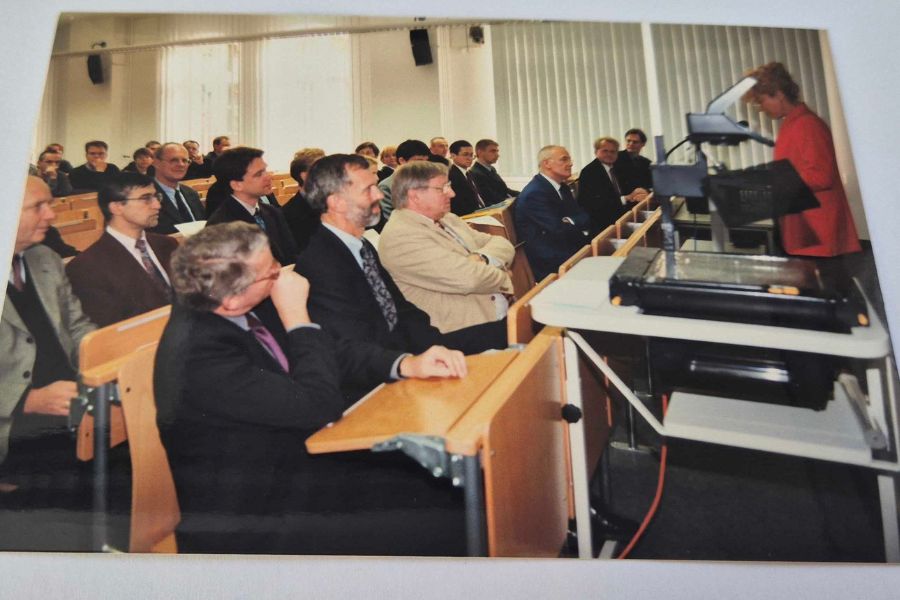
Inauguration of the Research Training Group: on the right, at the lectern, the President of Viadrina, Prof. Dr Gesine Schwan back then; in the front row, third from the left, Prof. Dr Hans N. Weiler
In 2000, the German Statistical Society held its meeting at Viadrina University: Prof. Dr Wolfgang Schmid served as its chairman for eight years
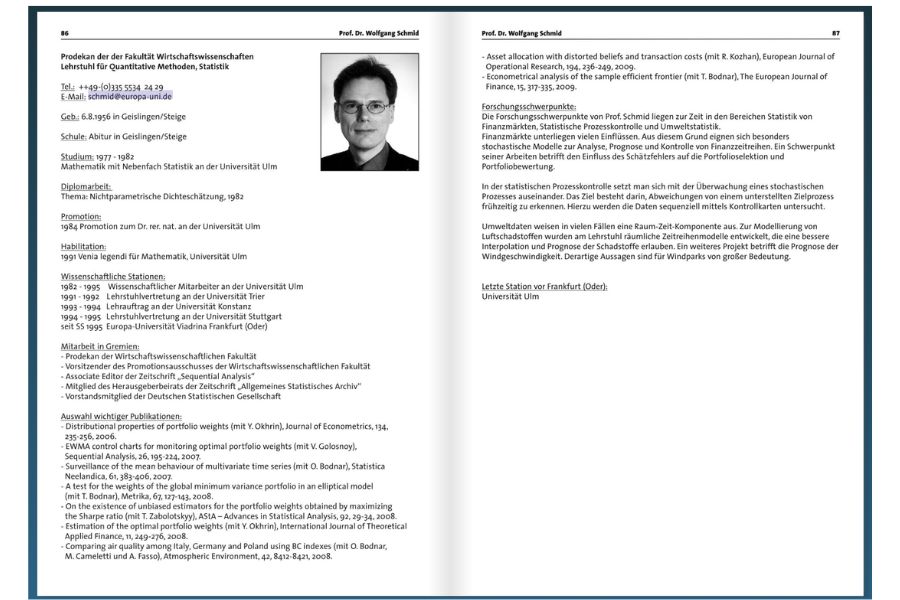
In 2011, a ‘Who’s Who’ of Viadrina was published – featuring profiles of the professors at the time
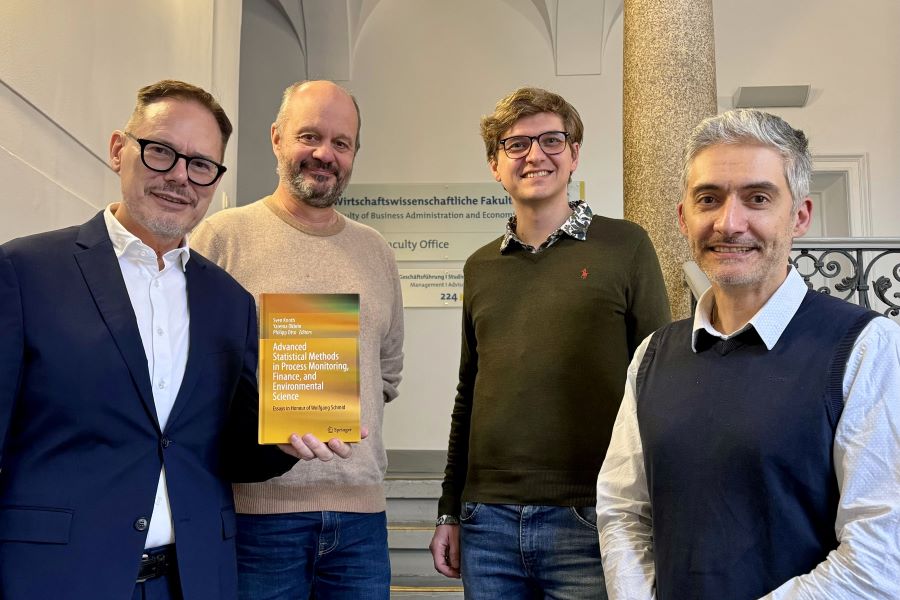
A special tribute on 19 December 2024: Prof. Dr Wolfgang Schmid with the editors Prof. Dr Sven Knoth, Prof. Dr Philipp Otto and Prof. Dr Yarema Okhrin (from left to right) of the anthology entitled ‘Advanced Statistical Methods in Process Monitoring, Finance, and Environmental Science’
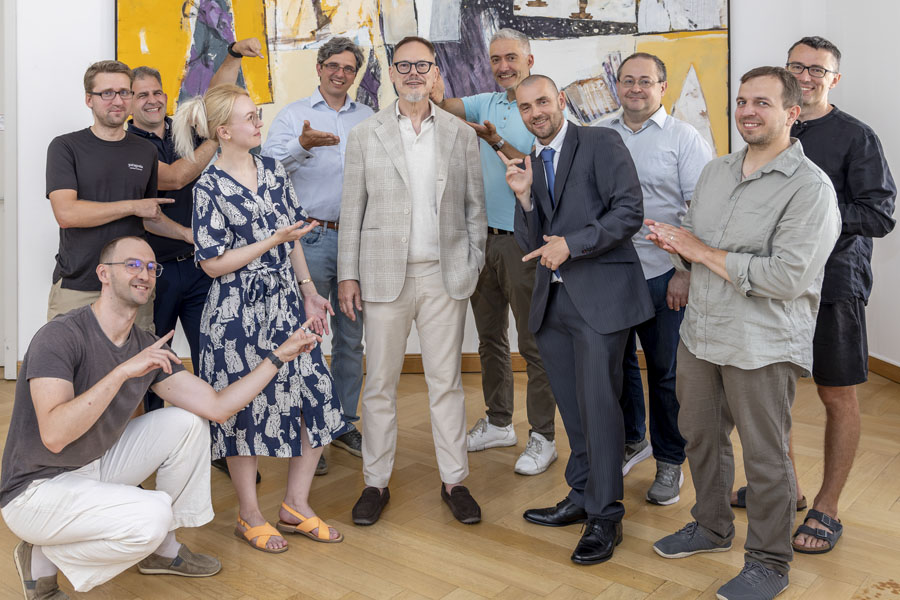
To mark the forthcoming retirement of Prof. Dr Wolfgang Schmid, researchers from Germany and abroad, as well as former PhD students, gathered at Viadrina in July 2026 for a workshop
You became the founding spokesperson for an international research training group. How did you attract PhD students to it back then?
The research training group on capital and financial markets in an enlarged Europe was funded by Deutsche Bank. We launched a major promotional campaign and sent posters to other universities; back then, we didn’t use the internet for this yet. One of these posters even led to applications from Ukraine. This resulted in contacts that have lasted to this day.
What did the posters say?
We promoted the research topics and the opportunity to write a doctoral thesis whilst receiving a good education. Of course, the scholarships were also attractive. The Research Training Group ran for almost ten years with young researchers from Ukraine, Bulgaria, Romania, Russia and others. Many of the graduates went on to work at universities themselves. When the funding ran out, I submitted more applications to the German Research Foundation (DFG) so that I could continue to employ doctoral candidates. I have always really enjoyed working with young people.
What was your favourite personal moment at Viadrina?
The biggest event was that I met my wife here. She worked on the same floor and was from Poland. Through her, I discovered a culture I had never known before. We decided to move to Słubice. For me, coming from the West, this opened up a whole new cultural world. Academically, too, this encounter took me to places such as Kraków, Warsaw and Kyiv – places I would never have imagined travelling to before.
And how well do you speak Polish now?
I can communicate well. However, I would not want to write an academic paper in Polish.
What inspired you in your research?
For me, curiosity is the most important quality a scientist should have. My starting point was process monitoring. When I moved to the Faculty of Business Administration and Economics, I wanted to know how this could be applied to economic processes, for example in the financial sector. Later, an Italian colleague introduced me to environmental statistics. If you look at data on air pollution, for example, it’s spatial data – and from there it is only a short step to spatial statistics. That is how my research topics have gradually developed, often by chance and through discussions with colleagues. You have to stay curious and look beyond the boundaries of your own field from time to time.
Was there a particular ‘aha’ moment?
Yes, I remember one very clearly. I had given a presentation as part of a job application in Frankfurt/Main and was sitting on the train on the way back, where I was continuing to work on a mathematical problem. When you are fiddling about with formulas, people do tend to look at you a bit strangely. And suddenly I had a flash of inspiration as to how the problem could be solved. Moments like that are very rare, but for me they are the best part of research. The solution later led to a publication in one of the top specialist journals.
Statistics is a compulsory subject for many students. How did you try to get them excited about it?
Statistics is compulsory here, and yes, most students probably do not particularly like it. That is why, in our advanced courses, we have consistently offered topical subjects, ranging from computational statistics to statistical methods in artificial intelligence. The way we teach has also changed completely. In Ulm, I used to write my lectures on the blackboard; at Viadrina, we initially used an overhead projector, then prepared slides, and finally a laptop. Today, students are given the materials and can also use learning programmes and other digital aids. We tried to introduce such programmes at an early stage. One should view them critically whilst at the same time making the most of their potential.
You have supervised many PhD students. What was important to you in this regard?
29 have completed their doctorates under my supervision, and I hope one more doctoral student will complete hers – that would make it 30 in total. It was important to me to give them freedom and not to overload them with other tasks at the chair. Some wanted a specific topic, whilst others chose their own research question; you have to take the individual into account. Anyone wishing to remain in academia should publish early on, present their own findings at conferences and build up a network of contacts. In this regard, I was also able to draw on my contacts from the German Statistical Society, of which I was chairman for several years. I am particularly pleased when former colleagues are appointed to a post or win a research prize.
Prof. Dr Wolfgang Schmid ‘by the numbers’
Anyone who devotes their professional life to statistics deserves a statistical profile of themselves as a farewell:
- more than 170 publications in international specialist journals
- 29 doctoral theses for which he served as principal supervisor
- 12 former PhD students or staff members who are now professors themselves
- 5 habilitations at his chair
- 9 DFG projects for which he has successfully secured funding since 2004
- a total budget of around €1.6 million for these DFG projects
- 8 years as Chair of the German Statistical Society, from 2012 to 2020
Perhaps the most rewarding statistic of all: twelve people from his academic circle now hold Professorships themselves – in Germany, England, the Netherlands, Sweden, Scotland and Ukraine.
Heike Stralau - Translated by DeepL and edited
Back to the news portal
Share article: