

Diversity Days
How can social cohesion be achieved?
Tuesday, 3 November 2026, 4.00–6.00 pm Logensaal, EUV
Between a New Beginning and Powerlessness: Is (East) Germany Shifting to the Right?
Matthias Quent (Professor of Digitalisation in the Context of Societal Transformations in Social Work at the Ernst Abbe University of Applied Sciences, Jena) in conversation with Dr Anja Hennig about his new book.
For anyone interested
What does it take to remain capable of taking action in the face of social crises, uncertainties and democratic challenges? What responsibility do civil society, academia and politics bear in light of the rapidly growing electoral success of far-right parties?
We will be discussing these issues with Prof. Matthias Quent – openly, critically and with a focus on our role at the university and in society. Dr Matthias Quent is Professor of Digitalisation and Transformation at the Ernst Abbe University of Applied Sciences in Jena and one of Germany’s leading experts on right-wing extremism. In 2026, his book “No Power to Powerlessness: How We Overcome Crises and Defend Ourselves Against Fascism” was published. Dr Anja Hennig (formerly of Viadrina) is a political scientist.
Please send any questions or comments to: chancengleichheit@europa-uni.de
The event will be held in German.
Wednesday, 4 November 2026, 4.30–6.30 pm Coworking Space, Carrel 1
Democracy: Unplugged
Michalina Lorych (Student Engagement Coach), Equal Opportunities Division & ERUA Student Engagement Team
How do other people experience democracy in their everyday lives? Do we all understand participation in the same way – or do others see it completely differently to you? The way we talk about democracy and live it together shapes our society every day. Yet in everyday life, there is often a lack of space for genuine, honest exchange about different experiences and perspectives.
As part of the Shared Humanity Experience, the Democracy: Unplugged programme invites you to do just that: Through structured conversations, we create a mindful space to share experiences, listen attentively and explore together how democracy comes to life through human connection and dialogue.
Discover new perspectives.
Please send any questions or comments to: chancengleichheit-assistenz@europa-uni.de
Registration link - feel free to sign up, but you’re also welcome to pop in at short notice!
The event will be held in English.
Thursday, 5 November 2026, 10.00–12.00 HG 217
Countering anti-constitutional activities at universities – scope for action and legal limits
Joschka Selinger (Solicitor/Society for Civil Liberties)
For administrative staff
How can universities, and in particular their administrative bodies, counter anti-constitutional activities in accordance with the rule of law?
This workshop provides an introduction to the constitutional foundations of the state’s duty of neutrality and the requirements of public service law.
The focus is on the tension between political neutrality and the defence of the free democratic basic order in the university context.
Drawing on recent case law, the scope for action, obligations and limitations of university administration will be examined and discussed.
Please send any questions or comments to: chancengleichheit@europa-uni.de
Please register at: Chancengleichheit@europa-uni.de
The event will be held in German.
Thursday, 5 November 2026, 3.00-5.00 pm Coworking Space, Foyer
Family Café
Nadine Arnold (Family Affairs Officer at Viadrina) & Guests
For people with caregiving responsibilities and anyone else interested
How can we interact and exchange ideas in our everyday lives, and shape our society together? What opportunities are there to get involved, take on responsibility and practise democratic participation – within the family, in the neighbourhood, in clubs or at university?
The Family Café invites people with caregiving responsibilities, as well as anyone else who is interested, to engage in conversation, share experiences and discover new perspectives. In an open and supportive atmosphere, we create a space for connection, exchange and inspiration. Together, we discover just how diverse commitment and social participation can be, and how democratic coexistence is put into practice in everyday life.
Insights from local stakeholders provide an overview of different forms of engagement (parents’ council, neighbourhood, sports clubs…) and encourage participants to discover their own ideas and opportunities for getting involved.
Please send any questions or comments to: narnold@europa-uni.de
The event will be held in German.
Friday, 6 November 2026, 10.00–11.30 am (online)
Protect democracy!
How academia is now living up to its responsibilities.
Amrei Bahr (Assistant Professor of Philosophy of Technology & Information, University of Stuttgart)
For researchers and anyone interested
Our democracy is under acute threat. This also has consequences for academia, as key framework conditions are at stake. It is essential that academia now recognises this, rather than falling for misguided demands for neutrality or remaining silent out of ignorance or fear.
How can each individual researcher, and how can we as a scientific community, actively champion democratic science instead?
This event will provide inspiration and concrete suggestions for this.
Please send registrations and enquiries to: Chancengleichheit@europa-uni.de
The access link will be provided after registration. The event will be held in German.
Diversity Days 2026
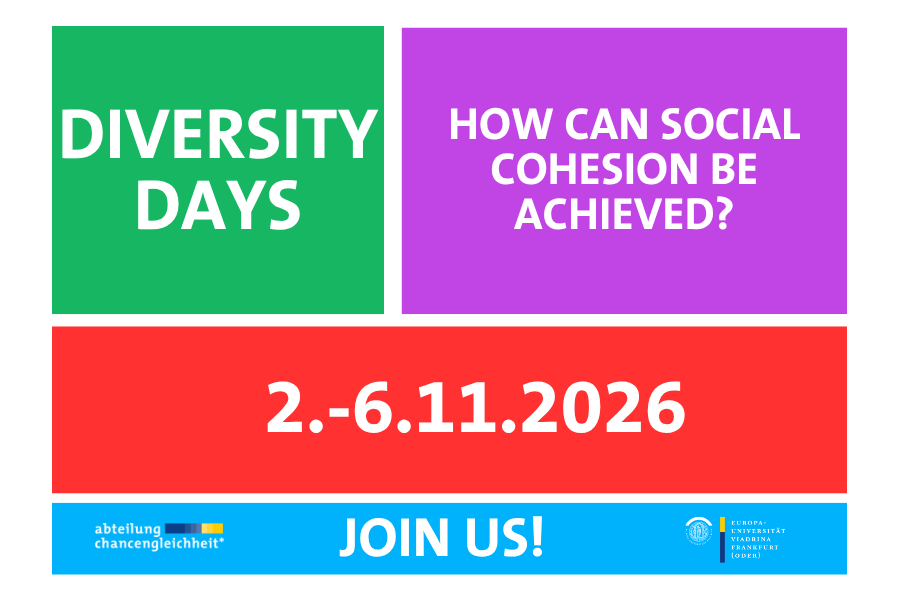
Once again this year, Viadrina is organising its Diversity Days.
These are not easy times – crises, wars, financial hardship and polarisation. Many people are feeling uncertain, worrying about what lies ahead and what the future holds.
What sustains us in times like these? What fosters social cohesion? How and where can we get involved?
Questions we all ask ourselves. Questions we discuss at home and also bring with us to Viadrina. Questions to which there are no easy answers, yet which keep coming up and demand that we – and Viadrina – take a stand.
We will be addressing these questions at the Diversity Days 2026 through various events, both on-site and online, and offering a space for meeting others, exchanging ideas and generating concrete suggestions on how you can get involved – at the Viadrina and beyond.
We warmly invite you to join us.
What is it about?
Viadrina and many other universities regularly organise Diversity Days to promote equal opportunities, inclusion and diversity in the academic sphere.
Universities are places for exchange, learning, interaction, research and work. We want to create an environment in which all students and staff feel comfortable and safe, and can contribute equally to studying and working successfully.
Through Diversity Days, we raise awareness of issues that are often overlooked or remain invisible in everyday university life, even though they affect and impact many people: for example, chronic illnesses, disabilities, family care and support responsibilities, experiences of racism and much more.
Here, for instance, we highlight counselling and support services and, through a variety of events, create space for dialogue.
Furthermore, in the face of growing social and political tensions in society, these days help us to take a united stand: for a university based on solidarity that champions all its members, particularly those who are more vulnerable than others. And for a university that makes it clear: we take our commitment to preventing discrimination seriously.
Previous Diversity Days
2024
On 18 June 2024, as part of the 3rd university-wide Diversity Days, the Equal Opportunity Division opened the exhibition ‘Same Same, But Different – Insights and Outlooks at the Viadrina’. For the exhibition, we spoke to various members of our university and asked them what matters to them, what they hope for, what ideas they have for the future of Viadrina, and how we can grow closer together so that our university is a place where we all enjoy studying and working. The portraits can be viewed in the accordion below or visited in the GD Foyer until the end of July.
The Diversity Days at Viadrina have been an annual event since 2022, held as part of German Diversity Day.
The aim of the Diversity Days is to create a platform that highlights diversity within the university, combats discrimination and promotes an open and respectful study and working environment. In these times of social change, Viadrina aims to be a place where everyone has equal access and opportunities, and where the potential of a more diverse academic and working culture is recognised.
Same Same, But Different – Insights and Outlooks at the Viadrina
An exhibition as part of the 3rd Diversity Days at the Viadrina
We all study or work here; we are part of Viadrina, and Viadrina is part of our lives. We shape this place with our interests, our commitment and our diversity. We are passionate about what we do and drive ideas and projects forward here. So far, so similar – same same – we are part of the Viadrina family. But we also face challenges here; we see that the conditions for studying and working here are not the same for everyone; we encounter inequalities and unequal treatment, and we reflect on these issues. Perhaps we feel something is missing from our shared experience; perhaps we want change or greater visibility for our concerns. But different: after all, we are different too.
That is why, this year, we spoke to ten different people from various departments and faculties at Viadrina as examples. We asked them what matters to them, what they hope for, what ideas they have for the future of Viadrina, and how we can grow closer together so that our university is a place where we all enjoy studying and working. What unites us? What sort of university culture do we want to foster? Who is visible, and who is less visible or not visible at all? What is the same (same same), what is different (but different), what are their perspectives on Viadrina (insights), and in which direction do they want to move forward (outlooks)?
At the same time, the conversations are about more than just the personal stories of individual people. The portraits highlight power dynamics and forms of exclusion that also characterise Viadrina. A university that distinguishes itself through openness and adaptability must examine its own structures, create access, offer support and respond flexibly to different life circumstances. A university that wishes to be open to all must look beyond the ‘same same’ and understand that differences can either facilitate or hinder studying and working at Viadrina, especially if they are not taken into account.
To this end, it is an important step to reach out to one another, to engage in conversation with the people at the Viadrina and to listen carefully to their ideas and what they need in order to feel at home here and to be able to identify with the Viadrina as an institution. You can see this first step documented in the portraits in this exhibition.
We invite you to answer the interview questions for yourselves, to engage in conversation with others and to exchange your perspectives, insights and views. We would be delighted if you would also share these with us and send us your feedback, ideas, criticism and requests.
Your Equal Opportunities Division
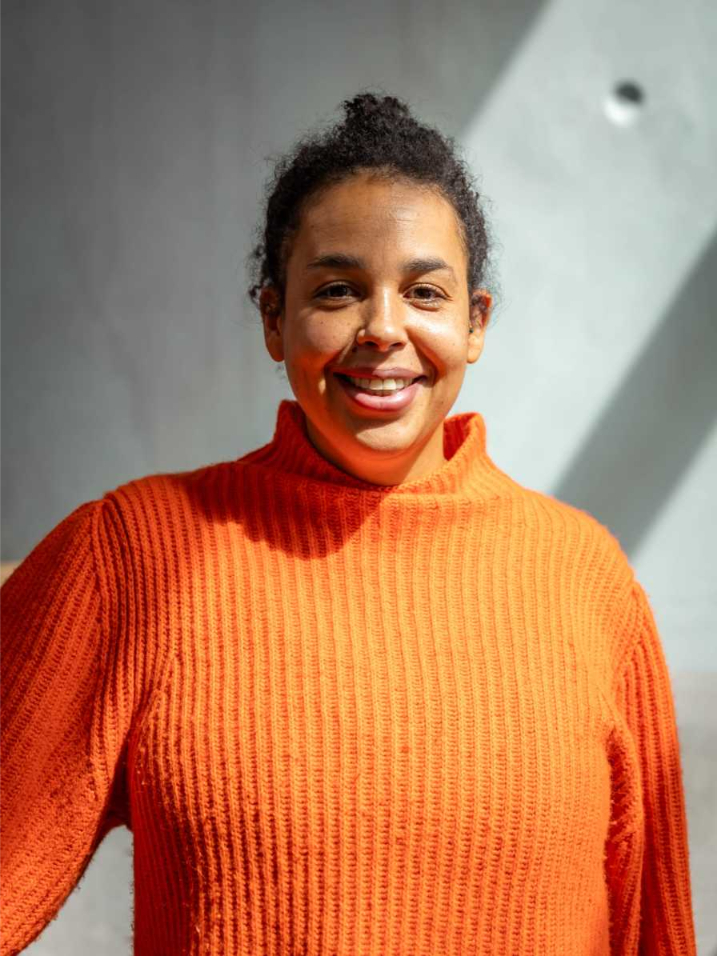
Who are you and where do you work?
My name is Anna Rößner; I work as a postdoctoral researcher at the Marketing Chair within the Faculty of Business Administration and Economics. I am also a member of numerous committees, such as the Staff Council, and have previously served on the Faculty Council and the Senate.
Why did you come to Viadrina?
I took my A-levels in Berlin and even back then it was somehow clear to me that I wanted to come to Viadrina, because it already had an international focus at that time. At Berlin’s universities, you could only study subjects such as International Business Administration to a limited extent. I then spent some time abroad and completed my Bachelor’s degree elsewhere, but came to Viadrina for my Master’s. I also knew lots of people who were very happy at Viadrina. After completing my degree, particularly whilst writing my final thesis, I discovered my passion for academic research. I really liked the department, I was really keen on my topic, and so I returned to Viadrina as a PhD student in 2016. The topic of my doctoral thesis was ethnic and religious minorities in advertising, and in my current research I have expanded on this to look more generally at the consumer behaviour of certain stigmatised, socially disadvantaged or minority groups.
What would it take for the many people at Viadrina to come closer together and build connections?
I think the most important thing, in any case, is that all social groups should develop a bit more understanding of one another, including an understanding of different life experiences. I also believe that individuality, so to speak, should be encouraged more. Since 2016, I’ve noticed quite clearly that everyone keeps to themselves a bit; nobody really knows one another. There’s the group that lives in Frankfurt – the people there perhaps know each other a bit better. Then there’s the Berlin group, and that often doesn’t exactly inspire positive feelings when the Berliners just turn up and then leave again very quickly. So I think that more understanding, more interaction, more dialogue and more communication are important. There’s also sometimes competition for funding or resources between the different faculties. It would be nice if these different groups were simply brought together a bit more. I suggested at one point that we organise a lunch speed-dating event, so that we could interact more and meet people we might otherwise have nothing to do with at all. I was told, ‘Why don’t you give it a go?’, but at the time I was still writing my doctoral thesis and simply didn’t have the resources for it. In itself, I think it would be something simple that lots of people would take part in. I believe that all the various events we already have – such as the summer party or the individual events organised by different groups – are definitely a step in the right direction.
What are your hopes for the future of Viadrina itself and for your work here?
On the one hand, greater visibility for what Viadrina actually is, what it stands for, and what it has to offer. I’m convinced that Viadrina really does have a lot to offer, both in terms of teaching and research, as well as everything else that goes with it.
We have so many dedicated staff and offer fantastic opportunities beyond teaching. We now have the Diversity Days, we have a Family Office that organises events regularly, we’ve had the Health Days, and the student initiatives have also really got a lot off the ground – yet I sometimes feel that this goes largely unnoticed and lacks visibility. It’s important that this is brought more into focus, communicated and valued. I’d like to see everyone moving more in the same direction and working towards the same goal. I also get the feeling that everyone has different goals, and of course different staff groups and departments have different requirements, but I think it would be good and important to collaborate a bit more and work towards the same objectives. Also, a bit more flexibility when it comes to individual life circumstances. I’ve only really realised this now, having been on parental leave last year. Before that, the issue wasn’t relevant to me at all, but now I realise that you have to fight for everything, at every turn. Sometimes I’d simply like to see more understanding and support, and a willingness to seek individual, flexible solutions, rather than this idea of ‘this is how we do it and we can’t deviate from it’.
This would also have a positive impact on teaching and for students: lecturers, for example, would like to offer online teaching again so they can make their courses more flexible. But the university’s requirement is that teaching must predominantly take place in person. Of course, I can only speak for our Faculty, but they’ve come up with such innovative formats! Particularly all the finance courses – what they’ve managed to do with R on various platforms – is, I’d say, even better teaching than in face-to-face sessions.
When you’re not at Viadrina, what do you get up to?
At the moment, I’m naturally spending a lot of time with my child. Generally speaking, though, I’m very active; I try to learn lots of new things, get to know different aspects of life and put myself in other people’s shoes. I try to live my life mindfully, sensitively and with a sense of social responsibility. Treating one another with respect is important to me, as is the sustainable use of our resources, and I always try to keep learning, read a lot and broaden my horizons. Otherwise, I do a lot of sport and spend time outdoors; I really enjoy organising things and try to bring people together to build networks where we can perhaps exchange ideas and support one another.
It’s absolutely crazy how priorities can change like that. I used to organise picnics, brunches, running dinners and things like that all the time; then COVID-19 hit and I simply didn’t do anything, and now it’s becoming relevant again. I think other things are becoming more important to me again right now, because I want to equip my child with as many tools as possible so that they can understand different realities of life, become empathetic and sensitive, cope with challenges, and perhaps also have a network where they can find support. I don’t yet know how my child will be perceived later on, but I’m definitely trying to build networks that aren’t made up solely of white people.
What is the connection between you and the issues addressed by the Equal Opportunities Division?
I’ve had some contact with the division before, as we once discussed the possibility of organising something together. Naturally, issues such as racism, discrimination and, above all, intersectionality are very, very important to me. I’ve been engaging with these issues for a long time – partly because, as a woman perceived as non-white, I have experienced multiple forms of discrimination myself, but also because I want to be sensitive, whether in my choice of words or in my interactions with other people who may have different identity markers, or who face discrimination because of their gender identity, religion, sexuality, etc. These are issues I therefore spend a great deal of time thinking about. My research is, more or less, also focused on this. Of course, there’s the marketing context, but it’s still important.
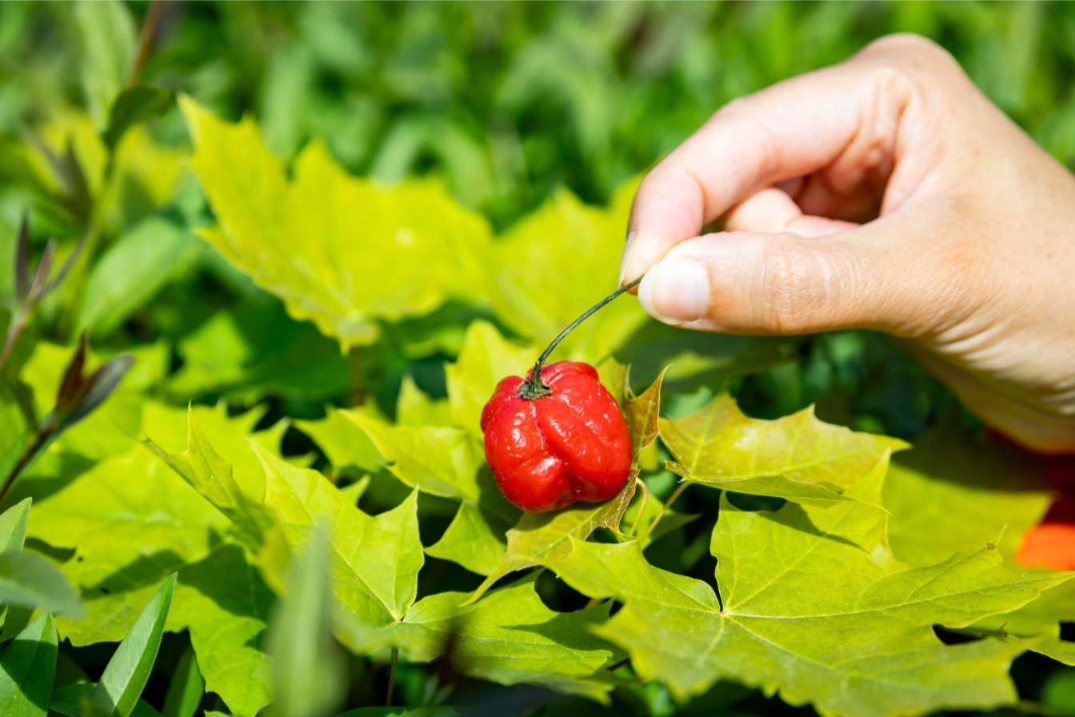
You’ve brought a chilli pepper with you. What does it symbolise?
On the one hand, I absolutely love cooking; it’s something that goes back to my childhood. My dad used to cook loads, including at street festivals, the Carnival of Cultures and so on. Among other things, he always used to make a chilli sauce that everyone loved and which, in my opinion, is the world’s best chilli sauce. I’ve got the recipe and I make it myself regularly. I always found it absolutely lovely to see how people celebrated the food – it made everyone happy and created a sense of togetherness.
That’s definitely why I’ve chosen the chilli as a symbol – but also because I simply love my food very, very spicy.
Is there anything else you’d like to share with us?
I’d be delighted if everyone continued to champion certain issues so passionately, and I’d like to see the university focus more on the topics the department is working on, so that they don’t fade into the background.
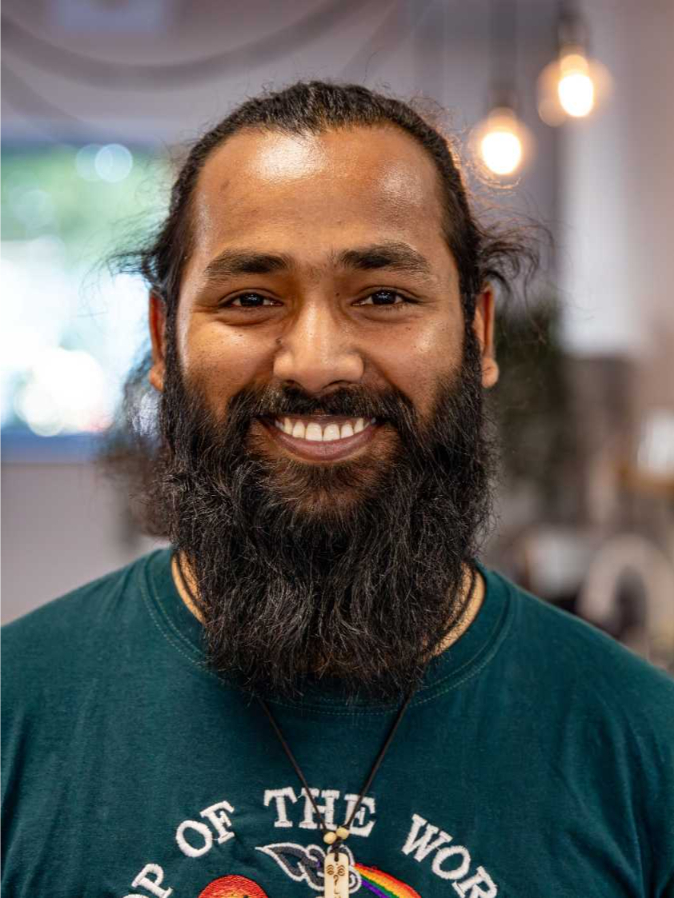
Who are you and what are you studying?
My name is Awanish and I’m studying for a Master’s in Digital Entrepreneurship (MoDE) at Viadrina. I’m an international Viadrina ambassador and am setting up ‘The German Guy’, a company that supports people who want to study or work in Germany. For a few years, I volunteered to mentor students, then I thought: “Why don’t I just set up a company through which I can support students, especially people from Nepal who don’t have the necessary resources?” I wanted to set up something where I could help people. So far, I’ve advised around 300–400 students and professionals free of charge. People think I’m mad, but I’m happy to help.
If these people go to other consultancy firms or agencies, they pay a lot of money. For example, if people here in Germany want to do a bachelor’s degree, they usually go to consultancy firms because they may have only just finished school, don’t yet have enough information and don’t know where to start. There, they pay around 4,000–5,000 euros; that’s the minimum fee if someone goes through the application process with a consultancy firm. I now charge a small fee myself, having done everything for free for a long time, because I invest a lot of time in the application process and advising clients. So I’ve changed the process and the whole business model, and it’s quite simple: if I spend a lot of time with someone, then they have to pay for my time, which amounts to about 25 per cent of what they would pay to a consultancy firm. Sometimes it’s too much for them and they don’t have to pay, but they have to make an effort themselves and try to sort things out. And if they need support, they can let me know. I’m always there to support them throughout the whole process. I help people put together a CV and personal statements, find a university where they can study here, and also with the financial documents they need to submit for a student visa to come to Germany. I support them right from the start, right up until they arrive here. After that, I can help them find a student job or accommodation. People can find me on my social media channels, on YouTube and on my website. I’m active across all platforms now and try to help people.
Why did you choose to come to Viadrina?
Whilst many students cite Viadrina’s transdisciplinary nature, its diversity and its unique location in the twin cities of Germany and Poland, my decision was primarily influenced by the MoDE programme, which aligned perfectly with my future business plans. Together with my nephew, who lives in Australia, we set up a company in Nepal that was a B2B marketplace; then we set up an IT services company in Australia; and then ‘The German Guy’ came about. We’ll see if they grant me the copyright for the name, but I’ll fight for it. These were the things I’d already had in mind before I applied to Viadrina. I wanted to study something related to this that would help me put these ideas into practice. Before that, I studied Data Science at TU Dortmund, but I realised I didn’t always want to work for other people. I wanted to set up my own business and apply my expertise to my own ventures. So I switched to MoDE.
What would it take for the many people at Viadrina to come closer together and build connections?
Expanding the range of courses taught in English would be beneficial, as would integrating modern technological advances into traditional courses. I have a background in computer science and feel that some courses are still teaching the old methods I started with back in 2014. Now is the time to embrace and apply new technologies. For example, there is currently a great deal of excitement surrounding AI, and these new trends and market demands can be incorporated into courses whilst still teaching older technologies as well. Furthermore, introducing more extracurricular activities, such as additional sports tournaments beyond ViaRun, could foster a stronger bond between students and lecturers.
What are your hopes for the future of Viadrina itself and for your studies here?
I just need to write my Master’s thesis, then I’ll have completed my MoDE degree. I’m grateful to the supportive lecturers at Viadrina who have helped me refine my ideas and put them into practice. I’d like to see more international students come to Viadrina and successfully complete their studies so they can pursue careers in the fields they’re interested in.
When you’re not at Viadrina, what do you get up to?
I’m a workaholic. When I’m not at Viadrina, you’ll find me at home, in the office or at CWS. My main focus is on my part-time student job at AutoScout24, managing my start-ups and being active on social media. At the weekends, I play cricket.
What is the connection between you and the issues addressed by the Equal Opportunities Division?
On the issues that matter to me: I believe that promoting equal opportunities for everyone, regardless of their background, gender, ethnic origin or other characteristics, is incredibly important. I am a passionate advocate for efforts to create an inclusive environment in which everyone has the opportunity to flourish and succeed. As an international Viadrina ambassador, it goes without saying that it is important to create an environment in which everyone feels valued and has equal opportunities to thrive.
The Equal Opportunities Division plays a crucial role in promoting fairness, inclusion and diversity within the university community and beyond. Its commitment to these issues contributes to positive change.
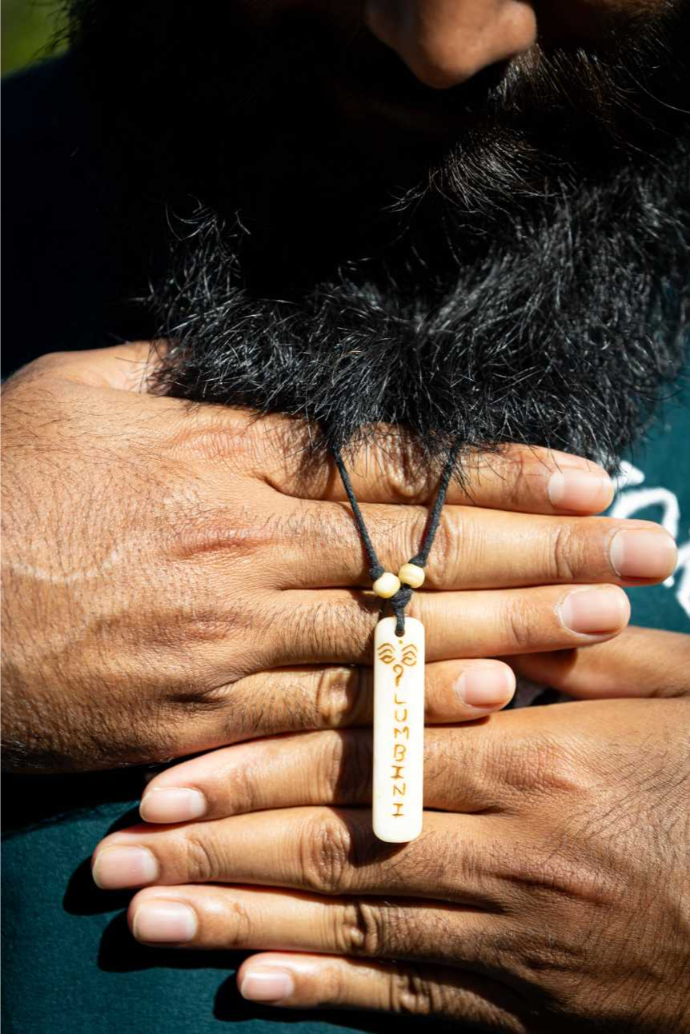
You’ve brought your necklaces with you. What do they mean to you?
These necklaces have a special meaning for me. The cylindrical one came from an elderly man in my village, who was my neighbour and a sort of priest. He made this necklace for me and waited almost a year for me to return to the village. It gives me spiritual protection. Then there is another necklace that I bought in my home town. It is made of elephant tusk and bears the inscription ‘Lumbini’, the name of the town where I was born and which is also the birthplace of Lord Gautama Buddha. I practise meditation, so the necklace suits me. When I wear it, I feel positive and calm and can concentrate on my tasks. There’s another one that one of my five sisters gave me. It’s associated with the goddess of wealth. I wear these necklaces every day. There’s one I simply can’t take off; I could take the others off, but I don’t.
Is there anything else you’d like to share with us?
Please feel free to share any further thoughts, experiences or wishes you may have relating to your time at Viadrina or beyond. Your unique perspectives are important, and I’m here to listen and engage with you.
Who are you and where do you work?
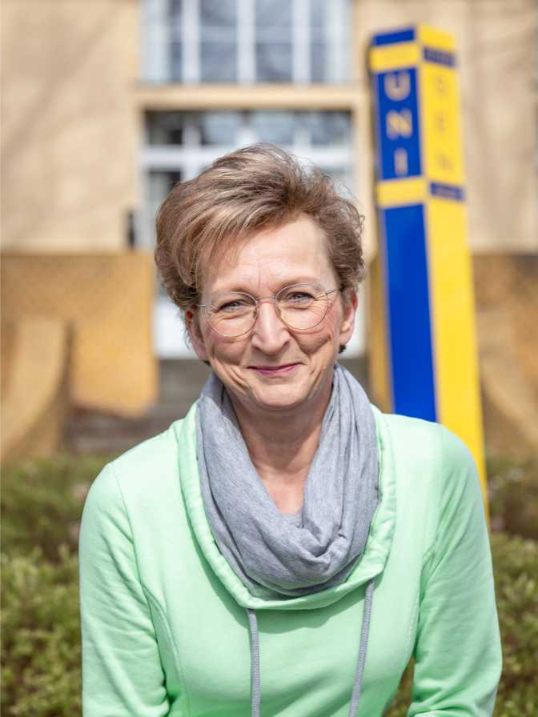
My name is Jana Wenzel. I’ve been here at the university since 1993 and spent the first seven years working with Prof. Schweisfurth, who was my first supervisor. Since 2000, I’ve been working alongside Prof. Heintschel von Heinegg in the same department.
In 1996, we moved out here to August-Bebel-Straße with Prof. Schweisfurth because building work was starting in the Main Building, which had previously been shared with the tax office. New windows, wall openings and so on. And then all the chairs and staff who were based in the Main Building at the time were asked whether we wanted to move within the building whilst our rooms were being refurbished, or whether we wanted to escape all the noise and mess and move out here to August-Bebel-Straße for the duration. We’d had a look at the rooms back then and were, of course, absolutely thrilled! There’s a circular room next door – it’s fantastic! After that, we never wanted to go back. When Prof. Heintschel von Heinegg started in 2000, he came here for the first time; we got to know each other and then I asked him if he thought this place was great and if we could stay here. He had a look round his office and said: ‘Of course!’ We’re definitely staying here!
Why did you come to Viadrina?
I’d previously been working as a secretary in Schwedt and then moved to Eisenhüttenstadt for family reasons. I actually wanted to sort out the flat first, but then the Jobcentre immediately offered me a further training course to become a foreign-language secretary, and I did that, though I was very unhappy with it. It was supposed to last over two years, and the first year was just secretarial training; the English training wasn’t due to start until the second year. But I’d already been a secretary for a few years, so it wasn’t for me. Then I read an advert in the newspaper from the university saying they were looking for secretaries for the new professors; I applied, came here for an interview, and I’ve been here ever since.
What would it take for the many people at Viadrina to grow closer and build connections?
This is the question I’ve given the most thought to, because ideas about coming closer together didn’t spring to mind at all – instead, the reasons why we’ve drifted apart came to mind straight away. To give a small example: Until a few years ago, when it was time for the annual stock-take of the department’s equipment, the ladies from the cleaning service would come here with their stock-take lists, check everything, have a natter, sometimes even have a coffee together, and then the annual – or I think even biennial – stock-take was over. Nowadays, the lists are sent to me and I go through them myself and make a note of everything. That’s something that has driven a wedge between us. Or take Formcycle, for example: in the past, when I submitted a procurement request, I’d stick a little note on it saying, ‘Thank you very much for your trouble, Ms Dochow, you’ve been a great help to me’. Nowadays, you just send it off; you no longer have any control over where the request is at the moment, what’s happening with it, whether my colleague is going the extra mile for me or not, and so on. Or take the postman: that used to be done by our lads from D4; they’d sometimes pop round with slightly larger or bulky parcels and we’d have a bit of a natter. Now PIN does it; you don’t know the people, they’ve got nothing to do with the university and they don’t even come into the office. I do understand the need for change, but something has been lost in the process and I don’t know how we can put things back the way they were. You do find yourself wondering: who comes up with these ideas and who thinks about the consequences? It might be easy enough to just fill in a form on the computer, but I’d have carried on submitting a request as I used to and stuck my little note on it. And as lovely as all these parties are that take place here, they’re not for everyone. That’s a shame.
What are your hopes for the future of Viadrina itself and for your work here?
For me personally, of course, my greatest wish right now is to have another brilliant boss, who’s due to start in October. I hope that our teamwork and the work itself will continue just as well in future as they have done so far.
When you’re not at Viadrina, what do you get up to?
I’m a gardener through and through! I have a small garden, so I’m out there from April to September and really come into my own. That’s actually what brings me joy, what I love doing, and what I get up to when I’m not here.
Nine years ago, I brought my parents to live with me in Frankfurt, and they’re still involved as much as possible. I look after them now, and that will certainly become even more of a priority as the years go by. Before that, we were just under two hours apart, so we were always on the move. On top of that, I was in a serious car accident a few years ago and, well, at first I didn’t really realise it, but as time has gone on, I no longer want to drive such long distances so often. I also don’t want to be away from my little oasis out in the garden for very long anymore. That’s probably down to my age as well, but even so, the arrangement we’ve now worked out with my parents is the very best thing that could have happened. Above all, because the flat right next to mine became available at just the right moment!
What is the connection between you and the issues dealt with by the Equal Opportunities Division?
Naturally, this care situation is the most important thing for me right now. They aren’t yet completely dependent on care, but it will become a major concern for me at some point. As it isn’t that urgent at the moment, it’s mostly been about doctor’s appointments or dealing with the bank or insurance company – more organisational matters, which I’m taking care of now. I used to work full-time, but I’ve voluntarily reduced my hours for the second year running and I realise that I’m very happy with this arrangement. I’m now working 30 hours a week, and that naturally makes it easier to find the time to drive them to the doctor and also to sort out my own appointments – that used to be more difficult. It really used to stress me out trying to juggle so many appointments for myself and my parents. Fortunately, the university is relatively flexible, including when it comes to health measures. I’ve also been attending physiotherapy full-time since the accident, and it’s great that this is possible.
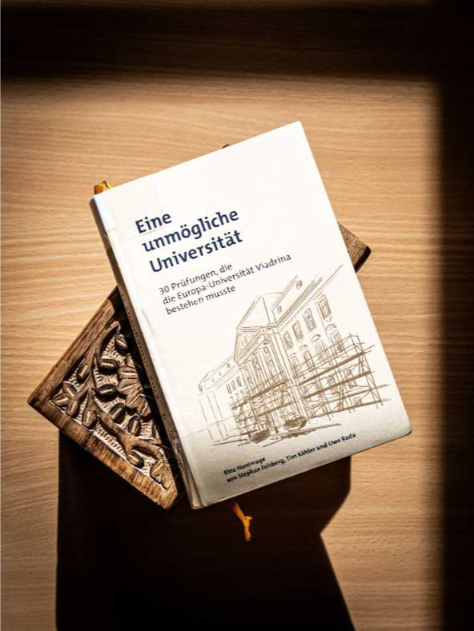
You’ve brought a book with you. What does it mean to you?
I thought about it for a long time, but I felt it was very fitting. It’s the book *An Impossible University – 30 Exams the European University Had to Pass* by Stephan Felsberg, Tim Köhler and Uwe Rada. First of all, I’m a proper bookworm through and through – I read all sorts of things. But a few weeks ago there was an obituary for Prof. von Brünneck, and this book was mentioned in it. So, naturally, I went straight to the University Library to get hold of it and read it in one go. It brought back a lot of memories for me, because I’d actually experienced everything described here right from the start – and, of course, hadn’t thought about it for a very, very long time. It didn’t just make me feel nostalgic; it also brought back memories of when we first started out. The modest resources with which we tried to get something off the ground here from scratch! It’s something that really moves me at the moment and also holds a strong personal significance for me. The 30 exams were published to mark the 30th anniversary, and yes, although I’ve been here for longer than 30 years, it feels right for me now.
Who are you and where do you work?
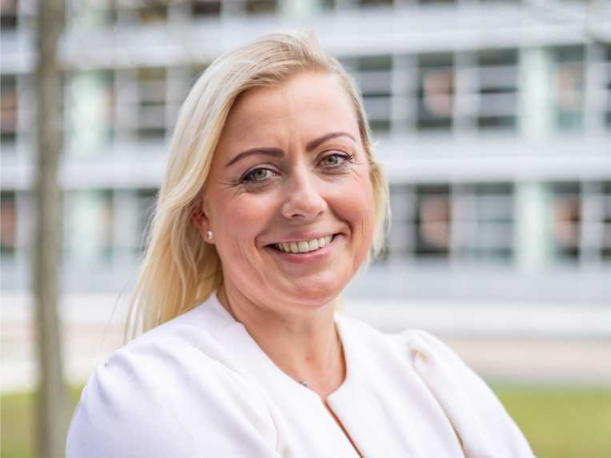
My name is Julia Walter and I’ve been working at Viadrina for almost 20 years, so I’m something of a veteran. I originally trained here as an events technician and, whilst doing so, also qualified as an electrical engineer; I was then taken on permanently and have stayed ever since. Over these 20 years, I’ve ‘shown many of our students the ropes’, as we call it. That means supporting them in planning their events, whether seminars, colloquia or other activities. I’m very involved in this and appreciate that I can still relate to the students on an equal footing, even if that’s becoming a bit trickier after such a long time. At first, I was also met with scepticism as a young woman in a technical profession, but many realised relatively quickly that it works well. Over the years, I’ve also shown that it’s possible to develop further and build something that will remain at the university in the long term and from which everyone can benefit.
Why did you come to Viadrina?
It’s quite simple to explain: my mum opened the newspaper! I was very young when I finished my A-levels; I’d just turned 19. I actually wanted to go into media design and attended several interviews in Dresden, Munich, Hamburg and Berlin, but back then – just like today – it was difficult to find a flat and afford it on a trainee’s salary. In the end, the only option left was to decide that I would stay in this area. So the offer from the European University, which had advertised a trainee position as an events technician, came at just the right time; I wanted to apply straight away. I didn’t make any effort for the interview, though – I turned up in jeans and a T-shirt and took it all rather casually. Of course, I could say that I enjoy organising things and am good at it and so on, but when it came to the technical questions, I was out of my depth; I thought they’d never get in touch. I hadn’t even quite got home when they rang and offered me the job. That was in the summer of 2004. The fact that I’m still here now wasn’t necessarily part of the plan, but everything has simply turned out very well.
What would it take for the many people at Viadrina to grow closer and build connections?
I think these so-called ‘Corona years’ have really taken their toll on us. Many people take the luxury of working from home for granted; I myself hardly ever do it. That’s one reason why everyone has distanced themselves from one another. Everyone looks at each other differently, stifles that obligatory cough or keeps their distance. And as a result, the bond with the students has been sorely missed. After all, in 2020 we had to switch everything over within days and set up a hybrid system using resources that weren’t even available yet. We ended up working with laptops that we set up however we could, simply to tell our students, ‘We’re still here!’. That caused a lot of damage. Social change has also made many things more difficult; people have become more cautious.
The only thing that can help – though this is just my personal opinion – is for Viadrina to remember the principles on which it was originally founded. Viadrina used to be a family, and everyone referred to it as such. Now there’s a lack of transparency, so we don’t know where our President is heading, or our Vice-Chancellor, our immediate line manager, or our colleagues. We no longer use the channels of communication as we used to – having a proper chat in the corridor, or students feeling confident enough to speak to us directly. I simply miss that family-like atmosphere and transparency. And Viadrina can only achieve this by doing more for its staff again. The trend in 2024 is that we have a strong political presence; you can see this in the many political events currently taking place, which are intended to reflect the global situation. These are all good events, but they do nothing for the university from within, and that has to change. Our student numbers are falling, and whilst we’re doing everything we can to make the university more attractive to the outside world, we also need to become more attractive internally.
I still remember the days when students used to put on musicals that we produced. The university summer party used to be absolutely brilliant! Everyone took part. But back then, none of it cost as much money as it does now. Now, of course, it’s a huge undertaking if you want to book a band and comply with safety regulations, and so on.
What are your hopes for the future of Viadrina itself and for your work here?
I think working from home is a brilliant idea, and I think work-life balance is a brilliant idea too, but in moderation. I work in a department where 50–80 per cent of the staff can’t work from home because they’re tradespeople, electricians, or staff from the photocopying centre or the post office. They’re not allowed to work from home – what on earth would they do there anyway? Are they supposed to sweep their own garden at home, or what? For me, it would be nice if we could come together more again and stop prioritising working from home so highly. Of course, it’s a great perk for people who are starting out here young, with families and children or whatever, but the employment contract states ‘place of work: Frankfurt (Oder)’. I don’t think working from home is a bad thing, but as I said, the sense of connection between us isn’t what it used to be. I often find myself wondering: Are they even still here? Are they still working here, or have they slipped seamlessly into retirement? Who on earth is that? Who’s messaging me – I’ve never even seen them before?
Another thing I want to get across more to the outside world is that we’re not just a university and an employer – we also provide vocational training. At the moment, I’m the trainer for two apprentices here. I’ve been lucky enough to have two young women as apprentices and to have been able to guide them into working life. In September, a new apprentice will be joining us, and a young skilled worker will be moving on to the wider world of work. We’re quite well positioned when it comes to the technical trades we train for.
When you’re not at Viadrina, what do you get up to?
Just as it’s unusual for a young woman to train for a technical profession, my private life is just as unconventional. I haven’t been away much – let’s put it this way: I own a farm and a house. Of course, I did run away a bit in my youth and lived in Frankfurt for a while and in Berlin for a few months, but I never really got far away. I’m very keen on DIY; I love building things, whether with stone, concrete or wood. I’ve got a thing for engines, of course – cars, big vehicles that make a lot of noise, or motorbikes, boats and jet skis. That’s my life! My day starts early at 4.50 am; I get up feeling relaxed and am usually here at work by 6 am, unless it’s a late shift or something like that. And that’s exactly how I head home too; I’ve got the 45-minute drive to completely wind down and look forward to either knocking down some walls or putting some up, or working on jobs for other people. I’ve got a huge circle of friends who just pop round all the time. It usually ends up in the party room or round the fire. That’s my life – I wouldn’t have it any other way, and I certainly don’t want to be forced to change. I’m always happy to help; I’m actually not very good at saying no.
Sometimes I feel the urge to get out and about; I’ll come home from work, jump onto the boat and dive headfirst into the lake, because I live right by the water. In the evening, I realise it’s been too long again, and then I’m standing on the jetty getting bitten by mosquitoes because I didn’t get the tarpaulin onto the boat in time. You’ve got to have a bit of fun like that, even if it means forgetting that you’ve got to be up early again in the morning. I never get bored.
What connection do you have with the topics covered by the Equal Opportunities Division?
I find the ‘Women in Leadership’ programme particularly interesting. That was actually the deciding factor in my first becoming aware of your division at all. Before that, it was just a side issue for me – something that simply exists within the university’s structure and has to exist, but there were no other points of contact.
But the ‘Women in Leadership’ programme was very important to me because I’m part of complex structures here; so whilst I’m a sort of team leader, I don’t actually have much say. I wanted to use the programme to make my mark. In 2015, whilst working, I completed a Bachelor’s degree in Event Management, and in 2023 I completed a Master’s in Technical Business Administration. Just as in my private life, I can’t stand still professionally either. This programme was simply intended to show me how I can help my team become independent, as it has grown significantly over the past few years. This has been a work in progress for some time now, but perhaps there will soon be a separate division for event technology and event management. We’ll have to wait and see exactly how that will be structured in the end. I also wanted to learn from the ‘Women in Leadership’ programme how to interact effectively with my colleagues in my intended role as a department head. Whether this is a weakness or not, I’m a very honest person and can often come across as quite forthright, which some people don’t cope with very well. That’s why I enrolled on your programme – to learn how to handle this better – and I also think it’s been very beneficial. I’m so grateful that I had the chance to meet the programme director; I was really impressed by her – it was a great encounter.
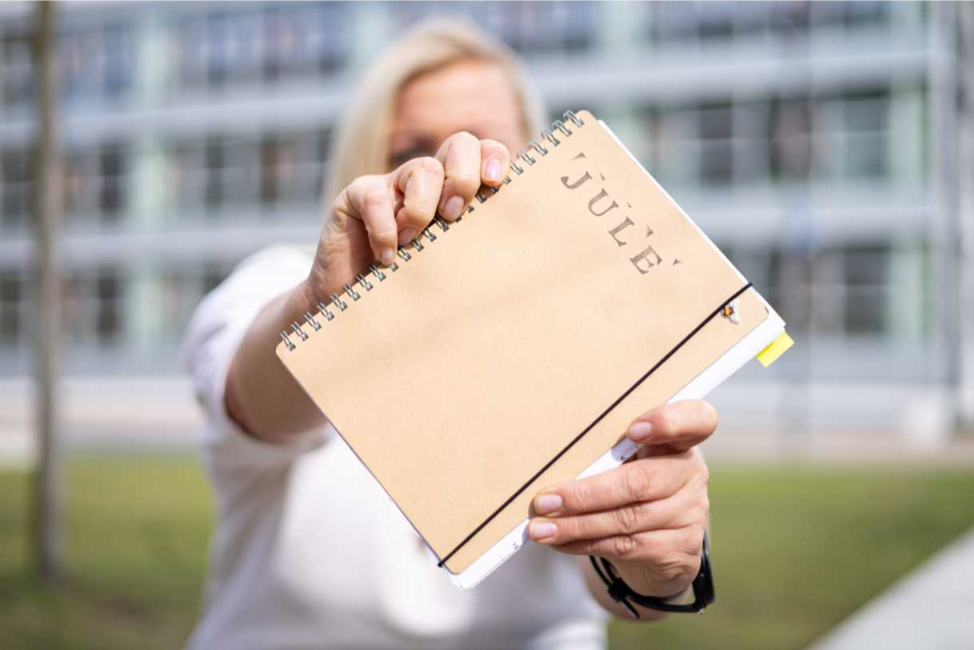
You’ve brought a notebook with you. What’s the significance of that?
It’s the ‘Women in Leadership’ notebook you gave me. I wrote two short stories in it back when I attended the workshop. We were asked to imagine where we saw ourselves at university following this expansion of our knowledge. Now, when I have days here where I’m hitting a brick wall – where something or someone isn’t going the way I’d like – I keep going back to read those two stories. That’s why the book is always in the private compartment of my desk.
Otherwise, it’s not so much a particular object that defines me personally, but rather the fact that you always see me walking quite quickly. It’s probably a departmental habit here, but in any case, you always see me walking briskly between the buildings.
Who are you and where do you work?
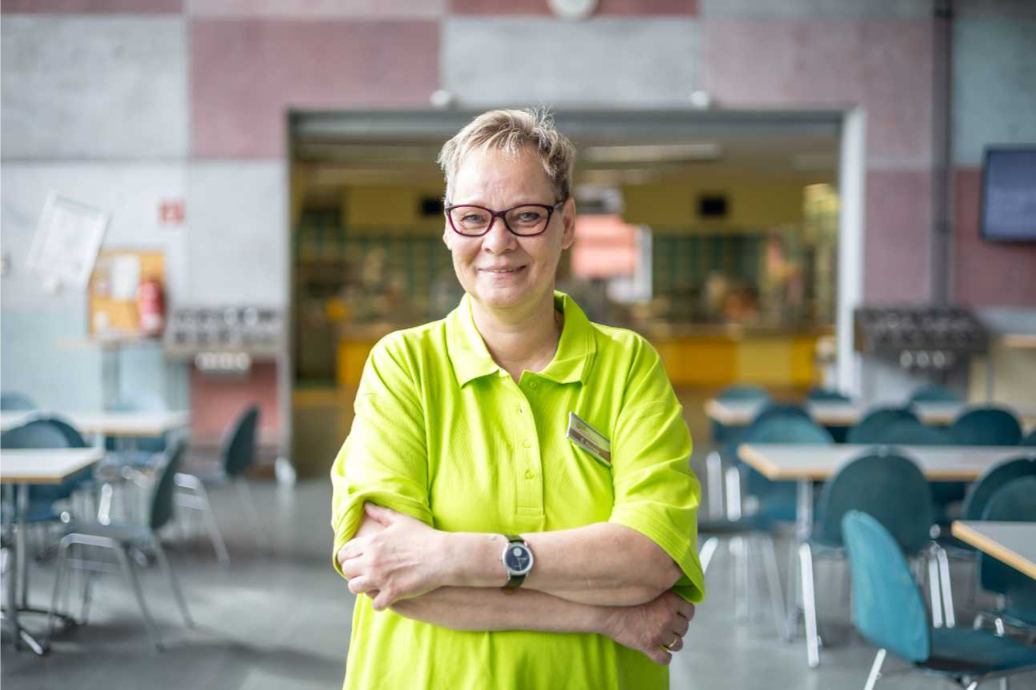
My name is Katrin Hennig and I work here in the Studentenwerk canteen. I mainly work at the till and help organise events, as I have a background in the service industry.
Why did you come to Viadrina?
At the time of the fall of the Berlin Wall, there was all that upheaval, and naturally I was looking for a new job; I got this one through an acquaintance. I’ve been here for 23 years; I started in the former bistro in the low-rise building/Audimax and then moved over here when this building was built. I then took over the bistro in the GD and am now working in the canteen.
I enjoy being here; I like working with young people – I’ve always done that, even back in the GDR days. It’s always been my thing. I find it keeps you feeling a bit young yourself. It’s particularly lovely when former students pop in and introduce me to their children – I always find that absolutely brilliant.
What would it take for the many people at Viadrina to come closer together and build connections?
I can see the problem: Berlin isn’t far away. And anyone who, let’s say, wants to go out, goes to Berlin. What do we have in Frankfurt? For example, the Helene has closed down; students used to always hold their beach parties there. We’re missing all that a bit, including the cultural scene. We need to make the city more attractive again and link it more closely with the university, so that people can get together and do things outside of campus as well.
What are your hopes for the future of Viadrina itself and for your work here?
I think the university and the Studentenwerk need to communicate with each other much more. Especially when there are events attended by international students who might not speak German very well. I myself, for example, haven’t learnt English. We need support staff so that people who aren’t very proficient in German can be better looked after. Sometimes we’re left standing there, trying to explain with gestures how everything works here. Take the card machines, for example – lots of people struggle to get to grips with them at first. We can have a natter in German, but it’s a bit… You don’t always have the time to explain everything either; the till’s busy, and you can’t just walk away. We’re definitely keen to help people, but it’s difficult. You can only use the card machine with a debit card; it would be better if it accepted credit cards as well, so that international students could top up their cards using their Visa cards – that’s not possible at the moment. And most people don’t have debit cards.
When you’re not at Viadrina, what do you get up to?
When I’m not here, I spend a lot of time at Helene – I’ve got a bungalow there. That’s my way of unwinding in my spare time, and I really enjoy it. Apart from that, my husband isn’t in the best of health, so I look after him and worry a lot. It’s exhausting, but it’s all I’ve ever known. Even back in the days when I worked in the catering industry, I was always stressed, but I always managed to cope with it. It’s not so easy at my age, but oh well. I read a lot, too. Otherwise, I’m quite a quiet person; I don’t go out or anything like that – those days are over; I don’t need that anymore.
What connection is there between you and the issues dealt with by the Equal Opportunities Division?
You’re all about equal opportunities, and as far as my work here is concerned, I think: we have men and women here, and all the women are part-time staff. And we women have no chance of being promoted. I find that unfair. They could have spread it out a bit more. The work gets harder and harder as you get older, and you really should be thinking about the future. As I’m only a part-time employee, I can’t afford to retire at 45 either, as the pension deductions would otherwise be very steep. When I look at my own situation, I’ll probably end up slipping below the poverty line. That’s what bothers me. What’s more, this job isn’t attractive enough anymore – young people aren’t coming through and we’re all getting older. Even if young people want to do it, who can make a living from part-time work? Especially here in the hospitality and catering sector, we simply need chefs and service staff.
Apart from that, we’re at an international university, so it should go without saying that we’re open to everyone. That’s my opinion.
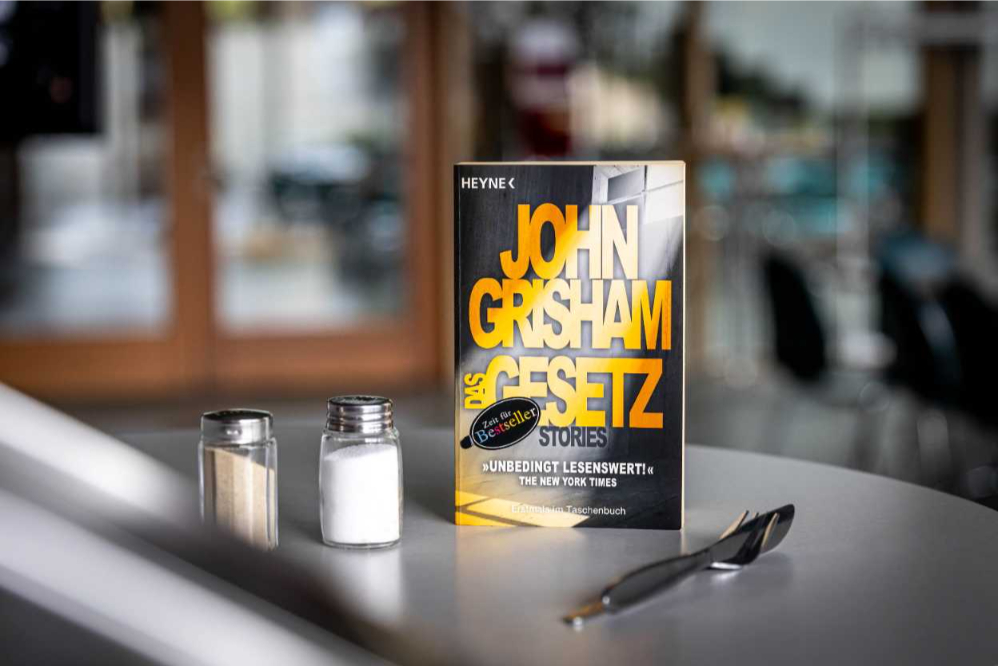
You’ve brought a book with you. What’s the significance of that?
As I said, I love reading, especially John Grisham. He writes crime novels and does so very authentically, because he used to be a lawyer. I’ve got at least 10 thick tomes by him, and apart from that, probably around 80 books in total at home. I’ve got a huge bookcase in my bedroom, packed full of books from top to bottom. I can’t bring myself to throw any books away either – it’s too much of a waste for me. I’ve always been interested in crime novels. If I’d had a different life or been a bit smarter, I might have gone into forensics.
Is there anything else you’d like to share with us?
There’s one thing that’s really weighing on my mind. I don’t want to tar everyone with the same brush, for goodness’ sake, but many students lack respect for the people of Frankfurt, especially when it comes to the elderly. I travel by tram every day, and our students are all sitting down; the elderly get on, and nobody stands up. That really annoys me. A while ago, an elderly gentleman with crutches got on, and I had to raise my voice to get someone to stand up. I can still stand up myself, but I mean, they sit in the lecture theatres all day and they’re all young; they’re staring at their mobiles and don’t even look up. But I also reckon it’s always been like that. For goodness’ sake, I’m not saying that our young people here are any different – they’re probably just the same. Perhaps it’s down to the mindset of young people, but it really strikes me. I don’t want to make a big deal out of it, but it annoys me every day. Some people simply don’t notice what’s going on around them; sometimes it might be stubbornness, or perhaps a lack of humanity – I don’t know.
Who are you and where do you work?
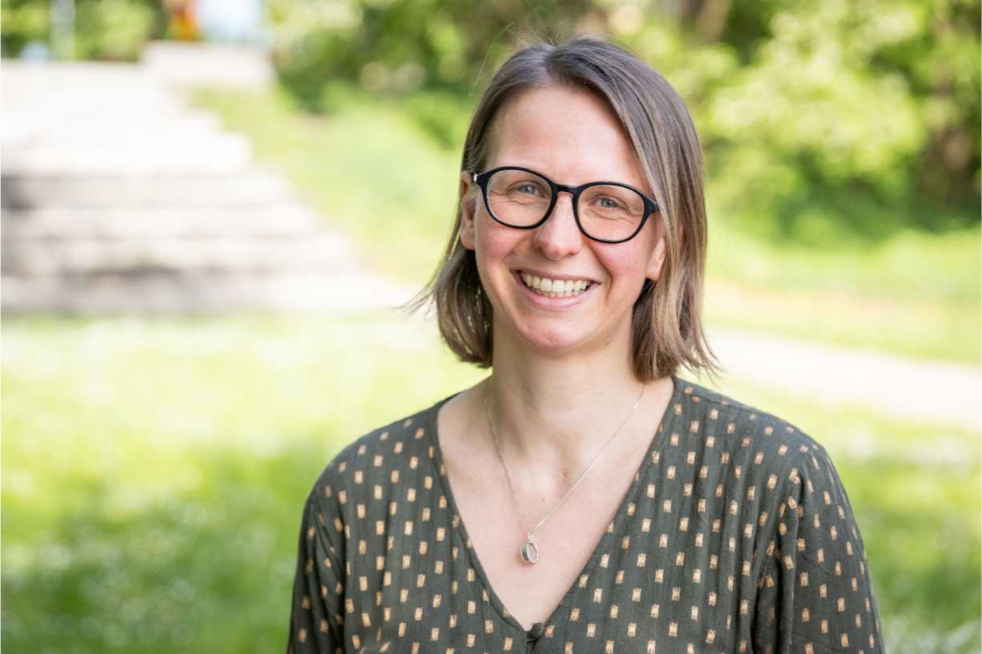
My name is Nicole Klück; I’ve been working in the Division of International Affairs for many, many years, and my role here is to send students abroad. I also take care of the formal, administrative background work; in particular, I draw up the agreements with partner universities, liaise with them and handle all the little details that need to be sorted out to ensure everything runs smoothly. I’m also responsible for the formal recognition of credits earned abroad by Bachelor’s students in Cultural Studies, and I advise on the establishment of dual degree programmes.
Why did you come to Viadrina?
I came to Viadrina in the summer term of 2003 to study Cultural Studies. Above all, I wanted to further develop the foreign languages I already spoke – English, Spanish and French – as that was important to me, and I was determined to go abroad again. I’d previously been an au pair in Madrid and felt that I wouldn’t be able to go abroad again unless it was a compulsory part of my degree.
I then applied to spend a semester abroad in Spain and saw a poster on the door of the International Office saying they were looking for an intern, and I still had to complete an internship. So I did the placement here, then became a student assistant, and at some point I was also a research assistant – and I just ended up staying. My responsibilities have always changed, and since 2010 I’ve been doing what I do now in a permanent role.
What would it take for the many people at Viadrina to grow closer and build connections?
I often notice that we simply listen without really hearing, that we aren’t truly open to the person we’re talking to, or to different opinions and goals. It’s sometimes hard to step back from your own opinion. It’s a complex mix of factors, but I do get the feeling that we’ve lost sight of the bigger picture a bit and it’s unclear what the university as a whole is actually all about. Why are we all here? I don’t mean why I’m here in my office doing my job – I can easily explain that to myself every day. But I am, after all, part of a bigger picture here, and sometimes you don’t really notice that anymore. In practical terms, it might really come down to things like social gatherings – simply getting together, whether it’s for a Christmas or summer party, an open day or other events. When you bump into each other at events, or on the train, or in the corridor, and strike up a conversation. I’ve noticed this here at our office: we’ve had a kitchenette for a few months now – something we’ve never had before – and suddenly people from different departments are meeting up there whilst boiling water or putting things in the fridge. That does change things in very subtle ways, because suddenly you speak to one another differently and interact differently than when you come together because you have a question or need something.
I really don’t want to put everything down to the pandemic, but I do feel that this period has marked a major turning point here. So much more is happening online, which is very practical. But some students are asking to join me in online meetings. I’ve now gone back to requiring students to pop in in person before their stay abroad, because it’s so important to me to make direct contact with people. It’s about refocusing on what really matters: of course, we work professionally here, but we’re still dealing with people.
What’s more, many years ago we had Gesine Schwan, who was simply an exceptionally strong President; people still remember her, and she brought a real spirit to this place. Not everyone liked it, but she certainly had it, and you could really feel it at this university. For many years now, we’ve had a succession of Vice-Chancellors who’ve only spent a short time here and were actually on their way elsewhere. But if, as the head of a university, I’m only here for a very short while because I need it as a reference for a future job, then I have a problem. I don’t want to put all the blame on that either; as I said, there are many other factors.
What are your hopes for the future of Viadrina itself and for your work here?
I believe it is absolutely vital that we talk to one another rather than about one another, and that we speak to one another respectfully. I notice this quite often – and I’m not immune to it myself – but this really must change; otherwise, we won’t make any progress here. Otherwise, everyone here will just be paddling along in their own boat and we’ll never get anywhere. And what I think this is all about – and it would be interesting to hear how others see it – is the education of students. That, too, sometimes gets lost and should be brought back to the forefront. Students’ needs are often completely ignored – by which I don’t mean that we have to cater to their every whim. Quite the opposite: they should certainly take responsibility, which often no longer happens. But we must bear in mind that this is simply a different generation, and there will always be new generations coming along who need and seek different things. We can’t simply carry on doing the same things we did 30 years ago, because that no longer works today.
When you’re not at Viadrina, what do you get up to?
When I drive home from Viadrina, I usually read a good book, then I pick up my children and actually spend most of my time with them. They’re 8 and 13, and we go out, we go into the woods, we go to see the horses – because my daughter rides – we bake, cook, play, laugh and read. That’s one part of it; of course, I also do other things besides university and spending time with my children. At the moment, I’m singing a lot and looking into the subject of trauma and trauma therapy, because I often recognise it here too. For me, this is primarily about myself. When I’m centred, I’m quite stable and can deal with everything that comes my way in a completely different way, and I can also be there for others in a completely different way.
What connection do you have with the issues addressed by the Equal Opportunities Division? Which of our topics resonate with you?
To begin with, I was a mentee myself back in the day in the ‘Mentoring for Women’ programme – that was ages ago. So I was already part of what the division is still doing in this area today. I also often attended breakfast meetings for students with children when I had children of my own, and advised students on studying abroad with a child. So I sort of stumbled into this area by chance, and to this day I advise students here in the division who have children, as well as those with disabilities or chronic illnesses, who want to go abroad. Apart from that, the issues of anti-discrimination and racism are certainly always on our agenda. I’ve just had a student who, because of this, ended up going somewhere else for her studies abroad because she was afraid to go to the place she’d originally intended to go to. I had a long chat with her, but I can’t change either the situation or her perception of it. I think it’s incredibly important to address this and not pretend that I can’t see skin colour or anything like that, because I just think that’s rubbish. It’s a major issue, even if it isn’t constantly discussed; but I believe it’s always present in some way, even when we don’t talk about it. Most incidents probably don’t even reach our ears, though.
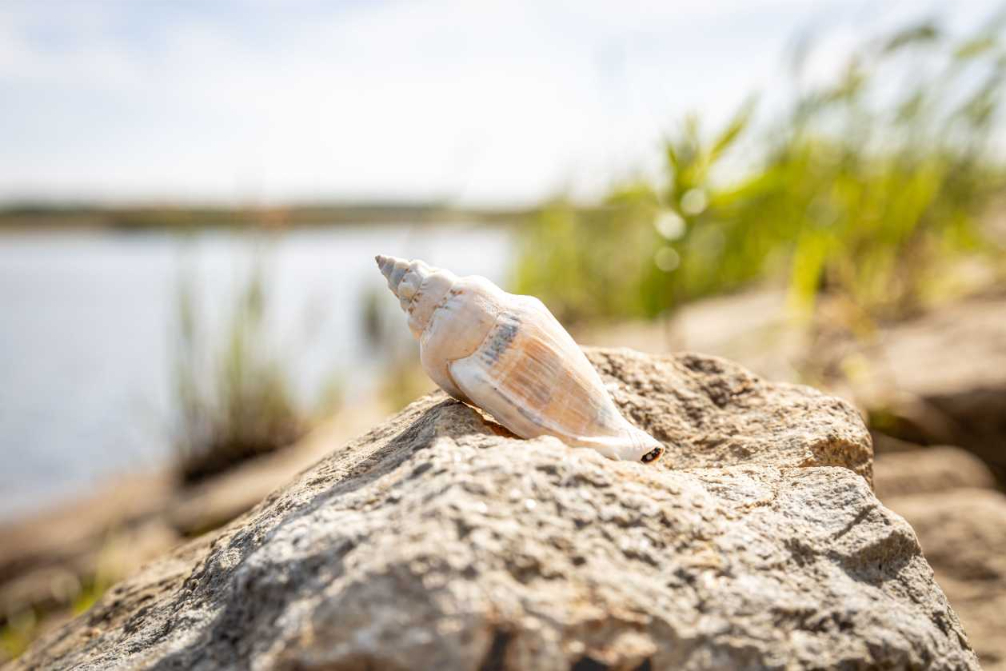
You’ve brought a shell with you. What does it symbolise?
I chose a shell. When I hold it to my ear, I can hear the sound of the sea – but only seemingly. Actually, I’m hearing the rush of blood. That brings us full circle to the other questions: if you listen closely, you can hear others and yourself too. To do that, though, I need to find peace and come to myself, and then I can reach out to others as well. So the shell also symbolises life and death – because it’s dead, that’s why I’m holding it – but also life, and the two go hand in hand. And at the same time, the shell also symbolises travel and otherness. So it fits in well with my work and with the other things that are important to me.
Is there anything else you’d like to share with us?
It shocks me how much responsibility is being taken away from the Equal Opportunities Division, how much funding is being cut, even though the issues you deal with are so important. At its core, this affects every one of us. We all look after someone, have children, aren’t originally from Germany and are perceived as ‘different’ here, have a disability or illness, and so on. None of us is completely free from these things. For example, there are so many people with dyslexia, including colleagues of mine, for whom I’ve developed a great deal of understanding over time. But to do that, I first need to be aware of it, and that awareness doesn’t just come out of the blue – I have to be open to it. That is exactly what this department stands for, yet it is sometimes treated so shabbily – and then funding is cut as well. I find that very, very regrettable.
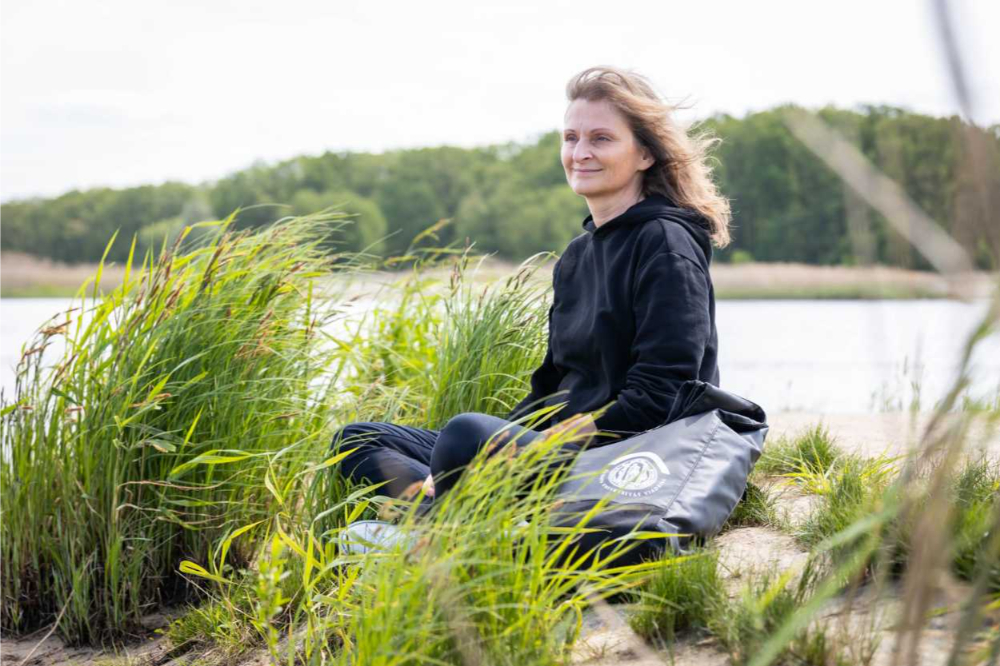
Who are you and where do you work?
My name is Paulina Jonczynski and I have been working part-time as a secretary at the Chair of Eastern European Literature under Prof. Werberger for almost three years, whilst also studying for a Bachelor’s degree in Cultural Studies. I ended up here when I decided four years ago to go back to university and later realised that the money I was earning from interpreting jobs was no longer enough. This meant I had to find another source of income, and I found this job to be perfect – it means I’m properly integrated into the university, both as a student and as a member of staff. I fled from Poland to Berlin in 1987 and had sewn all my documents – my birth certificate, academic records and so on – into my bag. If they’d found that at the border, they simply wouldn’t have let me leave Poland. I couldn’t even keep my passport at home in a drawer – it had to be held by the passport office. In February 1987, I arrived in West Berlin, got married there quite quickly and soon had a child. A few years later, shortly after the fall of the Wall, I moved to Prenzlauer Berg – that was the best time ever. A squatted house, democracy in action, nights spent sleeping on the roof because it was warm and summer, someone playing the guitar, smoking a cigarette… It was a wonderful, creative time, during which I really realised what possibilities were out there. I’d dropped out of university before that; I’d studied Jewish Studies for a year at the Free University of Berlin, but with a child, as a foreigner, without student finance, and in the midst of a divorce, university just wasn’t the right fit. I’m sure there are some incredibly resilient women who can manage that, but I couldn’t. Anyway, at some point I co-founded a school and a nursery. That was a phase during which I learnt an awful lot. I come from a big city, Gdańsk, but Polish society is actually very traditional. ‘Children and fish have no say’ – that’s what people say, and I never really felt comfortable accepting that. I wasn’t particularly lucky with my parents either, because they were quite simple people, but not necessarily the good, warm-hearted sort of simple, rather the complicated sort. I thought Berlin was absolutely brilliant; it had so much potential, so many opportunities, so many creative people, and, as I said, I really loved the democratic ideals and feminism there.
I’ll cut a long story short. One day I found out that a small organic shop was up for sale. That was exactly what I wanted to do! I really had no idea what I was doing, but anyway, after two days’ training, I became the owner of a small organic shop in Pankow – that was in 2002. I’m naive and brave; there are advantages to not worrying about what comes next. The early days were very tough – I worked around 60–70 hours a week and had wonderful customers. A lot of it was self-exploitation, something many women in the organic sector are familiar with. So I stuck it out there for almost nine years, training staff along the way, and apart from the absolutely gruelling working conditions, I was happy. However, after I was mugged in the shop, I decided to sell it. Whilst I was a shop owner, I’d started teaching a course on natural foods and over-the-counter medicines at private educational institutions. It was interesting because I’d work for a month, earn a lot of money, and then I’d have time off. The children were gradually leaving home, and I then had more time to myself, having been a single parent the whole time. Then I had just under two years during which I alternated between working for a month and having time to myself; I travelled a lot and was able to visit my friends. That was brilliant, but during that time I let a bout of pneumonia drag on, which led to heart surgery. That was a turning point in my life. At that time, I was in Chemnitz and, on my way to teach, I’d always walk past the university, and that’s where I realised that the university was where I belonged. I waited for my naturalisation, and then everything really happened in the blink of an eye. I’d found a really lovely room in a shared flat here, and now I live in my own flat.
Why did you come to Viadrina?
Several reasons. I found cultural studies really fascinating. Given my age, I also know that I won’t be pursuing a career again; there won’t be any major changes in my life. So the degree is more for myself, as a hobby, and to enrich my personal outlook on life. Cultural Studies offer me the chance to study a range of different topics without having to commit to any one thing. Of course, the proximity to Poland is also exciting for me. I was already familiar with Frankfurt; I’d been here from time to time. It just all fell into place.
What would it take for the many people at Viadrina to grow closer and build connections?
Personally, I haven’t noticed any drifting apart, but that might also be because I’ve only been here for four years. The pandemic was very stressful for many people; I also think that during that time, quite a few old traditions simply vanished into thin air. I found a good social circle here relatively quickly. There are plenty of opportunities – for example, there are regular get-togethers at the WG-Bar.
What is tiring, however, is the proximity to Berlin. People who live in Berlin won’t spend their evenings here; they’ll head home after their seminars. But we can’t change that. I think it depends on you as an individual. It’s not something that happens by itself; it’s something you actively make happen. We secretaries in the Faculty of Cultural Studies also meet up regularly, do things together and have a chat. Even the Christmas party has now been revived. I don’t know what it was like in the past, but I don’t feel lonely.
What are your hopes for the future of Viadrina itself and for your work here?
Of course, I hope that more students – particularly those studying cultural studies – will choose to study here. As for my work in the secretariat, I have no particular wishes; I’m happy here and the workload is fine.
When you’re not at Viadrina, what do you get up to?
My studies, my studies, my studies! I hope to complete my Bachelor’s degree in a year’s time, and then I plan to do a Master’s here. Apart from that, I’m very interested in city life. Partly because I enjoy observing how people think, how they act, and what motivates them.
As part of this, I also work as a volunteer interpreter for German and Polish here in Frankfurt. I realise how important it is to volunteer to accompany people to doctors’ appointments or government offices and to support families. For example, I was allowed to be present at a birth; I was able to hold the baby in my arms and hand it to the mother because she wasn’t feeling very well. That was amazing! So many very positive experiences, so many people who are truly grateful for the help they receive and who otherwise wouldn’t have been able to afford an interpreter.
Apart from that, I’ve got a cat. After the invasion of Ukraine, animals were rescued from Ukrainian animal shelters, and then I saw a cat on Facebook that looked so funny – she’s missing a tooth, she’s pretty in her own way, and her name was similar to my middle name. So I thought, ‘That’s my cat!’ Nobody wanted her anymore, and I suppose I have a soft spot for injustices in the world.
My sons are grown up, but they remain my lifeblood.
What is the connection between you and the issues addressed by the Equal Opportunities Division?
I’ve never been discriminated against as a white, straight woman, nor really as a foreigner. I came here with a relatively good command of German. I can’t complain. Here at the university, it isn’t even an issue; you’re judged for who you are, and there are relatively few filters through which you’re perceived. Not even because of my age – even the students have never made any negative comments about it. I tend to get positive reactions like ‘I’d love it if my mum did that too’.
As a feminist and a ‘left-winger’, I find your topics always relevant, so keep at it.
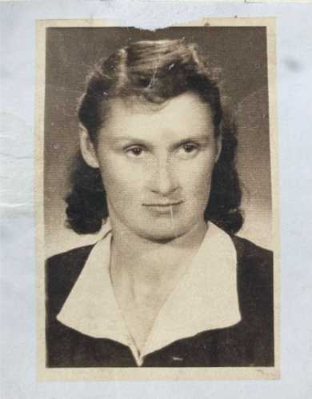
You’ve brought a photo with you. What does it mean to you?
My granny was the first person who came to mind when we were talking about the object. Because I used to move house a lot, most of my belongings turned out to be unnecessary. Objects are actually unimportant. There was once a situation when I was still living in a squatted house with my child; there was a ‘hot eviction’. So the house was set alight to smoke the squatters out, because we were unwanted by the owners. I actually had just 10 minutes to pack everything up and leave the flat. It was 6 o’clock in the morning; I had my child in my arms and thought, ‘OK, I need something for the next 2–3 hours, a few items of clothing for my child – what else should I take?’ Then I realised I didn’t need any of that at all – the memories are in my head. But, funnily enough, the one thing that has survived all those moves is the photo of my grandmother, who passed away when I was six years old. I’ve had easier and harder times in my life, and the picture of my granny was always there. Later on, when things were going well for me, the photo disappeared – after all, I didn’t need my granny any more. After I moved to Frankfurt, the photo suddenly turned up again somewhere amongst my papers. She loved me very much, and the fact that it’s back has symbolic value for me. I don’t need it now; now it’s simply there, resting.
Is there anything else you’d like to share with us?
We live in a society where we can all follow our own path, and if it doesn’t work out at the start, it will later on. You don’t have to finish your degree straight away; you don’t need to drive yourself mad worrying about whether you’ll have a successful career. Many things turn out differently from how we’d planned in our heads, and I believe a bit of flexibility and kindness towards yourself is important. We’re sometimes too hard on ourselves. Study, learn, have fun!
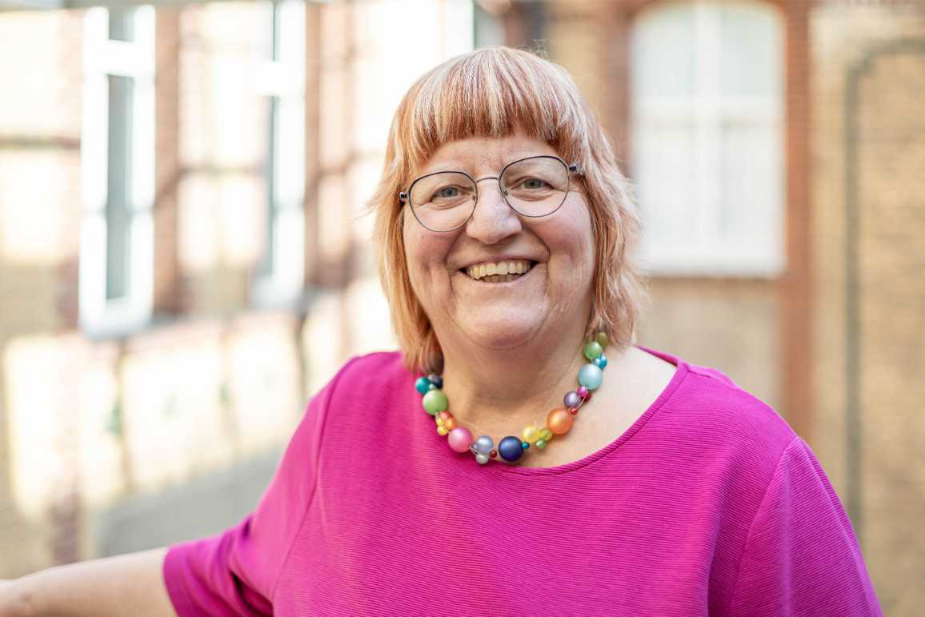
Who are you and where do you work?
My name is Renate Berthold. I work as Head of the User Services Department at the University Library, or UB for short. I am also the subject librarian there for political and social sciences and the arts, which means I decide which resources are purchased for the University Library and catalogue them by subject.
Why did you come to Viadrina?
Back then (in 1993), I was looking for a new challenge, having found a previous job in Bavaria to be very hierarchical. Viadrina isn’t particularly hierarchical, but it isn’t exactly open either. I found the years spent building it up to be both very challenging and rewarding.
What would it take for the many people at Viadrina to grow closer together and build connections?
Yes, you do notice that Viadrina has grown over the past 30 years. There are an incredible number of people you no longer know, whereas in the early years almost everyone knew each other personally. Of course, I also feel that this sense of togetherness is no longer there; for example, sometimes you don’t get a reply when you send an email. But I believe – and this may be down to my generation, even if not everyone wants to hear it – that a greater presence of university staff in Frankfurt (Oder) would certainly benefit both the city and the university in equal measure.
What are your hopes for the future of Viadrina itself and for your work here?
a) I hope Viadrina will attract more students again – and, first and foremost, offer attractive degree programmes and subjects that are in demand; after all, our financial future depends on this. Of course, the Future Centre would have been well deserved and a huge opportunity for the university. Now that hasn’t worked out, so why not use the resources available in the Faculty of Social and Cultural Sciences for teacher training subjects in the humanities as well, in cooperation with Potsdam, for example. If we do not have chairs in education, we could split the programme – for example, two days here in Frankfurt (Oder), whilst the other subject, which might be a natural science, is studied in Potsdam
b) It is my sincere (professional) hope that the library will finally regain the importance and recognition it truly deserves. We need students who visit the library and recognise what a treasure trove the media and databases available there are, and that these are vital to the quality of their work. The library’s environment must also be improved. To achieve this, however, the financial resources must finally be made available to carry out a thorough renovation of the Main Building. It fills me with sadness and anger that hardly anyone at this university seems to care that rain regularly leaks through the roof and that the University Library’s attic is too hot in summer and too cold in winter – in other words, virtually unusable. A lift that is almost constantly out of order does nothing to attract more users either. This is simply unacceptable.
When you’re not at Viadrina, what do you get up to?
I love travelling, all over Europe, but also within Germany. I spend a lot of time at the theatre or at concerts, and I also visit theatres elsewhere from time to time – for example, last year I went to the Staatstheater Braunschweig, where I saw Prof. Münnich, who was acting and singing there. This year, the Nibelungen Festival in Worms is on the agenda. I also enjoy cooking and read a lot. I’m happy to take on responsibilities for the community; I served as a city councillor here in Frankfurt (Oder) for 11 years and will now be serving as a lay judge on a voluntary basis. I have also always tried to forge links between the city and the university. I was always aware that whenever I attended a cultural event, I was also representing the university. It has also always been important to me to foster student culture; there are some great projects, for example at the Kleist Museum during the city festival.
What connection do you have with the issues addressed by the Equal Opportunities Division?
It was clear to me that you are opposed to discrimination of any kind, whether based on gender, origin, racism, etc. I was also quite amazed by the range of people you work with.
When I recently read about the mentoring programme, I thought that this was something I’d missed out on myself in the past. During the first few years of my university studies, I often felt like I didn’t belong. There was always this vague feeling that I wasn’t good enough. I think that was less down to my gender than to my background. I come from a non-academic family. No one in my family had ever taken A-levels before; my brother and a cousin – who are younger than me – went on to take them too, but in my generation I was the only one who had ever set foot inside a university. I actually have a university degree – back then, it was the state examination for a teaching qualification – and I’ve spent my whole life since completing my A-levels at universities. It would have been nice to have had more encouragement from female mentors – and male mentors, too, for that matter – with an academic background. You also support the ‘Arbeiterkind’ initiative, which really struck a chord with me.
I also believe that this hasn’t changed to this day. There is still no significantly higher proportion of students from non-academic backgrounds, especially as the financial situation has actually become much worse. The Bafög reform didn’t work out, after all. I was lucky back then to have a part-time job as a student assistant – at one point even two – so I was working 19 hours a week. That’s why I managed to get by quite well, and it gave me a sense of security. I would have worked as a waiter too, but if you can work in a subject you’re studying anyway, that’s obviously brilliant. That was a stroke of luck and set the course for my whole future: I was a student assistant at the Department of Political Science and my boss was the library officer, though he didn’t really fancy the job. The subject librarian who was doing the job I do today wasn’t keen on it either, and in fact I ended up spending just under 20,000 DM on my own and making my own suggestions as to which books we should purchase. When I later applied for this trainee post in library science, it was precisely the sort of work a subject librarian does. If I hadn’t had that experience, I probably wouldn’t be in the library today.
You’ve brought a necklace with you. What does it symbolise?
I found that very difficult to answer, because there isn’t one single item that stands out for me. However, I do have a distinct fondness for costume jewellery. Every morning, after getting dressed, I try to put on (fashion) jewellery that matches the colour of my clothes. So it’s not about gold jewellery or diamonds. For me, it’s like putting on a suit of armour, only nicer. I then feel stronger and better prepared for the day; I feel as though I’m in a better frame of mind.
Who are you and what are you studying?
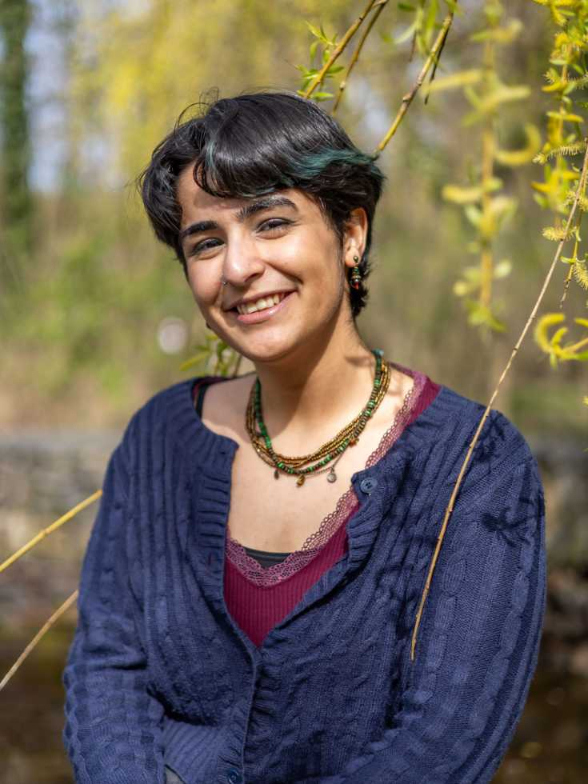
My name is Şevval and I’m 23 years old; I’m Kurdish and come from Turkey. I’m studying Social Sciences here, and in Turkey I studied Political Science. I’m very interested in politics and the social sciences.
Why did you come to Viadrina?
I first came here on an Erasmus exchange, and then I made so many great friends and created so many memories here. Ever since I was 17, I’ve wanted to live in Europe, so I thought, ‘This is my chance’, and I decided to become a full-time student at Viadrina. Now I’m working and studying, and trying to find my feet in this country. I think Viadrina is a really good place for that.
What would it take for the many people at Viadrina to come closer together and build connections?
I get the feeling that there isn’t such a strong university culture here as I experienced in Turkey, because at my university – or at other universities there – there are so many student clubs and so many student initiatives. If you’re interested in something, you can simply set up a club and like-minded people will join in. I feel that this is lacking here. I mean, there are a few student initiatives, but there aren’t many, and not many people can identify with them. I think if people could simply set up their own clubs and organise their own activities, it might bring people together more effectively. In theory, people could already be doing this, but if there isn’t an established culture for it, people tend to be reluctant to take the initiative and actually get something off the ground. That can be a bit daunting, and it’s hard to build communities. If there isn’t a space for it, it can feel a bit unsafe and uncomfortable.
At my university in Turkey, we set up a club, and I felt as though I’d achieved something – it was really lovely. It was called the ‘Free Dialogue Club’; my friends came up with the idea. Every week we chose a political, psychological, historical or social topic, and then people signed up; we paired them up at random so that they could talk to a complete stranger. We gave them a sheet of paper with a few questions on it, but these weren’t compulsory – they were just there to get the conversation going. We saw that people would chat for perhaps one or two hours, and even after we’d closed the room, they’d go off somewhere and carry on discussing. People kept coming back and it became one of the biggest clubs. It really was a wonderful feeling to be doing something, to be making a difference, to be influencing people’s lives in this way, and it was very good for the university culture. In fact, I’m planning something similar here.
What are your hopes for the future of Viadrina itself and for your work here?
Personally, I’d like to move on with my life. This was a good place to start, but at some point I’ll have to take a leap forward, do a Master’s degree and probably find a job in Berlin. I’ve really fallen in love with Berlin, but I’ll always look back fondly on my time here in Frankfurt, and I’m truly grateful that Viadrina made everything so easy for me and other international students. I have lots of other international friends who came here on an exchange programme and then decided to stay, and that’s a really lovely opportunity. There are lots of international students here, and I think that’s what makes this place what it is today – with the exchange programmes and the Bachelor’s and Master’s programmes taught in English; that’s really good. Looking ahead, perhaps we need more student societies or more activities in the city. I’d love to see more cafés or bars where you can hang out, or museums and art galleries and things like that.
When you’re not at Viadrina, what do you get up to?
I work part-time alongside my studies; I’m learning German to improve my skills because I really want to integrate more into this country; and I also have loads of hobbies. I don’t always stick with all of them, but yes, my attention is always here and there – it’s constantly jumping around. I’m currently learning to play the guitar, and I enjoy writing. I’ve been writing short essays, stories and poems for as long as I can remember – probably since I was eight years old. I mostly write about my feelings because I’m a very emotional person and feel a lot, so I need to express that creatively. Poetry is one way for me to do that; I really enjoy writing poems. I used to write short stories, but that’s not going so well at the moment. I’ve sort of lost my muse because I’m constantly too busy and too tired. I’m also interested in filmmaking. I made a film years ago, but I still sometimes come up with an idea and build a script around it. In the future, I’ll bring them to life and you’ll be able to see them on the big screen. I enjoy reading and exploring Berlin, because there are so many things to discover and do there. I meet up with my friends and enjoy the sun; I even enjoy the bad weather here. I enjoy cooking, especially for others.
It can sometimes feel a bit overwhelming for me because I just jump from one thing to the next. Now I’ve decided to learn to draw; I’m terrible at it, mind you, but at least I’m trying. You should see my bed! There’s a notebook lying there where I write; I’ve got my sketchpad, coloured pencils and my guitar on one side, and a novel, a book of poetry and a psychology book on the other; there’s usually a film or a video playing on my computer. My mind is constantly on the go, but I enjoy it.
What connection is there between you and the issues addressed by the Equal Opportunities Division?
I’m an immigrant, and there are many other students with a migrant background like me who come from somewhat difficult circumstances: I’m Kurdish and grew up in Turkey. It’s different for everyone, but what I experience and observe in myself and my friends is that we come here to a completely different country, with a language that most of us don’t speak and are trying to learn; many of us face financial difficulties because we come from economically underdeveloped countries. It can be a bit overwhelming trying to find your feet, and it’s not easy for us to carry on with our studies and everything else because we’ve left our universities and families behind. Perhaps we had a life plan back in the countries we come from, and here it’s difficult for us to find our way. In Berlin, there are a number of advice centres for immigrants, refugees and students from migrant backgrounds, and I feel that this is lacking here. I know that many of my friends simply feel lost because they’re working hard – in part-time or sometimes even full-time jobs – whilst trying to cope with their studies and the language, and that can be a bit overwhelming. It’s not impossible, but you still feel lonely at times.
Perhaps counselling services for students at Viadrina could be helpful. Maybe something like that already exists and I’ve just never heard of it, but if it does, it isn’t particularly visible. There are a few professional social workers in Berlin whom I’ve met who offer this sort of support. So perhaps we could bring in a few experts to get the ball rolling and then turn it into a student-led initiative or an official programme. All these struggles also go hand in hand with mental health issues, and help should be more easily accessible to students.
You’ve brought a notebook with you. What does it mean to you?
I’ve had this notebook since I was 14, I think. I started writing short stories and poems – whatever came to mind. It’s a way for me to let my feelings out. Then I stopped writing for a few years, and I left my notebook lying about somewhere. I recently dug it out again and started writing. I draw in it as well, so it’s the place where I can pour out my soul – the feelings I have, the happiness and the pain I feel. Most of my stories, especially the ones I wrote at secondary school when I was 15 or 16, are about the women in my family, because I come from a rather conservative family where women don’t have much say and have few opportunities. They marry very young and have a very hard time within this patriarchal family system and in society. I feel as though I carry their pain and their struggles with me, even though I’ve broken free and broken the cycle. But it’s still a part of my life, so I’ve let it all flow into this book. I feel connected to every person in my life, and they’re all in here. I also have a diary that I’ve been keeping since I was 12, and it’s really interesting to look back at my 12-year-old self today – that’s almost half my life.
Is there anything else you’d like to share with us?
This is a really lovely place to start, but don’t get stuck here. This city can hold you back a bit, especially if you don’t have that many opportunities.
Who are you and what are you studying?
My name is Tom Hilmar Seidelt, I am 25 years old and I live in Hoyerswerda, which is in northern Saxony, close to the border with Brandenburg. I’m studying for a Bachelor’s degree in Cultural Studies at Viadrina, and my particular interest within this field is literary studies, where I focus primarily on Jewish literature and sports literature. This summer term is set to be my final term.
Why did you choose to study at Viadrina?
Most of my friends went to Dresden to study, but that wasn’t an option for me from the start because the city was too big and the university too confusing. So I thought about a radius, and as I live right in the middle of the countryside, the options weren’t particularly wide. Viadrina was right on the outer edge of that radius and, after looking into the concept of the European University and the range of courses on offer, I came to the conclusion that it would be a good choice for me. That was in autumn 2021. However, given what I know now about my health, I wouldn’t make that decision in the same way. At the time, I knew I had a chronic illness, but I hadn’t yet realised the extent or the true severity of the condition. As a result, I imagined everything would be a bit easier than it ultimately turned out to be, but from a purely academic point of view, I’m still very happy with my choice.
What would it take for the many people at Viadrina to come together more and build connections?
I’ve only heard about it from friends who, in other cities, also go out in the town away from campus – for example, heading out together in the evenings. I think it’s difficult because many people commute from Berlin or other places and don’t actually live in Frankfurt. Basically, anything that happens outside the narrow confines of student or academic life is always a good opportunity to network, get to know one another and meet on equal terms – where that isn’t necessarily possible otherwise. I still remember back in the day when we had sports days at school. The headteacher would sometimes turn up in shorts and flip-flops at the goal-shooting wall, and that made him seem more approachable to us. It’s a chance to have a laugh together and chat casually, without any hierarchies. So we need to come up with something that allows us to come together on a human level, outside this rigid university framework.
What are your hopes for the future of Viadrina itself and for your studies here?
I’d like to see more inclusion, for example through the reintroduction of online teaching. I’m personally affected by the fact that, at times, I can’t travel for weeks on end because my doctor has forbidden it or because I’m taking medication that means I’m not allowed to drive. The only way I can get from where I live to Frankfurt is by car; public transport isn’t an option. You’re left in a bit of a bind if you miss classes for weeks on end. I’ve been able to join hybrid classes before, but it’s extremely awkward when I’m the only one visible on a huge screen and 30 students are staring at me, wondering ‘what on earth is wrong with him?’. I’m not suggesting the campus should be left deserted, but running 5 or 7 per cent of courses online – for example, one per module per semester – would give many people an alternative and would also put us on a more level playing field. In a Zoom meeting, you can’t tell who has a chronic illness, is looking after a child, caring for their grandmother, or has to work immediately before and after the seminar. I’ve already tried to raise this issue with the university. I simply can’t think of any arguments against online teaching, and I think it’s a shame that everything has been reset to square one now that the pandemic is, thankfully, over. After all, we’ve seen that online teaching can work, and it would be a huge relief for people like me, who didn’t know at the start of my degree what health challenges lay ahead. In my own case, I did manage to get to Frankfurt, but then had to attend the seminar lying on the floor because of the pain. I forced myself to attend in person, and that is neither productive nor sustainable in the long term. Failing to offer people like me – and those with even more serious health conditions than I have – alternative options for their studies also means that potential is not being realised. I would like to see more tolerance, understanding and recognition of the fact that we do not necessarily need a whole host of measures to compensate for disadvantages, some of which actually push us further into a marginalised position. Online courses would be a great help to many of us.
When you’re not at Viadrina, what do you get up to?
I’ve been active in local politics for the SPD since 2016, which isn’t exactly a comfortable environment here in Saxony. I’m also involved in the upcoming election campaigns at local and state parliamentary level.
Apart from that, I do a lot of sport despite my disability. I first had to work out what I’m still allowed to do and what I’m not. Unfortunately, ball sports are now off-limits for me, and I can no longer be a football referee for the DFB, as I used to be. I’ve since taken up cycling and specialise in time trials, as I can’t sit in the saddle for 80 km. Depending on how I’m feeling, I get on my road bike several times a week. But that brings new problems into play: I’m tall and have a slim, athletic build – nobody would guess from looking at me that I’m disabled. People still think that only someone on crutches or in a wheelchair can be chronically ill or disabled, which is of course not true. Often, people don’t believe me when I say that this affects me too.
What is the connection between you and the issues addressed by the Equal Opportunities Division?
I think it’s important that you exist, because I’m convinced that all students must be able to study freely and in an environment that is as tolerant as possible, in line with their needs. Otherwise, many people fall through the cracks for a wide variety of reasons, even though this needn’t be the case. And in the worst-case scenario, talented individuals are overlooked or not supported due to external circumstances, even though it would be possible to support them. It is important that you draw attention to these shortcomings and that other departments and committees also understand that such problems must be actively addressed – it is not enough simply to say how tolerant one is. This tolerance is often geared towards ‘normal’ or ‘healthy’ people, and anyone who deviates from this has to ask themselves how they can integrate into such a system.
In the photo, you can see your tattoo. What does it mean to you?
I have a chronic inflammatory condition of the lumbar spine in its most severe form. My symptoms include severe to extreme pain, an inability to sit for more than 60 minutes without discomfort, restricted mobility and neurological deficits such as functional impairments in my legs. It is neither curable nor properly treatable, and the long-term prognosis is poor. I do not go through life unscathed, even though, fortunately, the condition does not affect my life expectancy and I will be able to walk for the rest of my life. Nine years have passed since the first symptoms appeared, and I can hardly remember what it was like before. The condition has become part of my everyday reality.
I lived for many years with clear symptoms but without a proper diagnosis. At some point, my orthopaedic surgeon told me we needed to carry out extensive diagnostic tests and prepared me for the fact that this would take several months. It ended up taking 9 or 10 months – involving numerous tests and hospital admissions, ranging from neurology and neurosurgery to various pain management treatments. These extensive investigations were accompanied by an unimaginable amount of anxiety and pain. There were a number of suspected diagnoses, and it was even suggested that a tumour in my spine might be the cause of my symptoms. In connection with this, I had an MRI scan in 2018, during which I lay in the tube for over an hour, knowing that ‘cancer’ might end up on my medical record. This period was very difficult for me. What gave me strength back then were the matches played by my football club, West Ham United. I’d tell myself, ‘By the time the next match comes round on Saturday, I’ll have got through this or that test that’s causing me so much worry’. As I lay in the MRI scanner, alone with my fears and thoughts, I came up with the idea for this tattoo on my ankle, which I eventually had done. It was something that gave me a little comfort in that crucial and raw moment. I’ve had the tattoo for four years now, and I’ve remained loyal to the club to this day. I watch every match and organise my weekend around them; they’re a constant in my life. I always have the club with me, whether I’m at doctor’s appointments or before exams.
Is there anything else you’d like to share with us?
Wherever I can, I want to put forward suggestions for change and, above all, bring online teaching back into the conversation. My personal mission for my final semester at Viadrina is to be a thorn in their side and to voice my concerns confidently and emphatically. I’ve got nothing to lose!
2023 & 2022
The Diversity Days at Viadrina have been an annual event since 2022, held as part of the German Diversity Day.
The aim of the Diversity Days is to create a platform that highlights diversity within the university, combats discrimination and promotes an open and respectful study and working environment. In these times of social change, Viadrina aims to be a place where everyone has equal access and opportunities, and where the potential of a more diverse academic and working culture is recognised.
The first Diversity Days at Viadrina in 2022 focused on the challenges and opportunities presented by diverse life experiences within the university. Particular attention was paid to how people experience discrimination in their everyday academic and research lives due to their gender identity, social or ethnic background and caregiving responsibilities, and how this can be counteracted.
The second Diversity Days at Viadrina in 2023 focused on the mental and physical health of the university community. Students were able to learn how to look after their mental health during the often stressful phases of their studies, how to recognise warning signs and how to look out for one another. As part of the Shared Humanity Experience “Mental Health in the Context of Student Life”, they also had the opportunity to share personal experiences and find out about the various counselling services available within the university. Staff were able to make use of services such as nutritional advice and daily fatigue assessments at the Workplace Health Day, learn about workplace ergonomics and sleep hygiene, and take part in the active break programme. The event “What actually happens when Viadrina staff fall ill? Or: Illness at the intersection of health and safety, duty of care and entitlement to benefits” attracted a great deal of interest.