

Waste Separation at Viadrina
Waste Separation at Viadrina
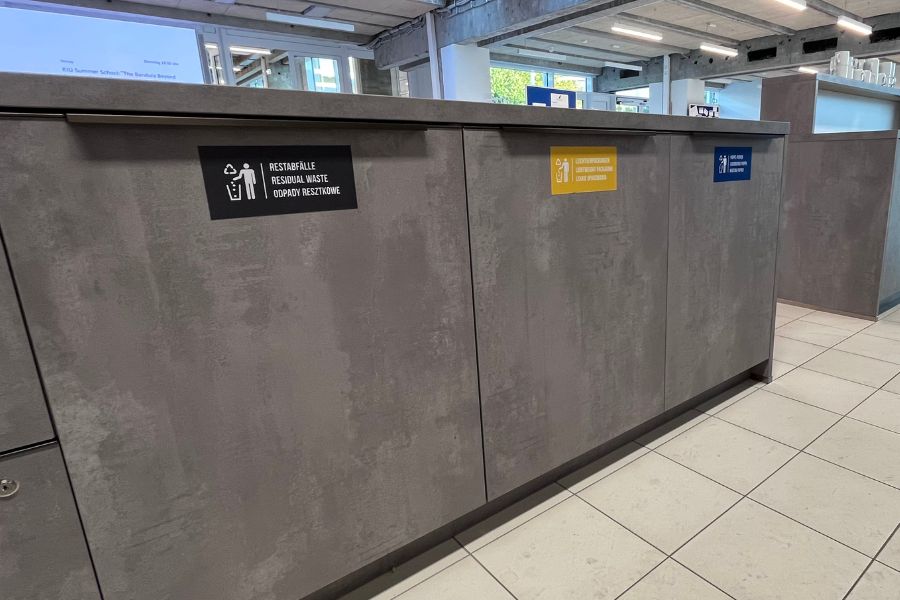
Collection bins in the Coworking Space
Ulrike Polley
By carefully separating our waste, we can help protect the environment and conserve resources by enabling more materials to be recycled. Viadrina is gradually expanding its waste separation system. Depending on the building, different waste collection options are available.
The best form of environmental protection is the reduction of waste. Before throwing away items that are still in good condition, consider whether they can be reused—this helps to reduce waste.
Frequently Asked Questions
Paper and cardboard (please flatten boxes to save space) belong in the blue collection bins. When disposing of large quantities of heavy books or files, please distribute the weight across several bins.
The yellow bin is for packaging made of plastic, metal, or composite materials, such as yogurt cups, plastic packaging, beverage cartons, tin cans, and plastic or aluminium foil. Other plastic or metal items that are not packaging do not belong in the yellow bin—these should instead go in the residual waste bin (Restmüll) or, if applicable, should be disposed with electronic waste.
The black bin is for residual waste. It should not be used for items that must be disposed of separately, such as batteries, light bulbs, electronic devices, liquids, or large food scraps.
Used batteries, rechargeable batteries, and light bulbs do not belong in the residual waste. Batteries and light bulbs used in the home can be returned free of charge at any location where they are sold—for example, in supermarkets, drugstores, electronics stores, or home improvement stores. Rechargeable batteries from electronic devices can be disposed of at electronics stores or at the recycling center in Seefichten.
There is no separate collection for organic waste in the university buildings, as the quantities are very small and separate collection is not worth the effort. Small amounts of organic waste, such as apple cores or tea bags, can be disposed of in the residual waste. Please do not throw larger food scraps or liquids into the residual waste, as these bins are not emptied daily everywhere and this can lead to unpleasant odors or mold. This applies in particular to the bins in the library. Organic waste from the dining hall and cafeteria is disposed of separately by the Studierendenwerk.
Glass can currently only be collected separately at the service yard of the main building. Glass or ceramic tableware does not belong in the glass recycling bin but in the residual waste. Light bulbs must also be disposed of separately (see above).
Where can I dispose of my trash?
In these buildings, collection bins are available for paper, packaging (yellow bin), and residual waste.
In the Gräfin-Dönhoff Building, structural preparations for separate collection are currently underway; until then, waste is still disposed of together as mixed commercial waste, which is subsequently partially sorted and recycled by the waste management company.
For fire safety reasons, separate trash collection in the hallways of the Main Building is currently not possible. Instead, waste is sorted at the main entrance, in front of the library, in the break rooms, and on the upper floors in the restrooms and the library.
Further Information
For detailed information on proper waste separation—available in several languages—we recommend the flyer from the City of Frankfurt (Oder)’s Waste Management Advisory Service:
👉 Separating Waste Properly (available in several languages)
https://fdh-ffo.de/wp-content/uploads/2024/09/abfaelle_richtig_trennen_mehrsprachig.pdf
Further information for employees is available on Viadrina's internal website.