

Putting data science into practice – Viadrina team successful at the IBM Datathon
A team of Viadrina students took third place for the Europe, Middle East and Africa region at an IBM Datathon. In mid-October 2026, the students from the Faculty of Business Administration and Economics came out on top with their adaptive system for detecting credit card fraud. More than 20,000 students from around the world took part in the online event. It was a valuable experience for both the student, Iqbal Hossain, and his lecturer, Dr Rick Steinert.
 Iqbal, what was the most interesting aspect of the IBM Z Datathon for you?
What I enjoyed most was the opportunity to build something together as a team and learn from one another along the way. We’re taking the same course on Deep Learning and eural networks with Rick Steinert. He suggested we take part in the Datathon based on our performance in the course. We had 24 hours to turn an idea into a working solution; that was both challenging and exciting.
What was your project about?
We worked on an adaptive system for detecting credit card fraud, combining three different types of machine learning models to analyse and identify potentially fraudulent transactions. Working with IBM LinuxONE was a particularly valuable and practical experience. These are high-performance enterprise servers designed to handle large-scale, business-critical workloads. Using the Community Cloud, we deployed and ran our solution in a real mainframe environment. This gave me a much better understanding of the difference between developing a model and actually getting it up and running as part of a functioning system.
How would you describe the Datathon format to someone who has never taken part before?
A Datathon is an intensive, time-limited team challenge in which participants bring their ideas and skills together to solve a real-world problem using data and technology – often turning an initial concept into a working prototype.
What will you take away from this experience for your studies and your future career?
As a Master’s student specialising in Data Science and Decision Support, I found this experience particularly relevant to my studies. We were able to apply concepts from the fields of machine learning and data analysis – which we learn in our courses – in practice, whilst also exploring how different technologies can work together to solve a problem.
Beyond the technical aspect, I learnt about collaboration, dividing responsibilities, making decisions under time pressure and adapting when things don’t go exactly as planned. These are skills which I believe will be just as valuable in my future career as the technical knowledge itself.
What’s your overall takeaway?
We actually built something functional, rather than just discussing theoretical solutions. I would definitely recommend that other students take part in a datathon, even if they’re not yet sure whether they already have all the necessary technical skills. You can learn a great deal simply by taking part.
I would definitely recommend that other students take part in a datathon, even if they’re not yet sure whether they already have all the necessary technical skills.
Iqbal Hossain
Why do you send your students to the Datathon, Mr Steinert?
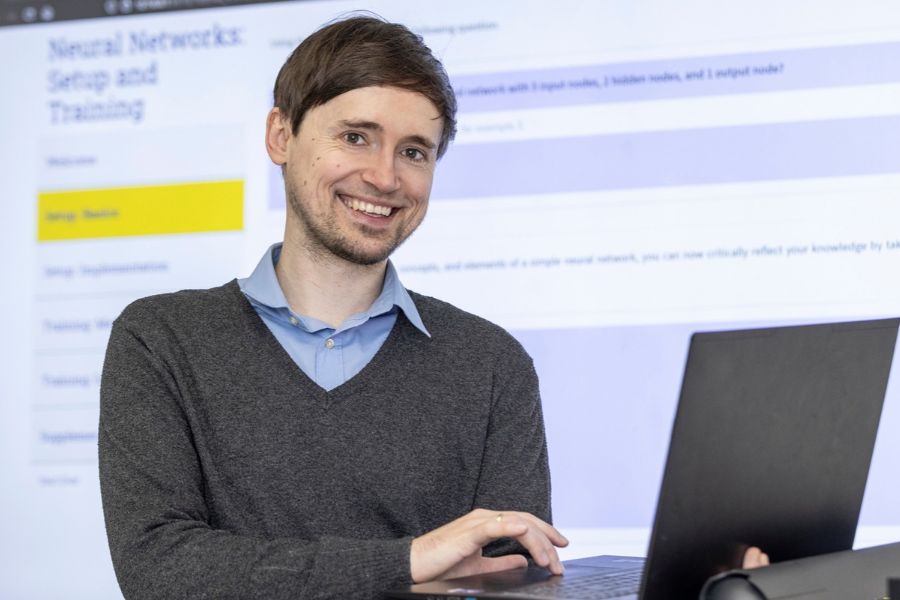
Mr Steinert, why was taking part in the Datathon of interest to you as part of your teaching?
Our Master’s specialisation in ‘Data Science and Decision Support’ is not just about understanding and applying modern machine learning techniques. What is crucial is that students learn to use these techniques to solve real-world problems and support well-informed decisions. I try to reflect this in my teaching through case studies. Often, however, the seven weeks allocated to a course are barely enough to cover both model theory and learning to write code, as well as to work on meaningful real-world application scenarios. The Datathon therefore offered an excellent opportunity to apply this knowledge outside the university seminar room. I hope, in particular, that such experiences will help students gain confidence in their own abilities and realise that they can already master demanding practical challenges with the knowledge they have.
How did you prepare the students for the competition? What was the biggest challenge?
We lay the technical foundations in our regular Master’s courses. There, students engage intensively with data analysis, statistical methods and machine learning. Alongside theoretical understanding, the focus is naturally also on independent practical application: Students programme models, analyse their results and critically evaluate their performance. In addition, in the run-up to the competition, students received insights into the technologies used and their practical applications from experts within the IBM ecosystem, primarily from Beta Systems Software AG.
I see the greatest challenge in the fact that a datathon demands far more than simply mastering individual algorithms. Within just 24 hours, the students had to turn their ideas into working solutions, whilst in some cases familiarising themselves with a completely new technical environment. This requires not only specialist knowledge but also initiative, teamwork and the ability to find solutions independently when faced with unexpected problems.
To what extent does a datathon like this complement classroom teaching?
In our seminars, we focus on systematically developing methods, understanding their mathematical foundations and comparing different approaches to problem-solving. This is essential, but at the same time creates a relatively controlled learning environment. A datathon adds another dimension to this teaching: there is no predefined model solution and no detailed work plan. Students must decide for themselves which problems to tackle first, which methods make sense and how to deal with technical setbacks. Here, they can also experience for the first time how various parameters – such as the operating system or other software modules – which are predetermined in teaching and rarely discussed, can change in practice; this, in turn, adds a level of complexity that I simply cannot cover in the classroom.
For me, this is precisely where the particular value lies. After all, in their future careers, graduates will rarely encounter tasks that are fully prepared in advance. What is required instead is the ability to familiarise oneself independently with new problems and to apply existing knowledge creatively. University teaching provides the methodological foundation for this. A datathon offers the opportunity to put this knowledge to the test under realistic conditions.
Later on in their careers, graduates will, after all, rarely find themselves faced with tasks for which they are fully prepared. What is required, rather, is the ability to familiarise themselves independently with new problems and to apply their existing knowledge creatively.
Dr Rick Steinert
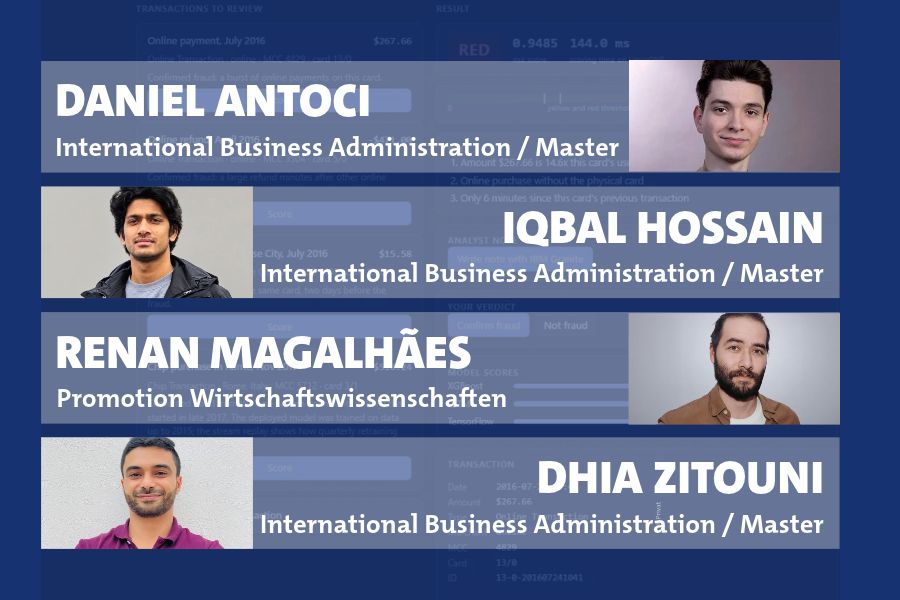
This team secured third place with its project on detecting credit card fraud.
Grafik: Katrin Hartmann
As well as Iqbal Hossain’s team, another team of Viadrina students from all Faculties took part in the Datathon. The Viadrina teams were invited by Dr Martin Thürling, a law graduate and Senior Manager of Legal Affairs at IBM partner Beta Systems.
Frauke Adesiyan, translated by DeepL and edited
Back to the news portal
Share article: