

“Young people are increasingly recognised as active partners” – IBA student Asif Sabeena on his commitment to the climate
On the fringes of the COP31 climate negotiations in Antalya, a special Viadrina gathering took place on 17 November 2026: Climate economist Prof. Dr Reimund Schwarze, who has been observing and analysing the negotiations for many years, met with Viadrina student Asif Sabeena. Asif is in his first semester of the Master’s programme in Business Administration and has been actively involved in the ‘Bring Back the Green’ foundation for years. Here, he talks about his work and his perspective on the climate negotiations.
Asif, how long have you been involved in climate issues, and what was the specific catalyst for your involvement?
I have been working in the climate sector for over seven years at the India-based foundation ‘Bring Back Green’, or BBG for short. Seeing firsthand how climate impacts directly affect young people and local communities, and realising that young people need real tools and platforms to turn their ideas into action, is what pushed me to get involved. A main catalyst was the flooding in the Indian state of Kerala in 2018 and its aftermath.
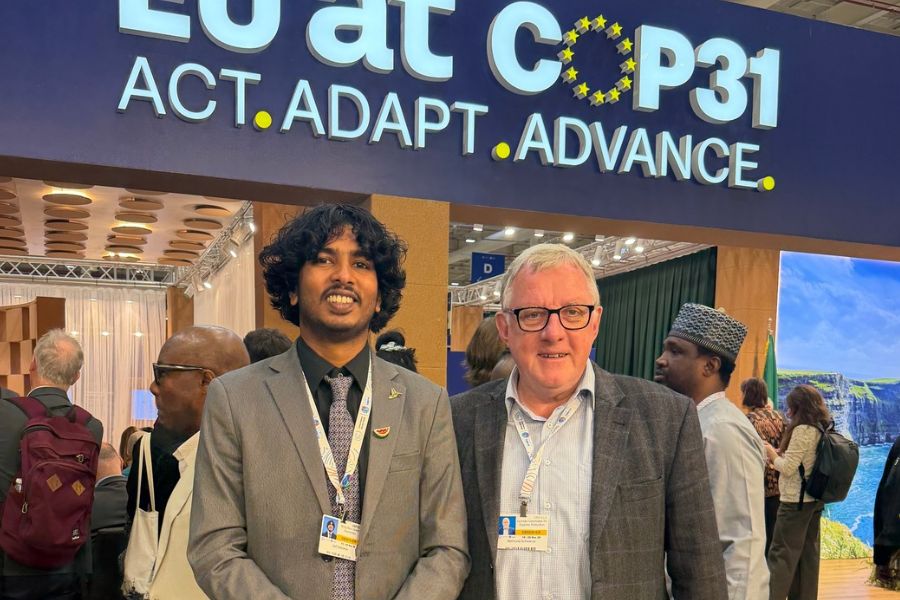
Asif Sabeena and Prof. Dr. Reimund Schwarze at the COP31 in Antalya
Privat
How exactly are you involved?
I serve as Operations Manager at the BBG Foundation, where we have been working for more than seven years to promote climate education, capacity building and climate storytelling. Our focus is on mobilising young people and building international partnerships.
What is your foundation doing at the climate conference in Antalya?
At COP31, we are running an exhibition booth to showcase our grassroots work and hosting several side events in collaboration with international delegations and organisations. I am actively building new partnerships here, particularly with a view to COP32 in Ethiopia next year, whilst also following the negotiations on ‘Action for Climate Empowerment’ (ACE), which are closely linked to our work in the areas of climate education and youth empowerment.
In your opinion, what were the most important issues discussed in Antalya?
The key issues dominating the negotiations here are adaptation finance – in particular, the provision of sufficient funding for the Adaptation Fund – and accelerating the energy transition. Alongside these core areas, the discussions within the ACE framework on empowering communities and young people remain crucial for putting political commitments into practice at a local level.
How do you assess the value and success of the negotiations?
The visit to Antalya highlights both sides of global climate diplomacy: the formal negotiations on finance and the energy transition can be intense and slow, yet the conference space itself is an indispensable hub for connecting grassroots organisations with international partners who wish to drive forward practical solutions.
What is currently your greatest concern regarding this issue, and what gives you hope?
My greatest concern is ensuring that the financial commitments for adaptation measures and the energy transition actually reach the vulnerable communities on the ground. However, what gives me real hope at the moment is the visible progress being made in involving young people, who are increasingly recognised as active partners and leaders rather than mere spectators.
How do you manage to balance your activism with your studies?
As I work remotely, I can coordinate projects and collaborate with my team online – alongside my coursework. I also travel to major milestones such as COP31. I deliberately chose Viadrina because it has a strong international profile and because its focus on strategic management and cross-border cooperation directly supports my work in expanding global climate and youth initiatives. The skills I’ve gained in strategic management, organisational scaling and partnership-building through my studies can be directly applied to the way I lead and expand our foundation’s global initiatives.
Frauke Adesiyan
Back to the news portal
Share article: