
“Social Change Is Usually Slow and Uneven”: Serdar Karabatı on Values, Culture and Universities
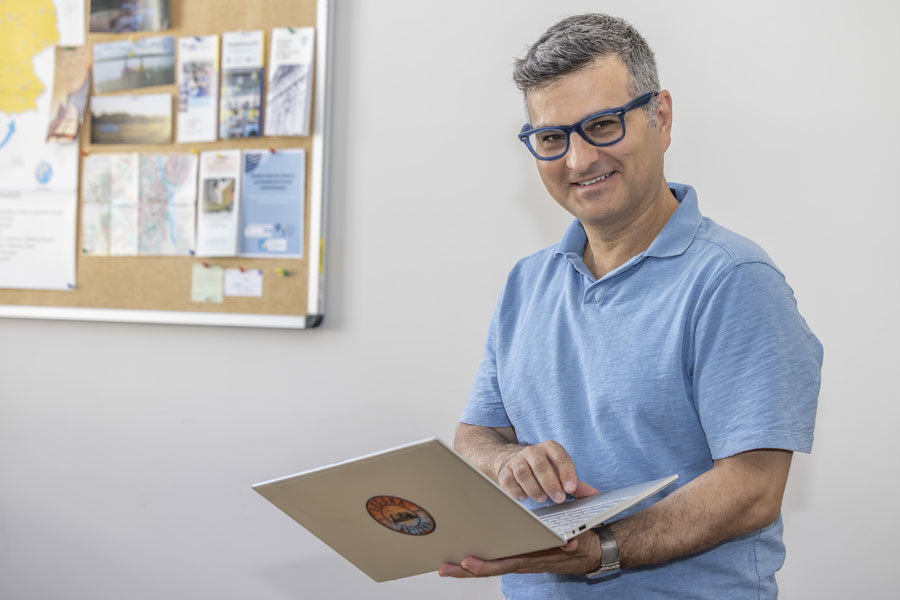
How are values changing across societies, and what role do cultural differences still play in understanding political and social issues? Master’s students from the European Studies programme spoke with Professor Serdar Karabatı, currently a visiting professor at Viadrina, about emancipative values, social change, the development of Istanbul Bilgi University and his experience of teaching in Frankfurt (Oder).
Professor Karabatı, to readers who may not know you, could you briefly introduce yourself, tell us about your academic background, and explain the main topics you teach and research?
I have a background in social psychology and completed my doctoral studies at Boğaziçi University on a topic related to cross-cultural management. I am particularly interested in comparative research on values, but I also engage in organisational behaviour research focusing on topics such as work engagement and work-related well-being. I recently contributed a chapter to a volume on well-being in higher education, published by the Oxford University Press. I am planning to initiate new studies on this critical issue while continuing my existing projects.
Heide Fest
Your seminar focuses on values, culture, and social change. What do you think are the most important value shifts shaping societies today?
The available evidence suggests that the world is gradually shifting towards greater emphasis on emancipative values, albeit at different paces in different regions. It is open to discussion whether we should be concerned about the gaps and lags that persist or be optimistic about the future since the trend may be viewed positively depending on one’s perspectives. In my opinion, we should not expect dramatic changes unless something exceptional happens but rather remain committed to defending values that foster tolerance and personal liberties in a non-invasive manner. Social change is usually slow and uneven. However, we should also not forget the fact that we are all agentic human beings with the potential to make a difference, at least in our immediate environment.
In an increasingly interconnected world, do cultural differences still play a major role in how societies understand politics and social issues?
Yes, to a certain degree. The convergence in values is still very slow. But I am not in favor of treating values as a catch-all explanation for a wide range of phenomena. It is not always about cultural differences. Most people across the globe feel anxious and sometimes hopeless due to the negative impact of multiple crises. I am not an expert on global affairs and institutions, but from my perspective, some of today's tensions are simply linked to declining trust in supranational institutions which are identified with many ethical failures.
Bilgi has built a strong reputation since its founding in 1996. What do you think makes Bilgi different from other universities in Turkey?
Bilgi began as what I would describe as a boutique university, shaped by the initial founders’ ideals. The school has always tried to play a leading role in addressing socially important issues. Not every member of the university necessarily approved everything the university or others were saying, but what made the difference was it was okay to agree or disagree with something.
Back then, the university had a relaxed culture of learning from others and was a pioneer in many areas. For example, Bilgi established a jazz programme under the Music department, which was a first for Türkiye. And it was something that made jazz fans like me extremely happy. It was truly enjoyable and meaningful to be able to contribute to that culture. Bilgi was also a pioneer in other areas such as online education. A great deal has changed, of course, since the establishment of the university as it became larger in size, almost four times bigger, expanded considerably, opened many new schools and programmes, and underwent changes in ownership several times. Many emerging universities at the time tried to emulate aspects of Bilgi's approach, and some have since become more successful in certain respects. It is difficult to explain it all in just a few paragraphs, but I think that Bilgi can be considered a more mainstream university nowadays. You can still feel that it is able to retain the original spirit to a certain degree, thanks to its committed faculty and staff.
How did the recent closure and reopening of Bilgi affect students and faculties, and what does it mean for the university's future?
It was unexpected. Especially considering that Bilgi was already under the oversight of a board assigned by the state apparatus. It is likely to affect Bilgi somewhat negatively in the short run as prospective students and their families may become more cautious when considering Bilgi. The academic staff is still there; there are yet no major changes to the system but sustaining the same image may be very difficult for Bilgi. Time will tell. I hope Bilgi stays because many people have a long-standing connection to and commitment to the university and, at the end of the day, the university is an asset for the whole of the country.
You have taught at both Istanbul Bilgi University and European University Viadrina. How would you compare the two universities, and what has your experience been living and teaching in Frankfurt (Oder)?
I do not think I have enough experience here at Viadrina to make a genuine comparison. You will have to invite me back so I can give you a more informed comparison. I really enjoyed my time in Frankfurt Oder. I guess this was my fourth or fifth visit to Germany, and it gave me the opportunity to learn more about different regions of the country.
The Bilgi University ist member of the ValEU's research network. As an overarching research initiative under the leadership of the European University Viadrina Frankfurt (Oder), the project is dedicated to current challenges faced by the European Union (EU) and the analysis of possible counter-strategies. The project involves twenty partner institutions from seventeen countries on five continents and investigates the foreign policy of the European Union and its related values. ValEUs aims to develop joint interdisciplinary research projects, engage in teaching co-participation and offering a platform for professional exchange through conferences, summer schools and a large-scale online course.
Back to the news portal
Share article: