
"Boxes without souls" - Clizia Franceschini researches the protection of intangible religious heritage
How can intangible cultural heritage be protected? And what happens to churches, for example, if their original meaning is lost? Administrative law expert Dr Clizia Franceschini is researching such questions in the INHERENT project (Intangible Religious Heritage and Religious Groups in national, european and global contexts) - including the example of Brandenburg. She is working at the Viadrina for three years as a fellow of the Alexander von Humboldt Foundation. On 24 and 25 March 2026, she brought together experts from Europe, North America, Australia and Latin America at an online workshop.
When people think of cultural heritage, they usually think of palaces, churches and castles. But what is a church without the intangible religious heritage? How does the monument relate to the spirit of the building, which is much more difficult to grasp? And what is protected, how and for what reasons? You could hardly choose a more suitable place to explore these questions than Brandenburg, where few people are aware of the intangible cultural heritage of their region, where 80 per cent claim to be atheists and where migration during and after the Second World War and the socialist education of the GDR continue to shape the population to this day.
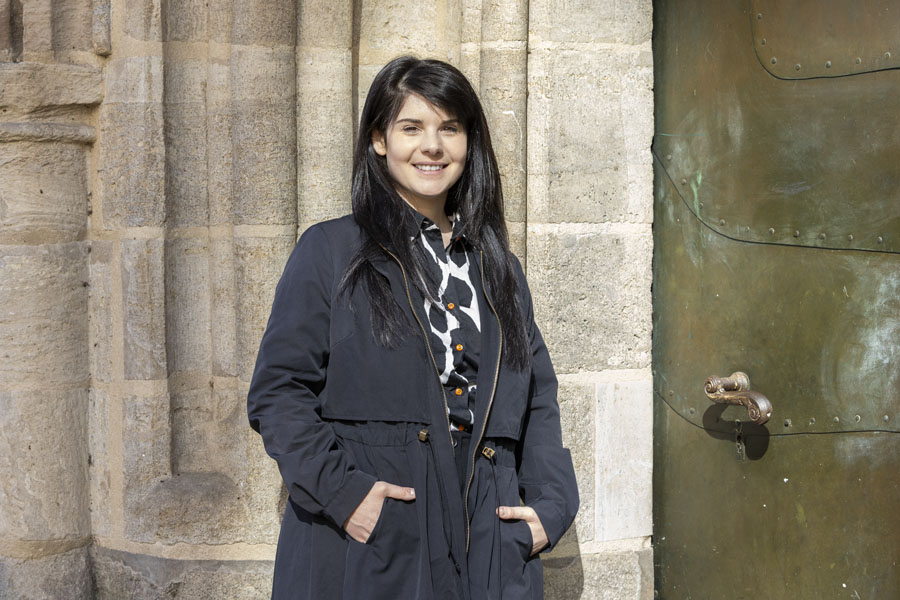
Dr Clizia Franceschini came to Frankfurt (Oder) in autumn 2025 to research the connection between immaterial and material religious cultural heritage. Her project INHERENT is being sponsored by the Alexander von Humboldt Foundation for three years; she is being supervised by PD Dr Izabela Parowicz from Viadrina and Prof Piotr Stec from the University of Opole.
Heide Fest
"In the current legal framework, the regulations on cultural heritage are tailored to tangible artefacts, while intangible heritage is enhanced and protected purely as a result of tangible cultural heritage. However, I believe that it should be the reverse," says the Italian legal scholar, summarising her thesis. For her, intangible cultural heritage is an integral part of tangible cultural heritage and has its own dignity. "If the intangible religious heritage is not protected, the tangible cultural heritage dies and is torn from its context; it loses its meaning," she is convinced. According to Clizia Franceschini, if churches are protected as monuments without also appreciating the knowledge of their actual purpose, you end up with a "boxwithout a soul". Intangible religious heritage includes religious communities, but also faith, mythology, rituals, dances, music and much more.
Clizia Franceschini deliberately approaches her topic from different perspectives. In addition to legal issues, she is interested in findings from the social sciences, art history, anthropology and religious studies. With this diversity of perspectives, she uses four case studies to look at trends in the secularisation and decontextualisation of religious sites in Brandenburg and southern Italy, as well as the political instrumentalisation of intangible religious heritage based on the fortified churches in Romania and the cult of St Barbara in Poland.
Methodologically, her work is based on analysing legal and political texts. In qualitative interviews, she also researches the attitudes and experiences of institutional authorities at various levels as well as leaders of religious communities. She has already conducted numerous interviews for the Brandenburg and southern Italian case studies. What she noticed in Brandenburg in particular was a very low level of awareness of the region's intangible religious heritage. "This heritage is preserved by passing it down through generations. But here, this transmission has been interrupted," she explains. One expression of this is the conversion of numerous religious buildings into secular buildings - such as St Mary's Church right next to the Viadrina Main Building.
In addition to her individual research, it is particularly important to Clizia Franceschini to establish a research hub - a pooling of expertise on her subject that does not yet exist. "I see this as a tool to create knowledge and understanding in the field of intangible religious heritage, but also to disseminate my own research," she explains her approach, which is also evident in a series of lectures organised by the project. On 24 and 25 March, for example, an online event brought together researchers and practitioners from Europe, North America, Australia and Latin America to share their findings in the fields of law, religion, anthropology and heritage conservation. Further editions of this dialogue series are to follow and a conference at the Viadrina is also planned before Clizia Franceschini tackles the next case studies in Poland and Romania.
There, she will focus on how political actors use intangible religious heritage for their own purposes. "The very decision to protect elements of cultural heritage is already a political statement," she emphasises. For example, the decision to promote and preserve intangible heritage can increase the prestige of a place for tourism or the economy. "In many cases, what you actually want to protect is then festivalised," she observes. Religious heritage thus becomes part of political games of power.
Frauke Adesiyan
Back to the news portal
Share article: