
"The political processes are also mined" - KIU doctoral student Anastasia Rodi researches Ukrainian democracy during the war
Since Russia's full-scale invasion of Ukraine four years ago, the whole country has been at war. How do current restrictions, for example on parliament and the media, determine post-war democracy? Anastasia Rodi is researching this as part of the PhD programme of the Competence Network for Interdisciplinary Ukrainian Studies (KIU). She talks about her dissertation project "Demining Democracy" in an interview.
Anastasia Rodi, you are researching the effects of the war on Ukrainian democracy. Why did you choose this topic for your dissertation?
I have been working as a journalist for several years and have written a lot about the war against Ukraine and about domestic political processes. I decided to also investigate these processes as a researcher in order to bring even more expertise to these analyses.
What exactly do you want to investigate in your work?
I want to explore how various restrictive instruments introduced into Ukraine's democratic institutions during the full-scale invasion affect the functionality of these institutions and what this means for the quality of democracy. I also look at how democracy is perceived by the Ukrainian population and how much trust there is in democratic institutions. It is an interesting paradox that 93 per cent of Ukrainians want a fully-fledged democracy in the country, but at the same time have very little trust in democratic instruments - only 15 per cent of the population trust parliament, for example.
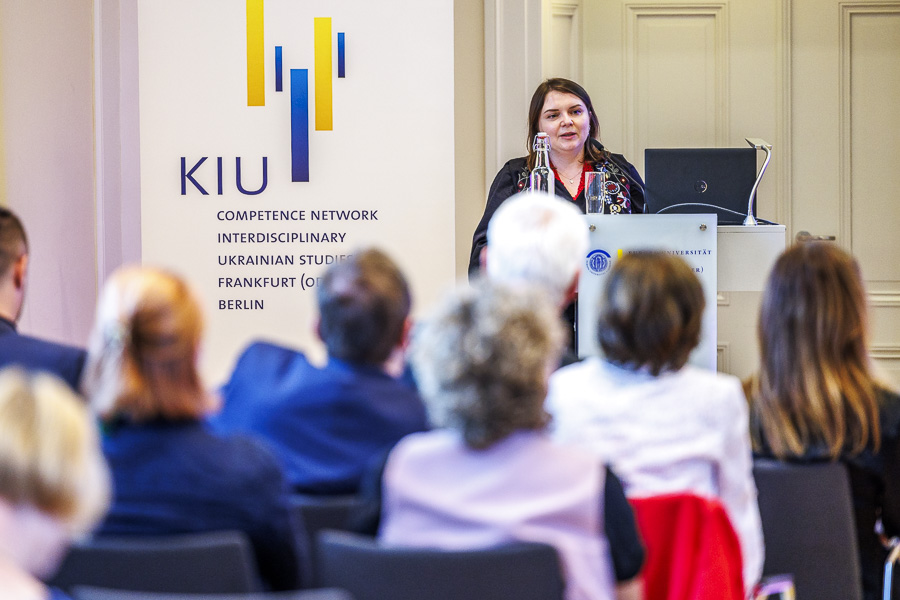
Anastasia Rodi at the opening of KIU's PhD programme in June 2025
Heide Fest
Your dissertation project is entitled "Demining Democracy", what do you mean by that?
I developed this metaphor to illustrate that war not only mines the ground, but also the political processes. After the war, demining will be necessary - also in democratic institutions and processes. I decided to document and analyse current decisions and processes because they are already influencing Ukraine's post-war democracy.
Which areas are particularly mined - to stay with your metaphor?
For example, it's about how decisions are currently being made in the country - which is actually a parliamentary-presidential republic. But the decisions are currently in the hands of a single person: the President. There are clear security reasons for this, but it is of course problematic for the quality of democracy.
Another example is media freedom. Some media outlets have been restricted or blocked, again due to security concerns. So on the one hand, there is no full media freedom. At the same time, however, you can see investigative journalists researching cases of corruption, for example - even in times of war. If you take a closer look, you can see that not everything is black and white. The current processes and decisions, as well as the reactions of civil society, will be decisive in determining what happens here after the war.
In your opinion, what is the current state of Ukrainian democracy?
I am only in the first semester of my dissertation, but what I can say for sure is that Ukraine remains a democracy despite the war. The war has very different and absolutely non-linear effects on democratic processes and institutions. Some of these institutions are strengthened by the war, others are undermined. On the one hand, there is a restriction of human rights. But at the same time, we are seeing a stronger mobilisation of civil society. Society remains very lively and active.
I conduct elite interviews and interviews with ordinary citizens. I focus on five groups: opposition politicians, journalists, activists, the military and people who experienced the occupation. I am trying to cover different perspectives and also different regions of Ukraine. In March, I will be travelling to Ukraine for the first interviews. I am also analysing political speeches and comments by Volodymyr Zelensky on the subject of democracy. I am interested in how he sees democracy as the country's President during the war and how he communicates Ukraine's democratic values to the outside world. Finally, I would like to analyse data in order to evaluate surveys on the perception of democracy.
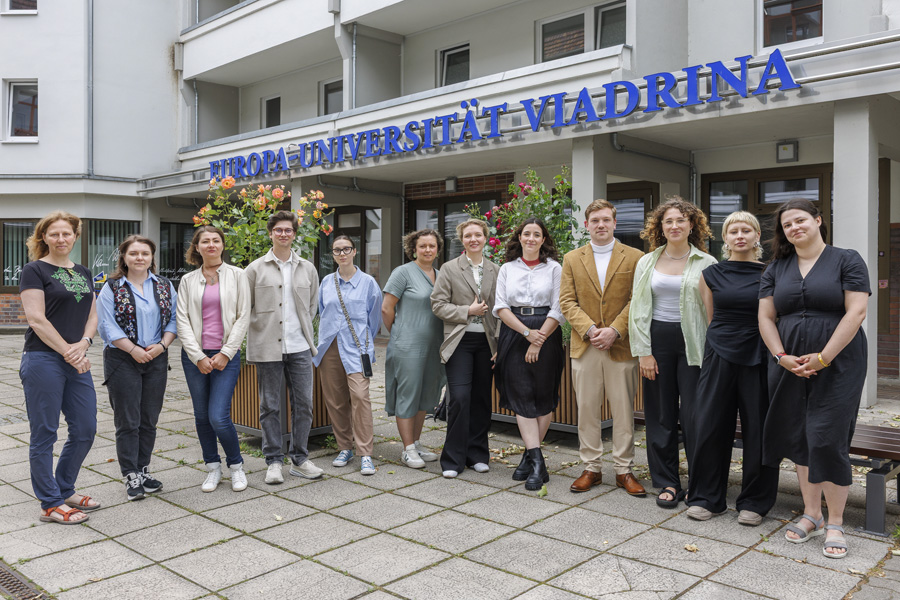
Anastasia Rodi is one of twelve doctoral students currently conducting research as part of the KIU's PhD programme.
Heide Fest
What are the biggest challenges of your research?
The most important challenge is the study of a country at war. Anyone researching a country at war can hardly really distance themselves. You can discuss what neutrality means and where the boundary between research and activism lies. Personally, I believe it is possible to remain professional. There is a big difference between advocates for the country and people like me who want to see and show change.
As we approach the fourth anniversary of the full-scale invasion, how do you view the development of research and reporting on Ukraine in Germany?
I have been observing German research and reporting on Ukraine since 2010 and can see how quickly it has changed. Unfortunately, I also have to say that it took a full-scale invasion for Ukraine research and reporting to become visible. That's very tragic. There have always been researchers working on Ukraine, but their voices were not heard. Now they have finally become audible, they describe on talk shows what they have long since researched. But I'm worried about whether Ukraine research can remain stable and established beyond the end of the war. That was also my motivation for contributing to these processes.
Personal Background
Anastasia Rodi is a Ukrainian-German journalist and political scientist born in Simferopol, Crimea. She holds a master's degree in Ukrainian philology (V. Vernadsky Taurida National University, Simferopol, 2011) and political science (Freie Universität Berlin, 2023). She has been working as a correspondent for German and international media since 2013. Her areas of interest include German-Ukrainian relations, democratic backsliding and authoritarianism, the West's policy towards authoritarian regimes and the role of disinformation. She was a fellow of the European Journalist Fellowship at the FU Berlin (2019-2020) and a participant of the programme "Digitalisation and Democracy" at the Aspen Institute Germany (2025). Her current dissertation project is being supervised by Prof Dr Gwendolyn Sasse at Humboldt-Universität zu Berlin.
Frauke Adesiyan
Back to the news portal
Press and Communications
- 59 Große Scharrnstraße, Rooms: Ground Floor 113b–117, 102
- 15230 Frankfurt (Oder)
- +49 335 5534 4515
- presse@europa-uni.de
- Team und Portfolio
Share article: