
PATHS Forced Migration: Europe in a Global Context
Header Photo
Fritz Schlüter
Key Facts
Degree
Master of Arts (M.A.) – Joint European Degree
Standard period of study
4 semesters
Type of study
Full-time, consecutive Master’s programme, mobility-based across partner universities
Main language of instruction
English
Start of studies
Winter semester
Admission
Admission by selection
Costs
EUR 9,000 per student per academic year.
Enrolment period
1 July - 31 July 2026
15 September 2026: Final list of admitted students.
Please visit the PATHS application website for full details.
Understand migration, develop solutions, become a changemaker
PATHS Forced Migration: Europe in a Global Context addresses the urgent and complex challenges of forced migration, driven by geopolitical instability, environmental pressures, and socio-economic factors. PATHS Forced Migration provides a unique blend of interdisciplinary and intercultural perspectives within a cohesive curriculum, combining mobility pathways, research opportunities, and close collaboration with local, national, and international organisations. As a PATHS Forced Migration student, you can select one out of three paths: European Border Regimes, Inclusion of Children and Minors, Politics and Policies of Migration. Each path takes place at three different universities. You will also have the opportunity to expand your learning through extracurricular courses offered by ERUA partner universities. Thereby, the European Reform University Alliance (ERUA) paves the way for a new model of European higher education.
In the European Border Regimes path, starting at Viadrina, you examine how global inequalities as well as ecological and geopolitical instability shape forced migration. You gain a deep understanding of the legal, technological, and social dimensions of European border regimes, and analyse the interactions between migration policies and global as well as racialised inequalities. The curriculum combines theoretical knowledge, methods training, empirical research, practical internships, and transnational mobility between partner universities in Germany, Poland, and Greece – enabling you to explore border management, refugee reception, and migration policy from local, national, and global perspectives. You develop the critical skills needed to design ethical, socially just, and evidence-based solutions.
Special Features
PATHS Forced Migration is taught entirely in English, bringing together students from across Europe and beyond into a shared international learning environment. As a student in the European Border Regimes path, you do not simply study migration and borders. You live and study in Germany, Poland, and Greece – countries that are faced with various phenomena of migration.
At Viadrina, nearly every second student is from abroad. This fosters an international community defined by multilingualism, diverse perspectives, and dynamic cross-cultural exchange. Situated directly on the German-Polish border, the European twin city of Frankfurt (Oder) and Słubice provides a unique European starting point for the study of borders, mobility, and displacement.
By the time you graduate, you will have built a strong international academic and professional network – a foundation for careers that operate at European and global levels.
At Viadrina, we are committed to being a university defined by short distances and direct interactions. Our excellent study and learning conditions ensure that, as a student, you remain in personal contact with our researchers. Teaching and research are conducted in an open atmosphere within small learning communities. A wide range of advisory services supports you with any questions you may encounter during your studies.
In PATHS Forced Migration, this principle extends across all ERUA universities. Throughout the programme, academic and administrative coordinators at each partner institution are your direct points of contact for academic and practical support. The research colloquium in your third semester brings the full cohort together for collaborative, research-led learning before you enter the final phase of your studies. Your Master's thesis is co-supervised by academics from at least two different partner universities, ensuring dedicated expert guidance from multiple perspectives throughout your final semester.
USPs
Why study PATHS Forced Migration?
- Joint European Degree awarded collectively by six partner universities
- Interdisciplinary curriculum combining sociology, political science and public administration, law, and psychology
- Three specialised study paths to choose from – each offering a distinct disciplinary and thematic focus on forced migration in Europe and globally
- Path-specific mobility across three countries that are faced with various phenomena of migration
- Fully taught in English within a diverse, internationally composed student cohort
- Internship with access to a network of 25+ partner organisations, including international organisations such as UNHCR and UNICEF
- Co-supervised Master's thesis, jointly assessed by academics from multiple partner institutions
Testimonial

Die Hoffotografen GmbH Berlin
"With the European Border Regimes path, you will develop critical, fact-based capacities to tackle one of the most urgent and divisive issues in European and global contexts."
Prof. Dr. Kira Kosnick, Professor and Director of the Research Center B/ORDERS IN MOTION, Academic PATHS Coordinator, European University Viadrina

Ildiko Otova, New Bulgarian University
"PATHS Forced Migration empowers future leaders to navigate the geopolitical, humanitarian, and socio-economic complexities of displacement in an interconnected world."
Ildiko Otova, Ph.D., Assistant Professor, New Bulgarian University
Qualifications and Career Prospects
In the European Border Regimes path, you gain in-depth knowledge on forced migration, border management, and refugees’ reception, struggles, and agency. Through mobility across three European universities located in countries of transit and reception, hands-on research, and an international classroom environment, you develop interdisciplinary expertise, critical thinking, and practical research skills. The programme combines seminars, fieldwork, and a professional internship, culminating in a joint Master’s thesis assessed by faculty from multiple partner institutions.
As a graduate, you are prepared for careers in
- European and international organisations
- Government agencies
- NGOs and humanitarian organisations
- Policy and advocacy
- Migration and border management institutions
- Research
- Consultancy roles
The programme also equips you for further doctoral studies in the field of migration and border studies, providing a strong foundation for leadership roles in the field of forced migration and border policy.
Application and Enrolment
Academic requirements
To apply for PATHS Forced Migration, you must hold a Bachelor's degree or equivalent qualification providing access to Master's degree programmes. Degrees in social sciences, humanities, and related disciplines are directly eligible; applicants from other fields may also be considered with relevant professional experience in migration or related areas.
Language requirements
You must provide proof of English language proficiency at CEFR B2 level or higher.
Required documents
- Cover letter explaining your motivation for your chosen study path
- CV (Curriculum Vitae)
- Supporting documents evidencing relevant achievements and experience
- At least one letter of recommendation from an academic or professional referee
For the full list of eligible degree subjects, accepted language certificates, and details on the selection process, please visit the PATHS Forced Migration application website.
Admission to PATHS Forced Migration is based on a selection process. Places are allocated on the basis of a competitive assessment by a Joint Admissions Committee comprising representatives from all partner universities. As part of the selection process, you complete an online entrance examination.
You apply online through the PATHS Forced Migration application website, managed by SWPS University as the coordinating institution. International applicants — including those from EU, EFTA and OECD countries — follow a two-step procedure involving eligibility verification before the standard selection process.
Please note: The Admissions Committee reserves the right to offer you a study path different from your initial selection.
We are looking forward to warmly welcome you here at the Viadrina. For information about arrival and settling in etc., please follow the link to our page:
Information for incoming studentsApplication and admission (general for PATHS Forced Migration): admissions@swps.edu.pl (SWPS University)
Admissions Office: Advice on the enrolment process at Viadrina
Central Student Advisory Service: Further advice on starting your studies (housing, financing, arriving)
Viadrina International Affairs: Specific information and advice for prospective students from abroad
Programme Structure
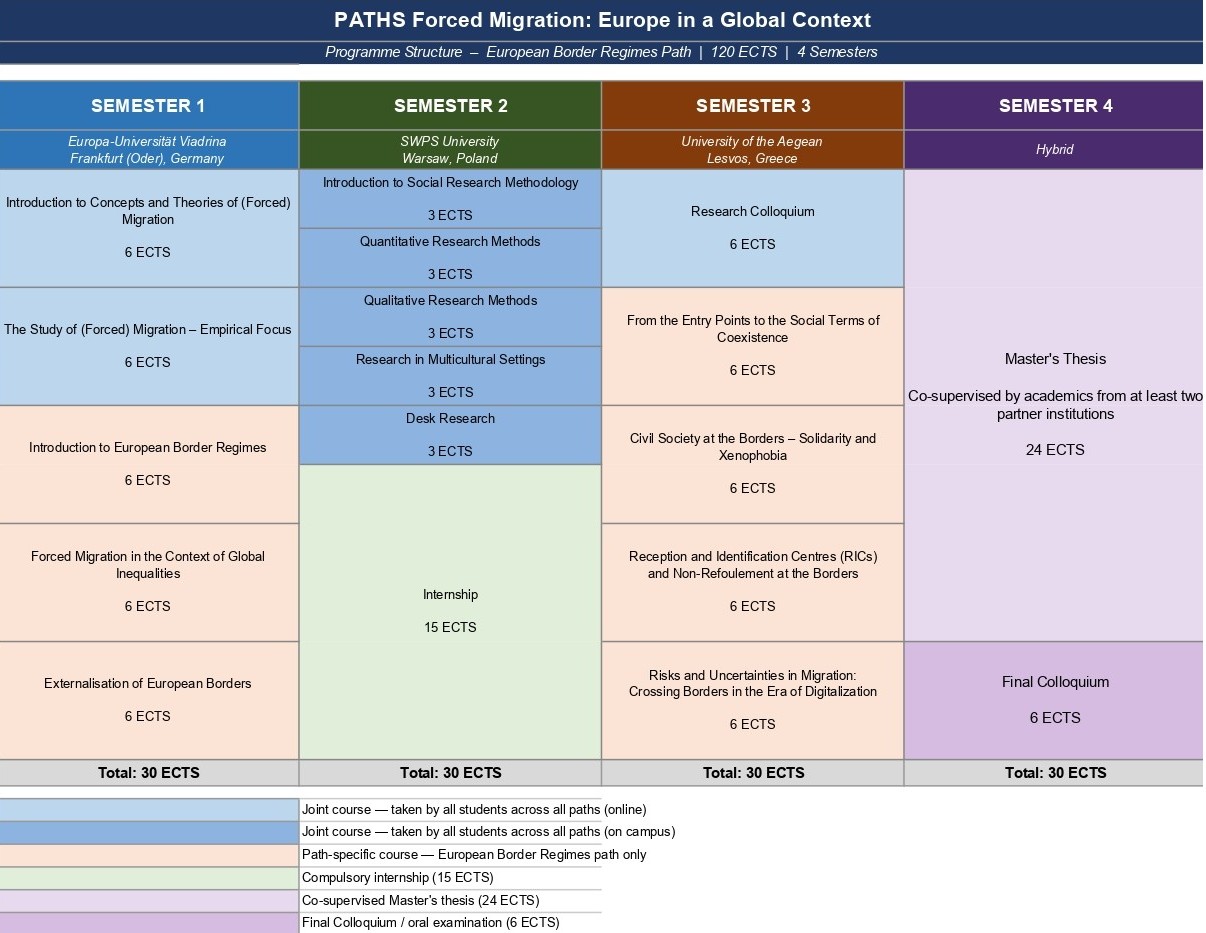
The curriculum combines general courses for all students with path-specific courses. The European Border Regimes path follows a structured four-semester curriculum totalling 120 ECTS.
You start at the European University Viadrina with two joint introductory courses as well as foundational courses on forced migration and border regimes, equipping you with comprehensive knowledge in areas such as migration control and negotiation, access to protection, and effects of externalisation.
For your second semester, you move to SWPS University, where you will deepen your skills in research methods. You will also complete a professional internship at leading organisations such as UNICEF and UNHCR to put your knowledge into practice.
The third semester takes place at the University of the Aegean, focusing on refugee reception, border management, and the politics of non-refoulement. In this semester, you take part in a research colloquium designed to prepare you for your Master’s thesis in the fourth semester.
All modules combine lectures, seminars, practical exercises, and independent research, ensuring theoretical grounding, methodological competence, and professional experience across multiple European contexts.
Programme Coordination

Die Hoffotografen GmbH Berlin
Prof Dr Kira Kosnick
- Große Scharrnstraße 59 | 15230 Frankfurt (Oder)
- +49 (0) 335 5534-2646
- kosnick@europa-uni.de
Student Advisory Service
Heide Fest
Dr Oliver Kossack
- Große Scharrnstraße 59 | 15230 Frankfurt (Oder)
- HG Room 059
- +49 (0) 335 5534-2273
- kossack@europa-uni.de