
’68 NOW. European Entanglements - '68 NOW. Europäische Verflechtungen
About the Event Series
While the legacy of May 1968 in Western Europe represents a symbol of emancipation and rebellion against rigid power structures, remembrance in Central and Eastern Europe clearly revolves around the Prague Spring and the Soviet invasion of Czechoslovakia. This reveals political and cultural lines of division within Europe that can be productively discussed from a transnational perspective.
The temporal distance of half a century allows for a better understanding of the extent to which the diverse events of 1968 in different parts of Europe have produced a discrepancy in perceptions of Europe as an internationalist project. Here, the idea of internationalism emerges as an ambivalent phenomenon: on the one hand, it carried emancipatory potential through demands for democratic participation and greater individual freedom; on the other hand, it was instrumentalised as an ideological construct that legitimised the suppression of deviant subjectivities and ultimately culminated in the Brezhnev Doctrine.
The ambivalence of 1968 as a symbol of a political event is reflected in the opposition between individual and collective emancipation, which continues to shape discussions of these events to this day. The Western ’68 movement has often been criticised for shifting the focus of political struggle primarily towards identity politics, thereby moving attention from the universal to the particular. At the same time, attempts in Central and Eastern Europe to develop a third path between Soviet dictatorship and capitalist market economies — a “socialism with a human face” — failed under the ideological weight of Soviet-style socialist internationalism.
The event series seeks not merely to juxtapose the individual events of 1968, but to examine their interconnections through a relational historical approach. This is particularly relevant given that the revolt of the ’68 movement itself was closely tied to an internationalist perspective.
The public discussions in Berlin and Frankfurt (Oder) will address the events of 1968 from a transnational perspective and explore the continued relevance of the ’68 movement for the current political constellation in Europe as well as for various global emancipatory strategies. A central theme running throughout the series concerns questions of the legacy of 1968 today: How are the events of 1968 referenced? What has become of the emancipatory demands for greater freedom, participation and democracy from a transnational perspective? How, for example, can the events of the Maidan be read in relation to the European experiences of ’68?
Especially in times of growing populism and political disaffection, exclusion of the Other, and social fragmentation, ’68 offers a point of reference for engaging with questions that remain highly relevant today regarding democratic European values and political participation. This retrospective gaze thus also constitutes a look towards the future, raising the question of what kind of society we wish to live in, while understanding the relationship between “the individual and the social, the economic and the political, leisure and labour, utopia and reality, reason and emotion”[1] as a process of ongoing social negotiation.
The event series “’68 NOW. European Entanglements” is a cooperation between the Federal Agency for Civic Education (Bundeszentrale für politische Bildung, bpb) and the European University Viadrina, Frankfurt (Oder). It builds on the programme of the Kyiv Biennial, which took place in April–May 2018 in Kyiv (http://vcrc.org.ua/en/68-now).
[1] Ludivine Bantigny, Die Zeit des Möglichen. Die Erfahrungen von 1968 oder eine anthropologische Revolution, in: Lettre International, Issue 120, Spring 2018, p. 35.
► Follow this link to listen to the audio recording of the panel discussion.
Panel Discussion
1968 in Plural: Ambivalent Legacy of the Prague Spring and the Student Protests in Europe
Opening Event of the Series “'68 NOW. European Entanglements”
Date and time: 24 September 2018, 7.00 pm
Venue: Bundeszentrale für politische Bildung, Friedrichstraße 50, 10117 Berlin
While in Western Europe the legacy of 1968 symbolizes emancipation and rebellion against the rigid power structures, in its central and eastern parts it mostly evokes the memories of the Prague Spring and invasion of the Soviet troops in Czechoslovakia. This discrepancy might lay bare divergent political and cultural tendencies in Europe, that can be fruitfully and critically discussed from a transnational perspective.
A temporal distance of half a century enables a better understanding of the extent to which the controversial events of 1968 in different parts of Europe have contributed to the ambivalent perception of Europe as an international(ist) project. In this regard the notion of internationalism appears as an ambivalent phenomenon, that, on the one hand, bears emancipatory potential anchored in demands for (more) democratic participation and larger individual freedom(s), and on the other hand, can be instrumentalized as an ideological construct that legitimizes suppression of alternative subjectivities, as was manifested in the Brezhnev doctrine.
The ambivalence of 1968 as a symbol of the political Event is also reflected in the widespread conceptual opposition between individual and collective emancipation, which has strongly defined the discussions around it until today. Taking into account this plurality of perceptions, the discussion in format of Monday Talks at Checkpoint bpb on September 24, 2018 will explore the connections between these various cases and the relations in which they stand to each other. Such a broad geographical focus should allow to transcend the reductions of the legacy of 1968 to single national interpretations, to emphasize the entanglements between those events in various parts of Europe and to discuss dissident movement, emancipation, protests and their suppression from a larger comparative perspective.
Participants of the panel discussion:
Dr. Silja Behre, historian, author of the book "Bewegte Erinnerung. Deutungskämpfe um "1968" in deutsch-französischer Perspektive", Tübingen 2016.
Dr. Marie Černá, historian, Institute of Contemporary History of the Czech Academy of Sciences
Dr. Vasyl Cherepanyn, cultural theorist, Head of the Visual Culture Research Center, Kyïv (Ukraine)
Moderation: Markus Nesselrodt, historian, Europa-Universität Viadrina, Frankfurt (Oder)
On facebook you can find the event here.
The panel discussion is the opening event of the series “68 Now. European Entanglements”, that is organized in cooperation between European University Viadrina Frankfurt (Oder) and the Federal Agency for Civic Education (Bundeszentrale für politische Bildung (bpb) and in collaboration with Visual Culture Research Center, Kyiv (VCRC).
► Click on the thumbnail to watch the recording of the panel discussion. 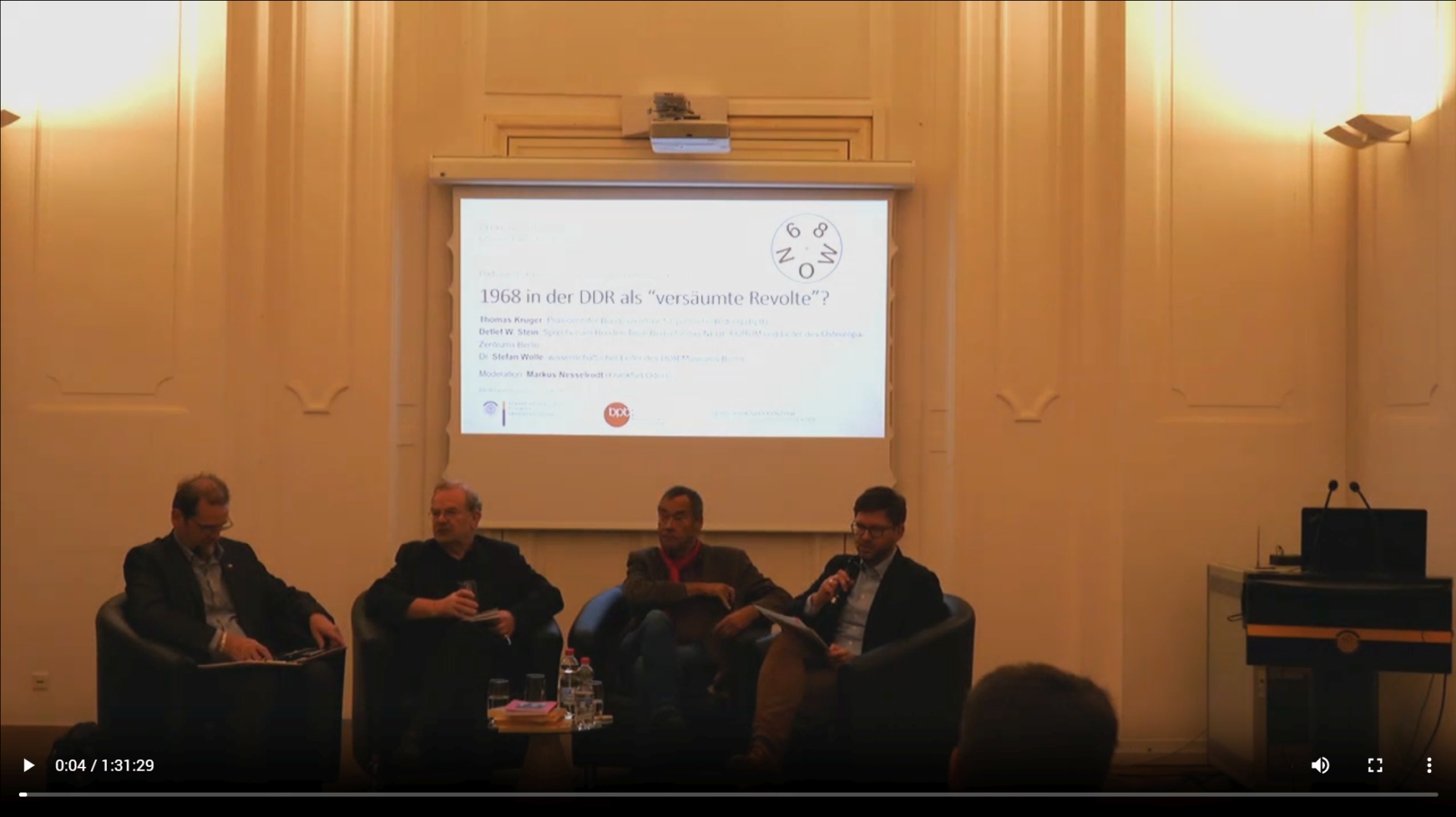
Place: European University Viadrina, Große Scharrnstr. 59, 15230 Frankfurt (Oder), HG 109
Time: 6.15 pm
Participants:
Thomas Krüger, President of the Federal Agency for Civic Education (Bundeszentrale für politische Bildung, bpb)
Detlef W. Stein, Spokesperson of the Berlin Round Table for the NEUES FORUM and Head of the East European Centre Berlin
Dr. Stefan Wolle, Academic Director of the DDR Museum Berlin
Moderation: Markus Nesselrodt (Frankfurt/Oder)
While the events of 1968 in the Federal Republic of Germany have been repeatedly discussed and revisited, developments in the German Democratic Republic during this period have received comparatively little attention. The attempt to establish a “socialism with a human face” during the Prague Spring in Czechoslovakia, and its violent suppression through the invasion of Warsaw Pact troops, has often overshadowed anti-authoritarian attitudes that undoubtedly also existed in the GDR. How did the events of 1968 in the Federal Republic of Germany and in Czechoslovakia resonate within the GDR? How did citizens respond, and how did the state authorities react? To what extent did left-wing anti-authoritarianism — for example in the work of Herbert Marcuse — pose a challenge to the GDR’s self-conception as a workers’ and peasants’ state?
► Click on the thumbnail to watch the recording of the panel discussion. 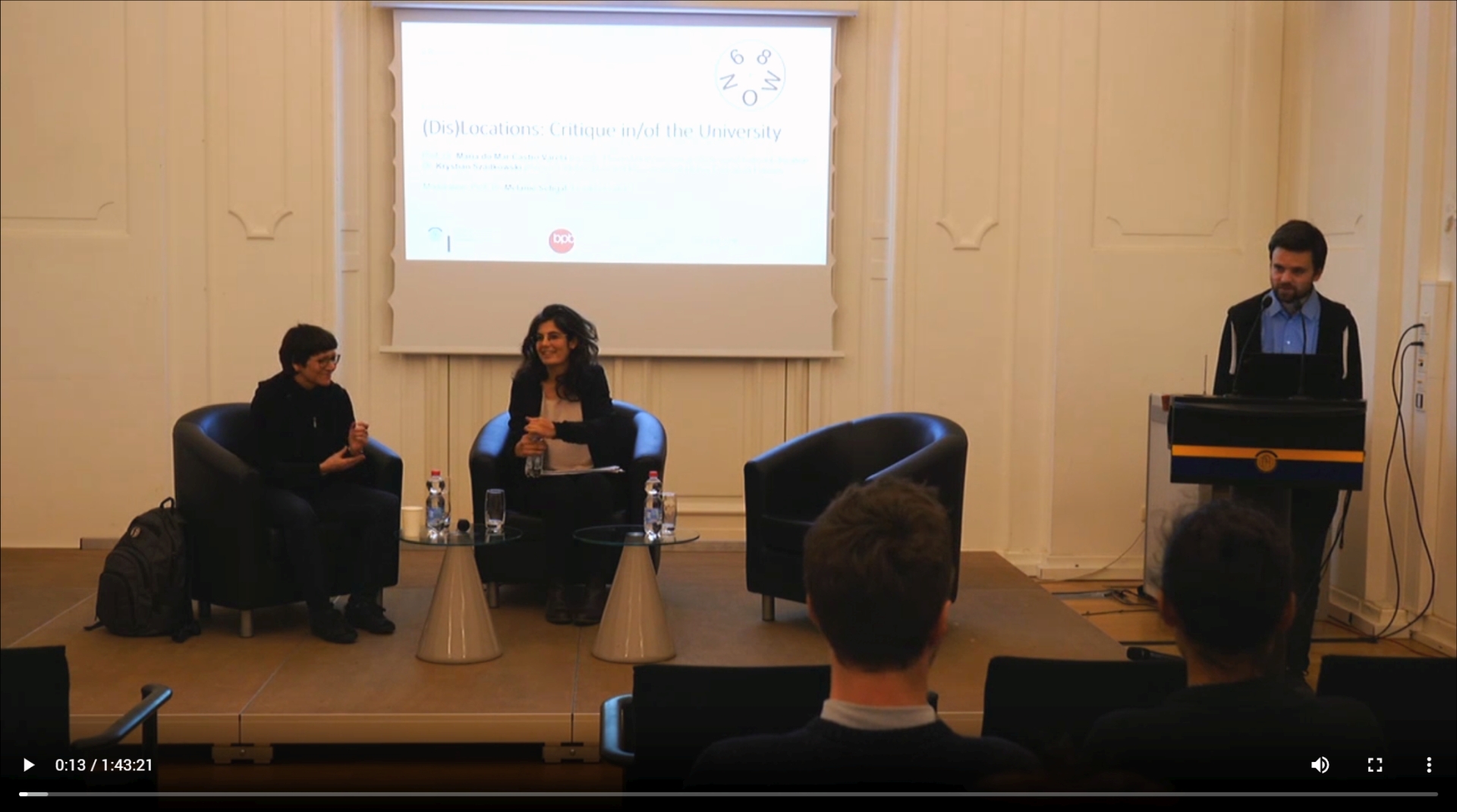
(Dis)Locations: Critique in/of the University
Location: European University Viadrina, Frankfurt (Oder), Große Scharrnstr. 59, 15230 Frankfurt (Oder), HG 109
Date and Time: November 6, 18:00.
Panelists:
Prof. Dr. María do Mar Castro Varela (Berlin)
Dr. Krystian Szadkowski (Poznan)
Moderation: Prof. Dr. Melanie Sehgal (Frankfurt/Oder)
Students' protests that peaked in 1968 turned the university into one of the epicenters of political struggle, that aimed to challenge its institutional boundaries. Later on the call for decolon(ial)izing knowledge as an instrument of oppression and critique of institutions of knowledge production found special resonance in the context of postcolonial theory, which aimed to connect this critique with the fundamental aspects of colonial experience. This anti-authoritarian gesture, however, considers not only the field of theoretical deliberations, but also the very (pedagogical) practice of various educational institutions, which have been facing the question about the relevance of education beyond the narrow field of students' professional specialization. Inter alia, the panel discussion will aim to raise the issues of social responsibility of the university, often packaged under such terms as "service-learning" and "third mission", as well as the general question of its function in contemporary society.
► Click on the thumbnail to watch the recording of the panel discussion. 
Polish Perspectives on ‘68: March Events and Antisemitic Campaign
Place: Jewish Museum Berlin / W. M. Blumenthal Akademie, Saal, Fromet-und-Moses-Mendelssohn-Platz 1, 10969 Berlin
Time: 7.00 pm
Panelists:
Lidia Drozdzynski, writer, journalist and film director (i.a. "Unsere Vertreibung 1968", 2008)
Dr. David Kowalski, historian (Berlin)
Prof. Dariusz Stola, director of POLIN Museum of the History of Polish Jews (Warsaw)
Michał Zadara, stage director (Warsaw)
Moderation: Katarzyna Wielga-Skolimowska (Munich)
The so-called Polish 1968 political crisis combined various aspects of the year 1968 together. Similarly to France, the GDR and later on Czechoslovakia student and social protests developed against the state authorities and the rigid political order. Student strikes at universities also turned them into one of the main spots of this protest. At the same time, the specificity of the Polish case of 68 consists in the fact that public student demonstrations against censorship (“We want culture without censorship!”) and the ban of the theater performance “Dziady” (Director: Kazimierz Dejmek) were countered with an antisemitic campaign, that affected significant parts of Polish society and forced several thousands of Polish Jews into exile.
► Click on the thumbnail to watch the recording of the panel discussion. 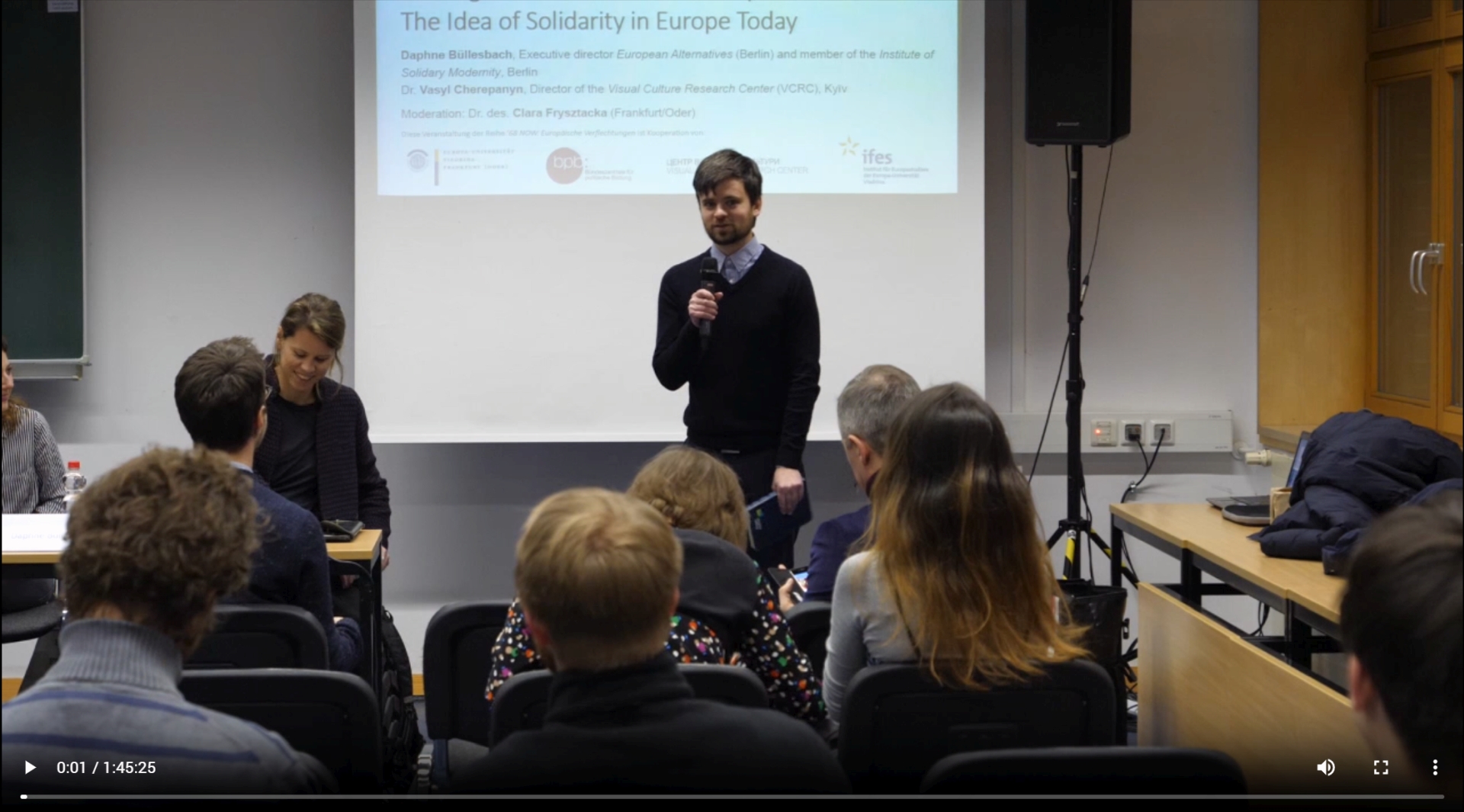
Date and time: 31 January 2019, 6.15 pm
Venue: European University Viadrina, Gräfin-Dönhoff-Gebäude, GD 102, Europaplatz 1, 15230 Frankfurt (Oder)
The project of common cosmopolitan Europe seems to be suffering from several challenges, that boil down to antagonistic tension between universalist claims and particularist interests. Under the conditions of growing political, economic and social inequalities, structural weaknesses of international institutions, and swiftly proliferating (ultra)conservative and illiberal tendencies, the logic of the nation-state is more and more often evoked in the struggle for an illusory restoration of the national sovereignty all across the European continent. This makes even the motto of the European Union - "Unity in diversity" - sound more like a challenge these days rather than a solution that paves the way for peaceful coexistence. In this regard, no deliberation on the future of Europe can avoid the issue of (international) solidarity, which always serves as the basis for any durable political engagement, as the experience of the 68 movement testifies.
The discussion at the European University Viadrina will revolve around the core notions of the project of common Europe, such as (local and transnational) democracy and (intersectional and international) solidarity, as well as civic and political engagement, all of which seem to remain as topical as they used to be during the events of 1968. Besides that, in a truly internationalist sense it remains necessary to think these categories not only within the institutional framework of the European Union, but also beyond it, feeding into the imaginaries of a cosmopolitical Europe, that is united by common political space with ample room for emancipatory action and active citizenship as well as sensitivity towards existing differences within it.
Participants of the panel discussion:
Daphne Büllesbach (Berlin), Executive director European Alternatives, Berlin, and member of the Institute of Solidary Modernity
Dr. Vasyl Cherepanyn (Kyïv), Head of the Visual Culture Research Center (VCRC) and an editor of Political Critique magazine (Ukrainian edition)
Moderation: Dr. des. Clara Frysztacka (Frankfurt/Oder)
On facebook you can find the event here.
The panel discussion is the opening event of the series “68 Now. European Entanglements”, that is organized in cooperation between European University Viadrina Frankfurt (Oder) and the Federal Agency for Civic Education (Bundeszentrale für politische Bildung (bpb) and in collaboration with Visual Culture Research Center, Kyiv (VCRC).
► Click on the thumbnail to watch the recording of the panel discussion. 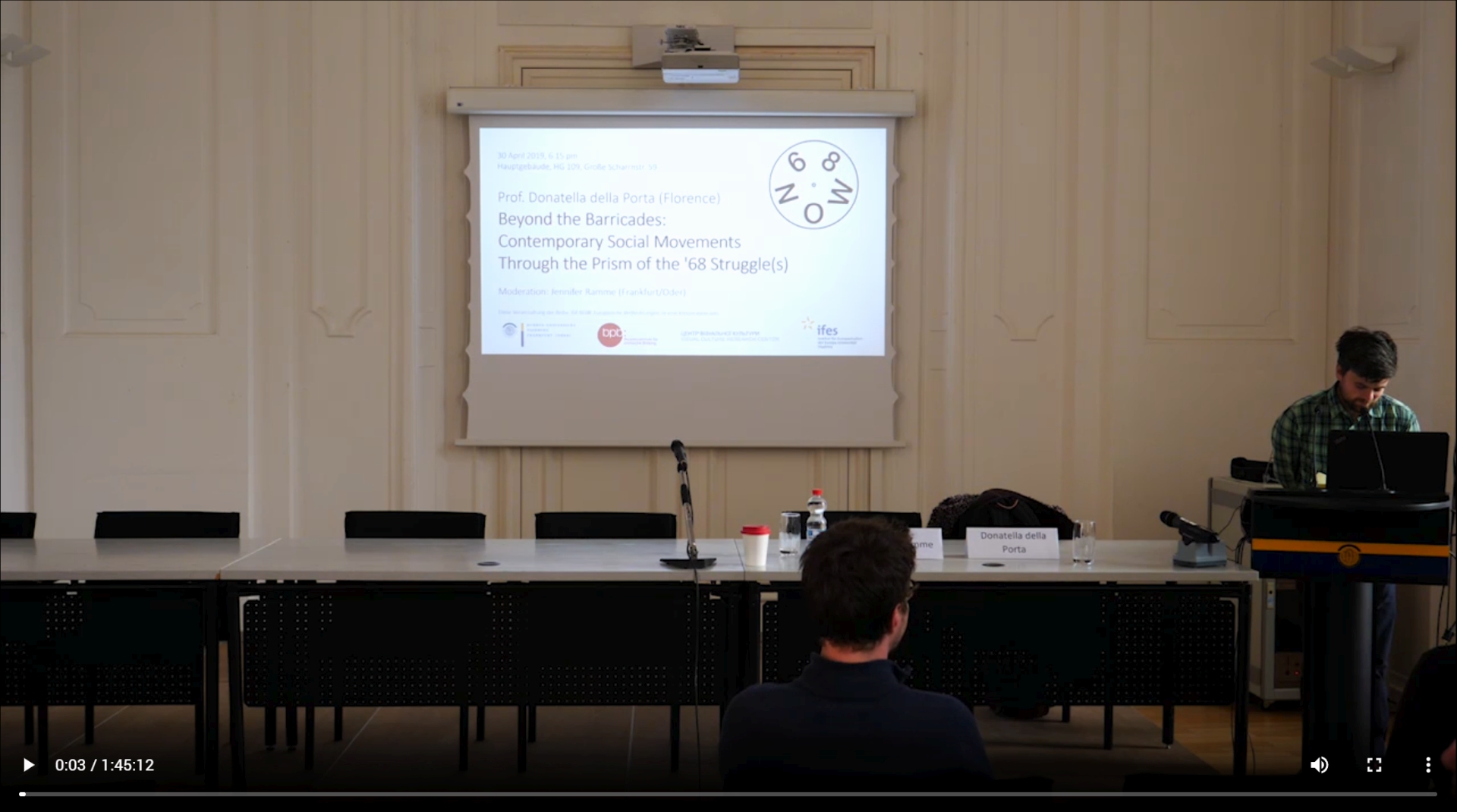
Prof. Donatella della Porta (Florence)
Beyond the Barricades: Contemporary Social Movements Through the Prism of the '68 Struggle(s)
Moderation: Jennifer Ramme (Frankfurt/Oder)
Location: European University Viadrina, Frankfurt (Oder), Senatssaal, HG 109, Große Scharrnstr. 59
Date and Time: 30 April 2019, 6.15 pm
Contemporary political condition can hardly be supplied with an adequate diagnosis without a proper account of the protest and activist culture that has developed itself during the last 50 years. A reflective gaze back to the events of 1968, that are widely considered as the cradle for new social movements, can serve as a good departure point for analyzing the evolution of the forms of non-institutional political participation and collective action from the eve of post-industrial economy to our days of rampant digitalization. This lens might allow to trace, how the calls for the long march through institutions and the rumble of street politics have still been echoed in the strategies of the recent socio-political protests in different parts
of the world. And even if it stays debatable, to which extent contemporary social movements can be considered as the agents of change and the harbingers of global democratic public sphere, their potentiality to undertake these roles remains acutely relevant today and, therefore, invites thorough interrogation.
Prof. Donatella della Porta (Florence) is a sociologist and political scientist, head of the Center on Social Movement Studies (Cosmos) at the Scuola Normale Superiore, Florenc.
The talk is part of the series of events „’68 NOW. Europäische Verflechtungen“ - a cooperation between Bundeszentrale für politische Bildung (bpb) and Europa-Universität Viadrina, Frankfurt (Oder), in collaboration with the Visual Culture Research Center (VCRC), Kyïv.
On facebook you can find the event here.
Public Discussion
Aesthetics of the Political. Exposing the Contingencies of Now
Ilya Budraitskis (Moscow), Political Theorist and Lecturer at the Moscow School of Social and Economic Sciences
Dr. Ulrike Kremeier (Cottbus/Frankfurt (Oder)), Director of Brandenburg State Museum for Modern Art (BLMK)
Moderation: Kirill Repin (Frankfurt/Oder)
Location: European University Viadrina, Frankfurt (Oder), AM 03, Logenstraße 4
Date and Time: 04 December 2019, 6.15 pm
When do arts and politics meet? Perhaps, the moment we can no longer distinguish between the two? Indeed, it is through destabilizing the (imaginary) boundary between them that the encounter of the aesthetic and the political appears to be at its most intense. And yet such mutual permeation can take different forms – from paintings to performances. Constantly testing, shifting and blurring the contours of socially acceptable and imaginable, (political) art and artistic practices expand the semantics of political (beauty) language and nurture alternative visions of organizing our collective being, that otherwise seem submerged under the multiplying images and routinized (re-)enactments of everyday normalcy. In these instances of aesthetic contestations the political starts to glimmer behind every notion of contemporaneity to remind us about that which is not (yet) fully present.
The discussion is part of the series of events „’68 NOW. Europäische Verflechtungen“ - a cooperation between Bundeszentrale für politische Bildung (bpb) and Europa-Universität Viadrina, Frankfurt (Oder), in collaboration with the Visual Culture Research Center (VCRC), Kyïv.
On facebook you can find the event here.
► Click on the thumbnail to watch the recording of the panel discussion. 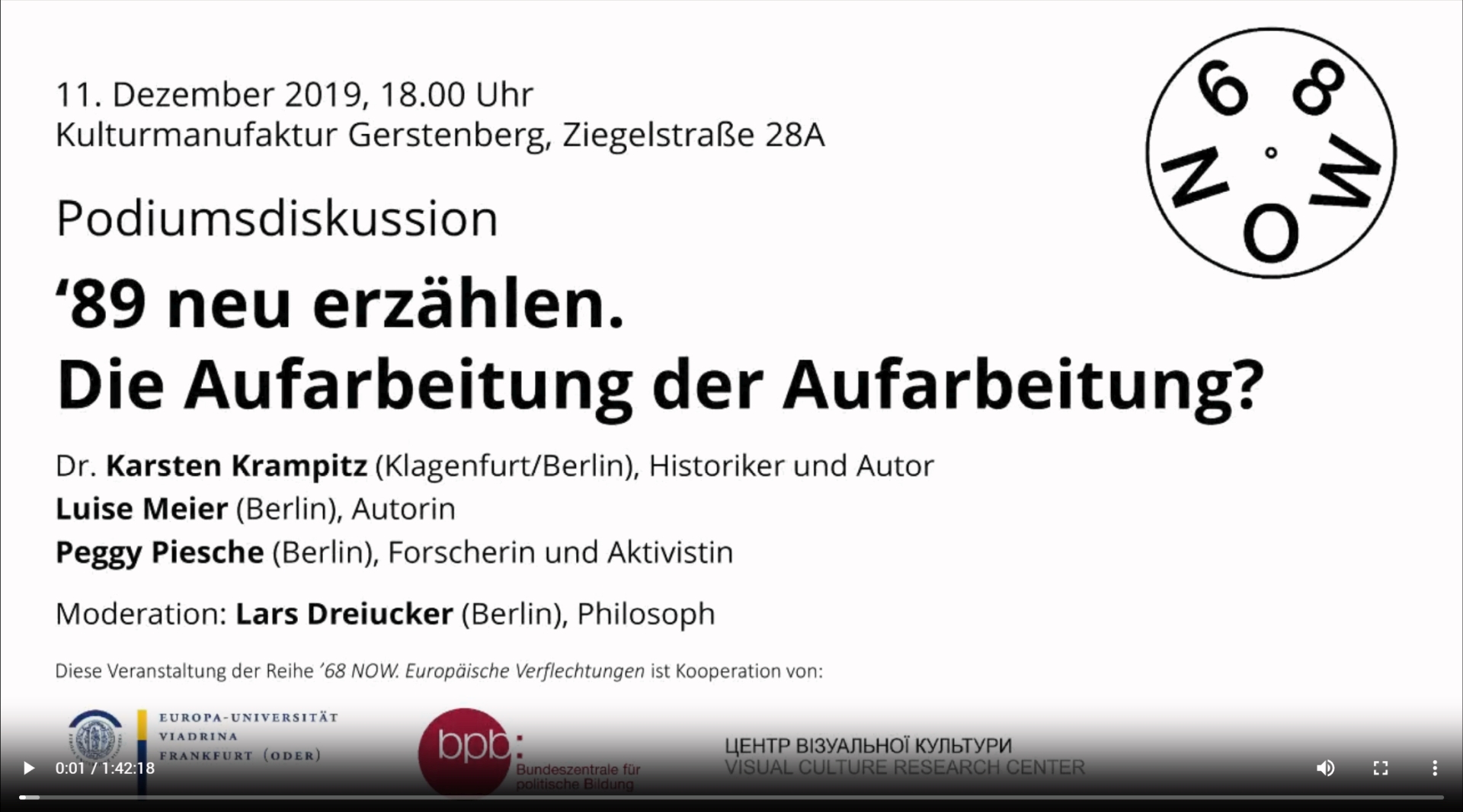
Dr. Karsten Krampitz (Klagenfurt/Berlin), historian and author
Luise Meier (Berlin), author
Peggy Piesche (Berlin), researcher and activist
Moderation: Lars Dreiucker (Berlin), philosopher
The commemorations marking the 30th anniversary of the fall of the Berlin Wall have come to an end. At the centre of the official remembrance stood the narrative of the peaceful revolution: symbolic walls were torn down and the steps towards (national) unity were celebrated. Which aspects of remembering the GDR are obscured by influential interpretative frameworks such as the notion of the “state of injustice” or the “second dictatorship”, and are further marginalised through processes of musealisation of ’89? To what extent do this selective perspective and the dominant imaginaries of ’89 (re-)construct a heteronormative “we”, serving as a form of self-affirmation for an uncritical majority society?
A deconstruction of the “text of ’89” would reveal gaps in the prevailing memory discourse and thus point to possibilities for engaging productively with the “Wende” — if “democracy is understood as an unfinished process” (Okwui Enwezor), which, like ’89 as an emancipatory movement as a whole, resists reductive forms of musealisation. How might we “think memory intersectionally” (Peggy Piesche), and what could be learned from the resulting plural ’89s?
On Facebook you can find the event here.
The panel discussion is part of the event series “’68 NOW. European Entanglements” – a cooperation between the Federal Agency for Civic Education (Bundeszentrale für politische Bildung, bpb) and the European University Viadrina, Frankfurt (Oder), in collaboration with the Visual Culture Research Center (VCRC), Kyïv.
The series builds on the Kyiv-based project THE KYIV INTERNATIONAL – ’68 NOW by the VCRC: http://vcrc.org.ua/en/68-now/
► Click on the thumbnail to watch the recording of the panel discussion. 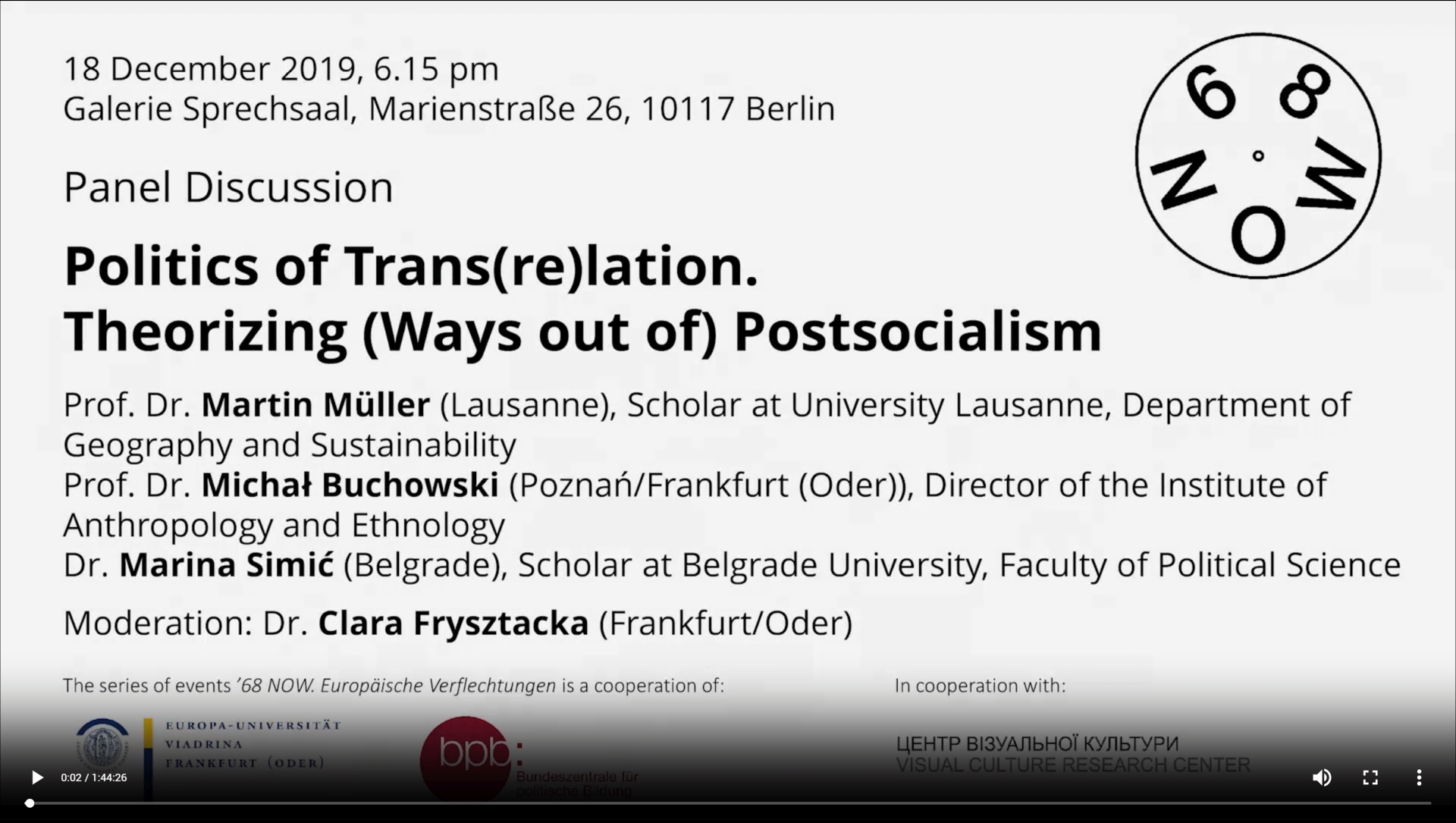
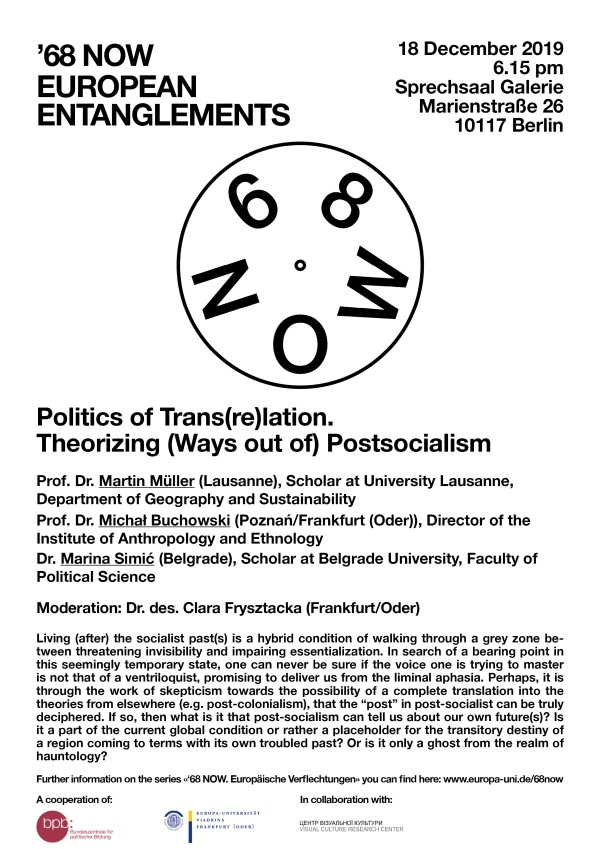 Panel Discussion
Date & Time: 18 December 2019, 6.15 pm
Venue: Sprechsaal Galerie, Marienstraße 26, 10117 Berlin
Politics of Trans(re)lation. Theorizing (Ways out of) Postsocialism
Prof. Dr. Martin Müller (Lausanne), Scholar at University Lausanne, Department of Geography and Sustainability
Prof. Dr. Michał Buchowski (Poznań/Frankfurt (Oder)), Director of the Institute of Anthropology and Ethnology
Dr. Marina Simić (Belgrade), Scholar at Belgrade University, Department of Political Science
Moderation: Dr. des. Clara Frysztacka (Frankfurt/Oder)
Living (after) the socialist past(s) is a hybrid condition of walking through a grey zone between threatening invisibility and impairing essentialization. In search of a bearing point in this seemingly temporary state, one can never be sure if the voice one is trying to master is not that of a ventriloquist, promising to deliver us from the liminal aphasia. Perhaps, it is through the work of skepticism towards the possibility of a complete translation into the theories from elsewhere (e.g. post-colonialism), that the “post” in post-socialist can be truly deciphered. If so, then what is it that post-socialism can tell us about our own future(s)? Is it a part of the current global condition or rather a placeholder for the transitory destiny of a region coming to terms with its own troubled past? Or is it only a ghost from the realm of hauntology?
The panel discussion is part of the series of events „’68 NOW. Europäische Verflechtungen“ - a cooperation between Bundeszentrale für politische Bildung (bpb) and Europa-Universität Viadrina, in collaboration with the Visual Culture Research Center (VCRC), Kyïv.