
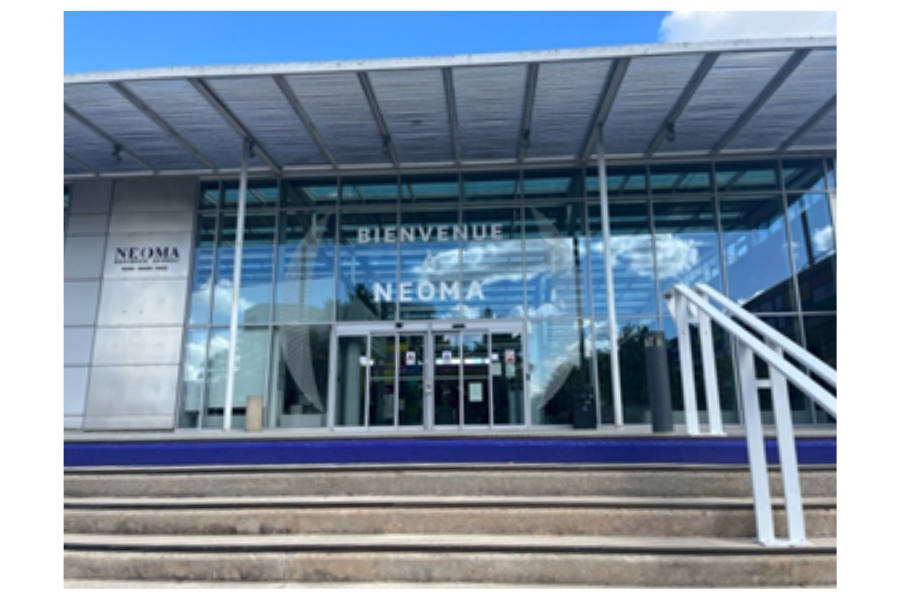
EN: NEOMA Business School (Reims): "I felt like I learned a lot during that time and the NEOMA Reims campus was also a great choice."
Internationale Betriebswirtschaftslehre (BA)
The link to the full experience report.
Preparation
The most complicated part in preparing for the exchange semester was gathering all the documents needed for the visa. As I am not an EU citizen and did not have the student Aufenthaltstitel, I had to apply for a student visa for France. Unfortunately, the only consulate in Germany that processed them was in Frankfurt am Main, so I had to travel there in person and pay a fee of 100 euros. The application required many documents, but it was easy to get an appointment at the consulate, and my passport with the visa was sent back to me by post after about two weeks.
Regarding health insurance, my German AOK remained valid in France. However, when I visited an eye doctor in France, I had to pay for it myself. Only later, after returning to Germany, I could submit a reimbursement request per post to receive the refund from AOK. They needed all the printed materials from the consultation as well as the receipts, so it’s better to keep them.
To get to France, I chose the most affordable option: a night FlixBus from Berlin directly to Reims, which took about 12 hours. It’s definitely a long trip, but it was rather comfortable nevertheless :)
The application process for NEOMA was pretty simple and also well organized. One of the best aspects was that there were many available places for exchange students that year, and this made it possible for me to be accepted together with three of my friends, which made the transition to France much easier.
At the beginning of the semester, NEOMA organized one orientation day. It took place only after the first week of classes and was not mandatory. There was also a buddy program where we could be paired with local students who could answer questions about the uni. Overall, everyone I met was really friendly and welcoming, despite this common stereotype about the unfriendliness of the French. However, it is true that for a lot of locals talking in English was pretty difficult and they switched to French (from students to most of the workers at student dorms).
Privat
Accommodation
I applied for student housing provided by CROUS. NEOMA sent an email to all the students about the dorms we’re eligible for and also explained the application process very well. My main recommendation is to apply immediately when the registration opens, because places fill up quickly. I stayed at the Residence Paul Fort, which was a good option for the four months I spent in Reims.
The room itself was very small, 9 square meters, but still, the good thing is that it was a private one. I also had my own small shower and a toilet, although the kitchen was shared with other students on each floor. The rent there was very affordable, 296 euros per month.
One of the biggest benefits of living there was that the student canteen was directly in the same building and we could eat without even leaving the dormitory. Normally, a full meal there costs a little over 3 euros, but students receiving scholarships can apply for a special reduced price. After writing to the support team through Izly (the app needed to pay for meals) and sending proof of my Erasmus scholarship, I was allowed to pay only 1 euro per meal. Each meal included a main dish, a snack, bread, dessert, and either cheese or yogurt, and on most days the canteen served not only lunch, but dinner too.
Another advantage was the location. NEOMA had two campuses in Reims (from September 2027 it will have three, as far as I know), and my residence was only five minutes away from the campus where I had almost all of my lectures. This was because I chose master-level courses, and they were mostly taught there. The city center was also very easy to get to, about ten minutes by tram or around 30-40 minutes on foot.
However, there were the downsides. The room was extremely small, which meant that I often preferred studying in cafés or other places instead of staying in my room. For a four-month stay this was fine, but I think I wouldn’t stay there for a longer period.
Also, the dormitory staff in France is allowed to enter rooms whenever they need to (or want to). During my stay, they entered my room about five times, for example to check for bed bugs or to replace the door lock system. They could come early in the morning and would never announce it in advance. Once, I ordered a package, and when I returned home, someone had already come into my room and put it directly on my table (still, I though the fact they accepted the parcel was good, because according to the dormitory policies, we are not allowed to order anything there).
Overall, I would still recommend this dorm, especially for those who want to save money on rent and food and live very close to the second campus. The most vibrant and exciting area to live in, however, is around Vesle or Opéra Cathédrale. It’s basically the city center, and there are many cafés and restaurants.
We could also apply for CAF, a French housing subsidy that reimburses part of the rent. Officially it is intended for longer stays, but some students I met were able to receive it even for a single semester. In addition, we had to buy a housing insurance before arrival, which cost about 30 euros for the entire stay. NEOMA gave us all the needed information sessions before the semester, and they also recommended some insurance companies there.
Studies at NEOMA Business School
During the semester, I took five courses in total: four business courses and one French language course. The business courses included Investments, Financial Decisions under Uncertainty, Predictive Analytics with AI and Machine Learning, and Algorithmic Thinking for Data Analysis. Attendance was mandatory for all of them. We had to scan a QR code during each class, and were allowed to skip only 2-3 classes per semester.
Although I took five courses, which was already considered quite a lot compared to most exchange students, my weekly schedule was really relaxed. Most weeks I had classes only two or three days per week. Sometimes this felt like a lot of free time, and occasionally I wished the schedule would be a bit more intensive.
One of the best decisions I made was choosing master-level courses, even though I am a bachelor student. At NEOMA this is possible for exchange students and I definitely recommend doing this. Many bachelor courses covered basic concepts that I had already learned in detail at Viadrina, while the master courses were much more specialized and interesting.
The grading system at NEOMA differed from what I was used to. Most courses included midterm and final exams, which were usually taken on personal laptops that we had to bring themselves. It was mostly allowed to bring printed and/or handwritten materials. Around 50% of the final grade came from assignments during the semester, like group projects or online tests.
The teaching quality was very good overall. The professors were welcoming, friendly, and happy to answer questions. In addition to the main courses, NEOMA offered different language classes, not only the French ones, but I personally took a “French for Business B2”, and the teacher there was wonderful.
Summing up, I definitely enjoyed studying at NEOMA and felt that exchange students were well supported by the university team.
Daily Life and Leisure
For public transport, I purchased a monthly tram student ticket for about 20 euros, which was the cheapest one and definitely necessary to get around the city. Unfortunately, unlike Germany, there is no equivalent to the Deutschlandticket that allows to travel by trains affordably. The cheapest way to travel to Paris, which is only one hour away, was a FlixBus, where I could often find tickets for around 10 euros one way.
Meals at canteens were very affordable, especially with the 1-euro meal option for scholarship students. Supermarket prices were slightly higher than in Frankfurt (Oder) and meals in restaurants or coffee at cafés cost about the same as in Berlin.
Personally, I ended up spending a lot more money than in Frankfurt (Oder) during my stay in Reims. However, this was largely because I preferred going to cafés and spending a lot of time outside due to the small size of my room and wanting to experience the city. It would definitely be possible to live more cheaply, for example with approximately 200 euros per month for food and 300-400 euros for rent.
Reims is a beautiful city with many wonderful streets and places that are perfect for long walks. There are great cafés for having a coffee and studying, for example Birds & Twigs and Mamatte. Another great option to study in is the Médiathèque, which is a big and very popular library, where there are always a lot of students.
Conclusion
My exchange semester at NEOMA in Reims was a great experience. One of the best decisions I made was choosing master-level courses instead of the bachelor ones. I felt like I learned a lot during that time and the NEOMA Reims campus was also a great choice. The atmosphere was beautiful and the proximity of Reims to Paris made it easy to take day trips there.
If I definitely had to pick one downside, it would be the schedule. I did feel like the time was spent ineffectively on some days, because the classes I had were almost always all stacked up only on Monday and Tuesday. But this can surely be an upside too :)
Beitrag teilen: